

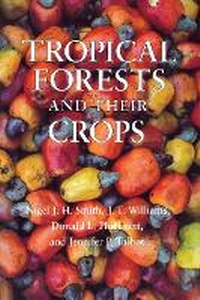
Tropical Forests and Their Crops
Published on 24. December 1992
Book
Hardback
584 pages
978-0-8014-2771-8 (ISBN)
Description
The tropics are the source of many of our familiar fruits, vegetables, oils, and spice, as well as such commodities as rubber and wood. Moreover, other tropical fruits and vegetables are being introduced into our markets to offer variety to our diet. Now, as tropical forests are increasingly threatened, we face a double-fold crisis: not only the loss of the plants but also rich pools of potentially useful genes. Wild populations of crop plants harbor genes that can improve the productivity and disease resistance of cultivated crops, many of which are vital to developing economies and to global commerce. Eight chapters of this book are devoted to a variety of tropical crops-beverages, fruit, starch, oil, resins, fuelwood, fodder, spices, timber, and nuts-the history of their domestication, their uses today, and the known extent of their gene pools, both domesticated and wild. Drawing on broad research, the authors also consider conservation strategies such as parks and reserves, corporate holdings, gene banks and tissue culture collections, and debt-for-nature swaps. They stress the need for a sensitive balance between conservation and the economic well-being of local populations. If economic growth is part of the conservation effort, local populations and governments will be more strongly motivated to save their natural resources. Distinctly practical and soundly informative, this book provides insight into the overwhelming abundance of tropical forests, an unsettling sense of what we may lose if they are destroyed, and a deep appreciation for the delicate relationships between tropical forest plants and people around the world.
Reviews / Votes
"This splendid book does much to remind us of the most significant legacy of the tropical rainforests. As repositories of germ plasm, sources of new crops and natural products, living laboratories where human ingenuity derives sustenance from the wild, these ancient forests serve not only the living but all the generations yet unborn. A vital book." -- Wade Davis, author of <I>The Serpent and the Rainbow</I>More details
Language
English
Place of publication
Ithaca
United States
Target group
College/higher education
Product notice
Paper over boards
Illustrations
24 maps, 80 halftones, 8 line drawings, 2 charts - 24 Maps
Dimensions
Height: 235 mm
Width: 155 mm
Thickness: 38 mm
Weight
1361 gr
ISBN-13
978-0-8014-2771-8 (9780801427718)
Copyright in bibliographic data and cover images is held by Nielsen Book Services Limited or by the publishers or by their respective licensors: all rights reserved.
Schweitzer Classification
Other editions
Additional editions
Nigel J. H. Smith | J. T. Williams | Donald L. Plucknett
Tropical Forests and Their Crops
E-Book
05/2018
1st Edition
Cornell University Press
€162.99
Available for download
Persons
Nigel J. H. Smith is Professor of Geography at the University of Florida. J. T. Williams is a consultant on international agricultural research. Donald L. Plunknett is Scientific Adviser, Consultative Group on International Agricultural Research (CGIAR), with the World Bank. Jennifer P. Talbot is a graduate student at Washington University.
Content
1. A Threatened Resource
Distribution and composition of tropical forests
Centers of diversity
Biodiversity, deforestation, and population growth
Driving forces
Crop gene pools2. Beverage and Confectionery Crops
Coffee
Cacao
Cupuafu3. Major Fruits of the Forest
Mango
Citrus
Pineapple
Avocado
Guava
Papaya
Sapodilla
Passionfruit4. Regional Fruits
Durian
Rambutan
Annonaceous fruits
African plum
Indian jujube5. Rubber, Oils, and Resins
Rubber
Oil palm
Balsams
Tropical pines6. Daily Bread
Bananas and plantains
Breadfruit
Peach palm
Sago palm7. Fuelwood, Fodder, and Woody Grasses
Leucaena
Bamboos8. Spices and Natural Food Colorants
Clove
Cinnamon and cassia
Vanilla
Annatto9. Nuts
Cashew
Brazil nut
Macadamia10. A New Cornucopia
The plant domestication process
A starting point for the search
Some crop candidates
Prospects for adoption11. Conservation Strategies
Ex situ conservation
In situ conservation12. Realizing the Potential
Conservation and sustainable development
Secure resource bases
Reaping the harvest
Research priorities for marginal lands
The quarantine bottleneck
Personnel requirements
Finding a way forwardAppendix 1. Domesticated Perennial Species with Wild Populations in Tropical Forests
Appendix 2. Abbreviations of Institutions Involved in Collecting, Maintaining, andlor Breeding Tropical Perennial
Crops
Appendix 3. Common Names and Distribution of Avocado's Relatives
Appendix 4. Avocado Accessions in Germplasm CollectionsReferences
Index
Distribution and composition of tropical forests
Centers of diversity
Biodiversity, deforestation, and population growth
Driving forces
Crop gene pools2. Beverage and Confectionery Crops
Coffee
Cacao
Cupuafu3. Major Fruits of the Forest
Mango
Citrus
Pineapple
Avocado
Guava
Papaya
Sapodilla
Passionfruit4. Regional Fruits
Durian
Rambutan
Annonaceous fruits
African plum
Indian jujube5. Rubber, Oils, and Resins
Rubber
Oil palm
Balsams
Tropical pines6. Daily Bread
Bananas and plantains
Breadfruit
Peach palm
Sago palm7. Fuelwood, Fodder, and Woody Grasses
Leucaena
Bamboos8. Spices and Natural Food Colorants
Clove
Cinnamon and cassia
Vanilla
Annatto9. Nuts
Cashew
Brazil nut
Macadamia10. A New Cornucopia
The plant domestication process
A starting point for the search
Some crop candidates
Prospects for adoption11. Conservation Strategies
Ex situ conservation
In situ conservation12. Realizing the Potential
Conservation and sustainable development
Secure resource bases
Reaping the harvest
Research priorities for marginal lands
The quarantine bottleneck
Personnel requirements
Finding a way forwardAppendix 1. Domesticated Perennial Species with Wild Populations in Tropical Forests
Appendix 2. Abbreviations of Institutions Involved in Collecting, Maintaining, andlor Breeding Tropical Perennial
Crops
Appendix 3. Common Names and Distribution of Avocado's Relatives
Appendix 4. Avocado Accessions in Germplasm CollectionsReferences
Index