

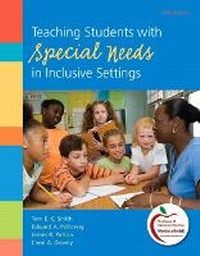
Teaching Students with Special Needs in Inclusive Settings Plus NEW MyEducationLab with Pearson eText -- Access Card Package
6th Edition
Published on 1. August 2012
Book
Mixed media product
608 pages
978-0-13-299532-0 (ISBN)
Description
ALERT: Before you purchase, check with your instructor or review your course syllabus to ensure that you select the correct ISBN. Several versions of Pearson's MyLab & Mastering products exist for each title, including customized versions for individual schools, and registrations are not transferable. In addition, you may need a CourseID, provided by your instructor, to register for and use Pearson's MyLab & Mastering products.
Packages
Access codes for Pearson's MyLab & Mastering products may not be included when purchasing or renting from companies other than Pearson; check with the seller before completing your purchase.
Used or rental books
If you rent or purchase a used book with an access code, the access code may have been redeemed previously and you may have to purchase a new access code.
Access codes
Access codes that are purchased from sellers other than Pearson carry a higher risk of being either the wrong ISBN or a previously redeemed code. Check with the seller prior to purchase.
--This highly praised text takes a categorical approach to covering the opportunities and challenges in creating inclusive classrooms for all students. IEP coverage, new material on Response to Intervention, chapters on both elementary and secondary classrooms as well as new features on differentiating instruction in both elementary and secondary classrooms provide the most coverage in the field of the instructional processes general education teachers will need to know to address the needs of all learners.
Packages
Access codes for Pearson's MyLab & Mastering products may not be included when purchasing or renting from companies other than Pearson; check with the seller before completing your purchase.
Used or rental books
If you rent or purchase a used book with an access code, the access code may have been redeemed previously and you may have to purchase a new access code.
Access codes
Access codes that are purchased from sellers other than Pearson carry a higher risk of being either the wrong ISBN or a previously redeemed code. Check with the seller prior to purchase.
--This highly praised text takes a categorical approach to covering the opportunities and challenges in creating inclusive classrooms for all students. IEP coverage, new material on Response to Intervention, chapters on both elementary and secondary classrooms as well as new features on differentiating instruction in both elementary and secondary classrooms provide the most coverage in the field of the instructional processes general education teachers will need to know to address the needs of all learners.
Reviews / Votes
I believe that the authors' approach to the subject matter is practical and presented in a manner that makes the reader want to read the book from front to back.Mary Darlene Hilsenbeck, University of Louisville
The readability is ideal for the undergraduate student. It contains enough theoretical, research-based information to be a strong text. It also contains practical information that students will want to retain this text as they become practitioners. The organization of the book is ideal. The included standards are ideal as students study for state certification exams. "Technology Today", "Rights & Responsibilities", and "Evidence-Based Practice" are gems of information.
Glenna Bilingsley, Texas State University - San Marcos
The application connection couldn't be any better than what your authors have put together for the reader and future teacher. I am very impressed with the wealth of information and suggestions your authors have provided for the reader that cover almost every aspect of learning disabilities. This book helps teachers use the tools they have to de3velop their students into productive members of society and prepare them for the future. The information just flowed and all came together outlining an effective inclusive program for students with disabilities and the best practices to prepare students for their future.
Shirley MacKinnon, Canisius College
More details
Edition
6th edition
Language
English
Place of publication
United States
Publishing group
Pearson Education (US)
Target group
Professional and scholarly
Weight
1134 gr
ISBN-13
978-0-13-299532-0 (9780132995320)
Copyright in bibliographic data is held by Nielsen Book Services Limited or its licensors: all rights reserved.
Schweitzer Classification
Other editions
Previous edition
Tom E. Smith | Edward A. Polloway | James R. Patton
Teaching Students with Special Needs in Inclusive Settings
Book
04/2007
5th Edition
Pearson
€94.27
Article exhausted; check for reprint
Persons
Tom E. C. Smith is currently Dean of the College of Education and Health Professions, and University Professor of Special Education at the University of Arkansas. He has been on the faculties of the University of Arkansas at Little Rock, University of Alabama at Birmingham, and the University of Arkansas for Medical Sciences. Prior to receiving his Ed. D. from Texas Tech University, he taught children with intellectual disabilities, learning disabilities, and autism at the elementary and secondary levels. President Clinton appointed him to three terms on the President's Committee on Mental Retardation. He has served as the Executive Director of the Division on Autism and Developmental Disabilities of the Council for Exceptional Children since 1996. His current professional interests focus on teacher education and legal issues and special education.
Edward A. Polloway is the Rosel H. Schewel Professor of Education and Human Development at Lynchburg College in Virginia, where he has taught since 1976. He also serves as Vice President for Community Advancement and Dean of Graduate Studies. He received his doctoral degree from the University of Virginia and his undergraduate degree from Dickinson College in Pennsylvania. He has served twice as president of the Division on Mental Retardation and Developmental Disabilities of the Council for Exceptional Children and also on the board of directors of the Council for Learning Disabilities. He also served on the committee that developed the 1992 definition of mental retardation for the American Association on Intellectual Disabilities. He is the author of 20 books and over 100 articles n the field of special education with primary interests in the areas of learning disabilities and intellectual disabilities.
James R. Patton is an Educational Consultant and Adjunct Associate Professor at the University of Texas at Austin. He received his Ed. D. from the University of Virginia. He is a former high school biology teacher and elementary-level special education resource teacher. He has also taught students who were gifted and those who were gifted/learning disabled. His professional interests include transition, life skills instruction, adult issues related to individuals with special needs, behavior intervention planning, and classroom accommodations. He has served on national boards of the Division on Developmental Disabilities, the Council for Learning Disabilities, and the National Joint Committee on Learning Disabilities.
Carol A. Dowdy is Professor Emerita of Special Education at the University of Alabama at Birmingham, where she has taught since receiving her Ed. D. degree from the University of Alabama, Tuscaloosa. She has written eight books on special education and published 34 articles on learning disabilities. She has served on the national board of the Council for Learning Disabilities and the Professional Advisory Board for the Learning Disabilities Association of America, and she has worked closely with the federal department of Vocational Rehabilitation to assist in their efforts to better serve adults with learning disabilities.
Edward A. Polloway is the Rosel H. Schewel Professor of Education and Human Development at Lynchburg College in Virginia, where he has taught since 1976. He also serves as Vice President for Community Advancement and Dean of Graduate Studies. He received his doctoral degree from the University of Virginia and his undergraduate degree from Dickinson College in Pennsylvania. He has served twice as president of the Division on Mental Retardation and Developmental Disabilities of the Council for Exceptional Children and also on the board of directors of the Council for Learning Disabilities. He also served on the committee that developed the 1992 definition of mental retardation for the American Association on Intellectual Disabilities. He is the author of 20 books and over 100 articles n the field of special education with primary interests in the areas of learning disabilities and intellectual disabilities.
James R. Patton is an Educational Consultant and Adjunct Associate Professor at the University of Texas at Austin. He received his Ed. D. from the University of Virginia. He is a former high school biology teacher and elementary-level special education resource teacher. He has also taught students who were gifted and those who were gifted/learning disabled. His professional interests include transition, life skills instruction, adult issues related to individuals with special needs, behavior intervention planning, and classroom accommodations. He has served on national boards of the Division on Developmental Disabilities, the Council for Learning Disabilities, and the National Joint Committee on Learning Disabilities.
Carol A. Dowdy is Professor Emerita of Special Education at the University of Alabama at Birmingham, where she has taught since receiving her Ed. D. degree from the University of Alabama, Tuscaloosa. She has written eight books on special education and published 34 articles on learning disabilities. She has served on the national board of the Council for Learning Disabilities and the Professional Advisory Board for the Learning Disabilities Association of America, and she has worked closely with the federal department of Vocational Rehabilitation to assist in their efforts to better serve adults with learning disabilities.
Content
Part 1: Foundations of Inclusion
1. Inclusive Education: An Introduction
2. Professional and Home-School Collaboration
3. Identifying and Programming for Student Needs
4. Managing and Differentiating Classrooms
Part 2: Teaching Students with Special Needs
5. Teaching Students with Learning Disabilities 6. Teaching Students with Emotional and Behavioral Disorders
7. Teaching Students with Intellectual Disabilities
8. Teaching Students with attention Deficit/Hyperactivity Disorders
9. Teaching Students with Autism Spectrum Disorders
10. Teaching Students with Sensory Impairments
11. Teaching Students with Low-Incidence Disabilities
12. Teaching Students with Speech and Language Disorders
13. Teaching Students with Special Gifts and Talents
14. Teaching Students who are At Risk
Part 3: Applying Inclusive Practice
15. Teaching Students with Special Needs in Elementary Schools
16. Teaching Students with Special Needs in Secondary Schools
Appendix
Sample IEP for an Elementary Student
Sample IEP for a Middle School Student
Sample IEP for a Secondary School Student
1. Inclusive Education: An Introduction
2. Professional and Home-School Collaboration
3. Identifying and Programming for Student Needs
4. Managing and Differentiating Classrooms
Part 2: Teaching Students with Special Needs
5. Teaching Students with Learning Disabilities 6. Teaching Students with Emotional and Behavioral Disorders
7. Teaching Students with Intellectual Disabilities
8. Teaching Students with attention Deficit/Hyperactivity Disorders
9. Teaching Students with Autism Spectrum Disorders
10. Teaching Students with Sensory Impairments
11. Teaching Students with Low-Incidence Disabilities
12. Teaching Students with Speech and Language Disorders
13. Teaching Students with Special Gifts and Talents
14. Teaching Students who are At Risk
Part 3: Applying Inclusive Practice
15. Teaching Students with Special Needs in Elementary Schools
16. Teaching Students with Special Needs in Secondary Schools
Appendix
Sample IEP for an Elementary Student
Sample IEP for a Middle School Student
Sample IEP for a Secondary School Student