

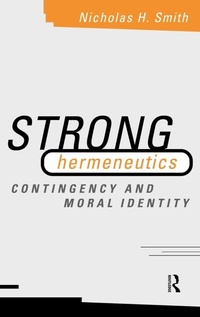
Strong Hermeneutics
Contingency and Moral Identity
1st Edition
Published on 28. August 1997
Book
Hardback
208 pages
978-0-415-16431-3 (ISBN)
Description
Recent years have seen a resurgence of interest in ethics, particularly in the approaches of deconstruction and hermeneutics. At the same time, questions of identity have risen to prominence in philosophy and beyond into cultural studies and literature.
Strong Hermeneutics is a clear and accessible investigation of both the enlightenment and postmodern or 'weak' approaches to contemporary discussions of ethics. The weak view, which can be traced back to Nietzche and seen in the recent work of Rorty and Lyotard, is sceptical of any universal principles in ethics. The enlightenment view, starting with Kant and more recently seen in the work of Habermas, views identity as subject to universal but formal moral constraints, the renewing of which is the proper task of ethics.
Nicholas Smith argues that neither of these views can provide a proper framework for ethics. He puts forward a third position - a strong hermeneutics - drawing on the work of Hans-Georg Gadamer, Paul Ricoeur and Charles Taylor. Strong Hermeneutics presents a defence of this view, compares it with the realism and anti-realism debate in philosophy, and demonstrates its relevance to contemporary issues, particularly ecological responsibility.
Strong Hermeneutics is a clear and accessible investigation of both the enlightenment and postmodern or 'weak' approaches to contemporary discussions of ethics. The weak view, which can be traced back to Nietzche and seen in the recent work of Rorty and Lyotard, is sceptical of any universal principles in ethics. The enlightenment view, starting with Kant and more recently seen in the work of Habermas, views identity as subject to universal but formal moral constraints, the renewing of which is the proper task of ethics.
Nicholas Smith argues that neither of these views can provide a proper framework for ethics. He puts forward a third position - a strong hermeneutics - drawing on the work of Hans-Georg Gadamer, Paul Ricoeur and Charles Taylor. Strong Hermeneutics presents a defence of this view, compares it with the realism and anti-realism debate in philosophy, and demonstrates its relevance to contemporary issues, particularly ecological responsibility.
More details
Language
English
Place of publication
London
United Kingdom
Publishing group
Taylor & Francis Ltd
Target group
College/higher education
Postgraduate
Dimensions
Height: 240 mm
Width: 161 mm
Thickness: 16 mm
Weight
482 gr
ISBN-13
978-0-415-16431-3 (9780415164313)
Copyright in bibliographic data and cover images is held by Nielsen Book Services Limited or by the publishers or by their respective licensors: all rights reserved.
Schweitzer Classification
Other editions
Additional editions
E-Book
09/2002
1st Edition
Routledge
€65.99
Available for download
E-Book
09/2002
1st Edition
Routledge
€65.99
Available for download
Book
08/1997
1st Edition
Routledge
€72.60
Shipment within 15-20 days
Person
Nicholas H. Smith is a Lecturer in Philosophy at Macquarie University, Sydney.
Content
Introduction; Chapter 1 The variety of hermeneutics; Chapter 2 Strong hermeneutics and the contingency of self; Chapter 3 Interpretation, practical reason and tradition; Chapter 4 Deep hermeneutics, emancipation and fate; Chapter 5 Communication and the contingency of language; Chapter 6 Strong hermeneutics and discourse ethics; Chapter 7 The ecological politics of strong hermeneutics;