

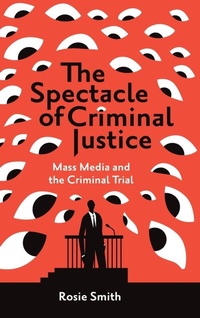
The Spectacle of Criminal Justice
Mass Media and the Criminal Trial
Published on 29. March 2022
Book
Hardback
160 pages
978-1-83982-823-2 (ISBN)
Description
In a world defined by and lived through media spectacle, nearly every part of human existence can now be documented, watched, and scrutinised. When mass media has the power to make the mundane not only visible but also entertaining, how have issues surrounding criminal justice, crime, and death taken centre stage in this media-saturated social world?
Presenting for the first time in a published work the concept of Spectacular Justice, which was developed during the author's doctoral research, Smith delves into how institutions of justice, such as criminal trials, as well as public expressions of justice, such as rage and grief, are played out in the media. Using media archival data, this book examines four murder case studies to develop a conceptual toolkit, designed to help the reader make sense of the complex position of justice in the spotlight. Taking the cases of Charles Lindbergh Jr, James Bulger, Jodi Arias, and Anders Breivik, Smith examines each through the lens of three key characters (Victim, Perpetrator, and Expert), and explores how human stories contribute both to the visibility of the case, and the thriving of justice spectacle.
Highlighting the value of bridging the disciplinary divide between criminology and death studies, this book also demonstrates how spectacular justice is often most conspicuous at the intersection between crime and death. It is appealing reading for scholars interested in Criminology, Sociology, Death studies, and Media.
Presenting for the first time in a published work the concept of Spectacular Justice, which was developed during the author's doctoral research, Smith delves into how institutions of justice, such as criminal trials, as well as public expressions of justice, such as rage and grief, are played out in the media. Using media archival data, this book examines four murder case studies to develop a conceptual toolkit, designed to help the reader make sense of the complex position of justice in the spotlight. Taking the cases of Charles Lindbergh Jr, James Bulger, Jodi Arias, and Anders Breivik, Smith examines each through the lens of three key characters (Victim, Perpetrator, and Expert), and explores how human stories contribute both to the visibility of the case, and the thriving of justice spectacle.
Highlighting the value of bridging the disciplinary divide between criminology and death studies, this book also demonstrates how spectacular justice is often most conspicuous at the intersection between crime and death. It is appealing reading for scholars interested in Criminology, Sociology, Death studies, and Media.
More details
Language
English
Place of publication
Bingley
United Kingdom
Target group
Professional and scholarly
Dimensions
Height: 235 mm
Width: 157 mm
Thickness: 13 mm
Weight
392 gr
ISBN-13
978-1-83982-823-2 (9781839828232)
Copyright in bibliographic data and cover images is held by Nielsen Book Services Limited or by the publishers or by their respective licensors: all rights reserved.
Schweitzer Classification
Other editions
Additional editions
E-Book
03/2022
1st Edition
Emerald Publishing Limited
€85.99
Available for download
Person
Rosie Smith is a Senior Lecturer in Sociology and Criminology at York St. John University, UK. Her research primarily focuses on representations of criminal justice in the mass media, historical archival methods, visual criminology, and death.
Content
Introduction - Spectacular Justice
Chapter 1. The Evolution of the Spectacle
Chapter 2. Celebrity and Spectacles of Criminal Justice
Chapter 3. Childhood, Transgression, and Spectacles of Criminal Justice
Chapter 4. Gender, Drama, and Spectacles of Criminal Justice
Chapter 5. Terrorism, Politics, and Spectacles of Criminal Justice
Conclusion
Chapter 1. The Evolution of the Spectacle
Chapter 2. Celebrity and Spectacles of Criminal Justice
Chapter 3. Childhood, Transgression, and Spectacles of Criminal Justice
Chapter 4. Gender, Drama, and Spectacles of Criminal Justice
Chapter 5. Terrorism, Politics, and Spectacles of Criminal Justice
Conclusion