

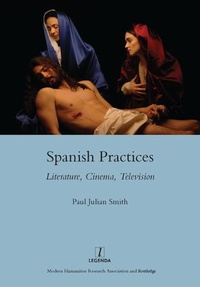
Spanish Practices
Literature, Cinema, Television
1st Edition
Published on 28. February 2012
Book
Hardback
176 pages
978-1-907975-04-2 (ISBN)
Description
This book focuses on some of the best known and most important books, feature films, and television series in contemporary Span, and addresses three pairs of linked issues central to Hispanic studies and beyond: history and memory, authority and society, and genre and transitivity.
More details
Language
English
Place of publication
Leeds
United Kingdom
Target group
College/higher education
Dimensions
Height: 246 mm
Width: 174 mm
Weight
498 gr
ISBN-13
978-1-907975-04-2 (9781907975042)
Copyright in bibliographic data and cover images is held by Nielsen Book Services Limited or by the publishers or by their respective licensors: all rights reserved.
Schweitzer Classification
Other editions
Additional editions
Book
06/2020
1st Edition
Routledge
€53.31
Shipment within 15-20 days
E-Book
12/2017
Routledge
€60.49
Available for download
E-Book
12/2017
Routledge
€60.49
Available for download
Person
Paul Julian Smith
Content
1. Introduction: Spanish Practices Part I: Literature: History and Memory 2. Winners and Losers in Cinema and Memoirs: Emilio Martinez Lazaro's Las 13 rosas ('The 13 Roses', 2007) and Esther Tusquets' Habiamos ganado la guerra ('We Had Won the War', 2007) 3. Resuscitating Franco in Popular Narrative and Television: Vizcaino Casas's ... Y al tercer ano resucito ('And in the Third Year He Rose Again', 1978) and Cuentame como paso ('Tell Me How It Happened', TVE 2001-) 4. The Audiovisual Transition: Cinema, Television, and Munoz Molina's El jinete polaco ('The Polish Horseman', 1991) Part II: Cinema: Authority and Society 5. A Question of Queer Authorship: Almodovar's Unpublished Short Stories (1973) 6. Spanish Cinema's Missing Children: Juan Antonio Bayona's El orfanato ('The Orphanage', 2007) and Jaime Rosales' La soledad ('Solitary Fragments', 2007) 7. Re-presenting the Others: Cinema and Television on Ethnicity and Immigration Part III: Television: Genre and Transitivity 8. Re-visions of Teresa: Josefina Molina's Teresa de Jesus (TVE, 1984) and Ray Loriga's Teresa: el cuerpo de Cristo ('Teresa, the Body of Christ', 2007) 9. Hybrid Fictions: Television Comedy between Soap Opera and Pseudo-documentary: Los Serrano (Tele 5, 2003-08] and Camera cafe ['Coffee Cam', Tele 5, 2005-09] 10. Travelling Narratives and Transitional Life Strategies: Yo soy Bea ('I Am Bea', Tele 5, 2006-08) and Ugly Betty (ABC, 2006-10) 11. Conclusion: Literature, Cinema, Television