

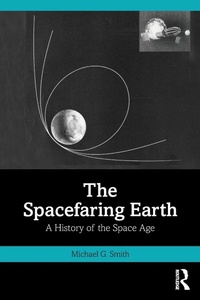
The Spacefaring Earth
A History of the Space Age
1st Edition
Published on 4. December 2024
Book
Paperback/Softback
308 pages
978-1-032-78071-9 (ISBN)
Description
This engaging survey of the Space Age links science and technology with politics and popular culture, war and peace, and crises and controversies. It examines the history of spaceflight as a mirror of human thought and action across the Earth.
The volume encompasses the new astronomy and sciences of the modern era, the early dreamers and pioneers after 1903, the national competitions of the First World War, the rocket states that prepared for the Second World War, the rivalries and "space race" of the Cold War between the US and USSR, as well as more recent developments including the Space Shuttle, the International Space Station, national space programs, orbital technologies, transhumanism, and military and commercial ventures in space. It also stresses the importance of geography in the geopolitics of spaceflight competition and in the nature of the planetary biosphere. Taking a chronological approach to lived human experience and threshold achievements, the chapters show how these themes have been reflected in literature, art, music, film, and our new digital worlds.
This book is essential reading for students of the history of the Space Age, as well as an excellent companion to courses on twentieth-century science and technology, the Cold War, and American history.
The volume encompasses the new astronomy and sciences of the modern era, the early dreamers and pioneers after 1903, the national competitions of the First World War, the rocket states that prepared for the Second World War, the rivalries and "space race" of the Cold War between the US and USSR, as well as more recent developments including the Space Shuttle, the International Space Station, national space programs, orbital technologies, transhumanism, and military and commercial ventures in space. It also stresses the importance of geography in the geopolitics of spaceflight competition and in the nature of the planetary biosphere. Taking a chronological approach to lived human experience and threshold achievements, the chapters show how these themes have been reflected in literature, art, music, film, and our new digital worlds.
This book is essential reading for students of the history of the Space Age, as well as an excellent companion to courses on twentieth-century science and technology, the Cold War, and American history.
More details
Language
English
Place of publication
London
United Kingdom
Publishing group
Taylor & Francis Ltd
Target group
College/higher education
Postgraduate and Undergraduate Advanced
Illustrations
8 s/w Abbildungen, 8 s/w Zeichnungen, 45 s/w Tabellen
7 Tables, black and white; 8 Line drawings, black and white; 8 Illustrations, black and white
Dimensions
Height: 229 mm
Width: 152 mm
Thickness: 17 mm
Weight
466 gr
ISBN-13
978-1-032-78071-9 (9781032780719)
Copyright in bibliographic data and cover images is held by Nielsen Book Services Limited or by the publishers or by their respective licensors: all rights reserved.
Schweitzer Classification
Other editions
Additional editions
Book
12/2024
1st Edition
Routledge
€198.00
Shipment within 10-20 days
E-Book
12/2024
1st Edition
Routledge
€49.99
Available for download
E-Book
12/2024
1st Edition
Routledge
€49.99
Available for download
Person
Michael G. Smith is Professor of History at Purdue University. He is the author of Rockets and Revolution: A Cultural History of Early Spaceflight (2014) and The Rocket Lab: Maurice Zucrow, Purdue University and America's Race to Space (2023).
Content
Introduction Part I: The Spaceflight Visionaries 1. Parabola: Picturing the Cosmos 2. Rocket: The Space Pioneers 3. Missile: Rocket States and War 4. Satellite: Strategic Power and Geopolitics Part II: The Space Race 5. Project: Vostok and Mercury in Orbit 6. Terror: The Intercontinental Ballistic Missile Race 7. Rendezvous: Voskhod and Project Gemini 8. Apollo: The Race for the Moon Part III: The Fragile Species 9. Portraits: Our Expanding Universe 10. Bodies: Living and Cooperating in Space 11. Orbits: Planet Earth from Outer Space 12. Thresholds: Shuttles, Star Wars, and Stations. Epilogue A Note on Non-English Sources