

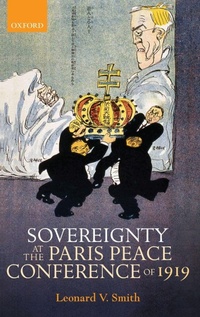
Sovereignty at the Paris Peace Conference of 1919
Published on 15. March 2018
Book
Hardback
300 pages
978-0-19-967717-7 (ISBN)
Description
We have known for many decades that the Paris Peace Conference of 1919 "failed", in the sense that it did not prevent the outbreak of World War II. This book investigates not whether the Paris Peace Conference succeeded or failed, but the historically specific international system it created. It explores the rules under which that system operated, and the kinds of states and empires that inhabited it. Deepening the dialogue between history and international relations theory makes it possible to think about sovereignty at the Paris Peace Conference in new ways. Sovereignty in 1919 was about not just determining of answers demarcating the international system, but also the questions. Sovereignty in 1919 was about remaking the world.
Most histories of the Paris Peace Conference stop with the signing of the Treaty of Versailles with Germany on 28 June 1919. Sovereignty at the Paris Peace Conference of 1919 considers all five treaties produced by the conference as well as the Treaty of Lausanne with Turkey in 1923. It is organized not chronologically or geographically, but according to specific problems of sovereignty. A peace based on "justice" produced a criminalized Great Power in Germany, and a template problematically applied in the other treaties. The conference sought to unmix lands and peoples in the defeated multinational empires by drawing boundaries and defining ethnicities. The conference sought not so much to oppose revolution as to instrumentalize it in the new international system. The League of Nations, so often taken as the supreme symbol of the failure of the conference, is better considered as a continuation of the laboratory of sovereignty established in Paris.
Most histories of the Paris Peace Conference stop with the signing of the Treaty of Versailles with Germany on 28 June 1919. Sovereignty at the Paris Peace Conference of 1919 considers all five treaties produced by the conference as well as the Treaty of Lausanne with Turkey in 1923. It is organized not chronologically or geographically, but according to specific problems of sovereignty. A peace based on "justice" produced a criminalized Great Power in Germany, and a template problematically applied in the other treaties. The conference sought to unmix lands and peoples in the defeated multinational empires by drawing boundaries and defining ethnicities. The conference sought not so much to oppose revolution as to instrumentalize it in the new international system. The League of Nations, so often taken as the supreme symbol of the failure of the conference, is better considered as a continuation of the laboratory of sovereignty established in Paris.
Reviews / Votes
Lucid study. * Financial Times * A formidable tour-de-force ... Smith combines clear-cut analytical concepts with an impressive overview to produce a compelling historical synthesis of the decision-making of the 'world sovereign' ... it should be essential reading for anyone interested in the ramifications of the First World War, the interwar years, and the League of Nations... * Haakon A Ikonomou, European History Quarterly *More details
Series
Language
English
Place of publication
Oxford
United Kingdom
Target group
College/higher education
Professional and scholarly
Illustrations
17 black and white figure/illustrations
Dimensions
Height: 240 mm
Width: 161 mm
Thickness: 21 mm
Weight
617 gr
ISBN-13
978-0-19-967717-7 (9780199677177)
Copyright in bibliographic data and cover images is held by Nielsen Book Services Limited or by the publishers or by their respective licensors: all rights reserved.
Schweitzer Classification
Other editions
Additional editions
Leonard V. Smith
Sovereignty at the Paris Peace Conference of 1919
E-Book
03/2018
1st Edition
OUP eBook
€28.49
Available for download
Leonard V. Smith
Sovereignty at the Paris Peace Conference of 1919
E-Book
03/2018
1st Edition
OUP eBook
€28.49
Available for download
Person
Leonard V. Smith is Frederick B. Arz Professor of History at Oberlin College, Ohio. He has previously written extensively about France and the Great War. His first book, Between Mutiny and Obedience: The Case of the French Fifth Infantry Division During World War I (1994) won the Paul Birdsall Prize from the American Historical Association. France and the Great War, 1914-1918 (co-authored with Stephane Audoin-Rouzeau and Annette Becker, 2003) won the Norman B. Tomlinson Prize from the Western Front Association. Smith is also the author of The Embattled Self: French Soldiers Testimony of the Great War (2007).
Content
Introduction: The Riddles of Sovereignty at the Paris Peace Conference
1: The Agents and Structures of Peacemaking
2: The Sovereignty of Justice
3: The "Unmixing" of Lands
4: The "Unmixing" of Peoples
5: Mastering Revolution
6: Sovereignty and the League of Nations, 1920-1923
Conclusion: History, IR, and the Paris Peace Conference
1: The Agents and Structures of Peacemaking
2: The Sovereignty of Justice
3: The "Unmixing" of Lands
4: The "Unmixing" of Peoples
5: Mastering Revolution
6: Sovereignty and the League of Nations, 1920-1923
Conclusion: History, IR, and the Paris Peace Conference