

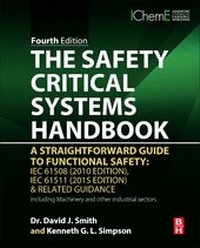
The Safety Critical Systems Handbook
A Straightforward Guide to Functional Safety: IEC 61508 (2010 Edition), IEC 61511 (2015 Edition) and Related Guidance
4th Edition
Published on 24. August 2016
Book
Hardback
330 pages
978-0-12-805121-4 (ISBN)
Description
The Safety Critical Systems Handbook: A Straightforward Guide to Functional Safety: IEC 61508 (2010 Edition), IEC 61511 (2016 Edition) & Related Guidance, Fourth Edition, presents the latest on the electrical, electronic, and programmable electronic systems that provide safety functions that guard workers and the public against injury or death, and the environment against pollution.
The international functional safety standard IEC 61508 was revised in 2010, and authors David Smith and Kenneth Simpson provide a comprehensive guide to the revised standard, as well as the revised IEC 61511 (2016). The book enables engineers to determine if a proposed or existing piece of equipment meets the safety integrity levels (SIL) required by the various standards and guidance, and also describes the requirements for the new alternative route (route 2H), introduced in 2010.
A number of other areas have been updated by Smith and Simpson in this new edition, including the estimation of common cause failure, calculation of PFDs and failure rates for redundant configurations, societal risk, and additional second tier guidance documents.
As functional safety is applicable to many industries, this book will have a wide readership beyond the chemical and process sector, including oil and gas, machinery, power generation, nuclear, aircraft, and automotive industries, plus project, instrumentation, design, and control engineers.
The international functional safety standard IEC 61508 was revised in 2010, and authors David Smith and Kenneth Simpson provide a comprehensive guide to the revised standard, as well as the revised IEC 61511 (2016). The book enables engineers to determine if a proposed or existing piece of equipment meets the safety integrity levels (SIL) required by the various standards and guidance, and also describes the requirements for the new alternative route (route 2H), introduced in 2010.
A number of other areas have been updated by Smith and Simpson in this new edition, including the estimation of common cause failure, calculation of PFDs and failure rates for redundant configurations, societal risk, and additional second tier guidance documents.
As functional safety is applicable to many industries, this book will have a wide readership beyond the chemical and process sector, including oil and gas, machinery, power generation, nuclear, aircraft, and automotive industries, plus project, instrumentation, design, and control engineers.
More details
Edition
4th edition
Language
English
Place of publication
Woburn
United States
Publishing group
Elsevier - Health Sciences Division
Target group
Professional and scholarly
Chemical, Process, Plant, Oil & Gas and related systems safety engineers.
Dimensions
Height: 235 mm
Width: 191 mm
Weight
850 gr
ISBN-13
978-0-12-805121-4 (9780128051214)
Copyright in bibliographic data and cover images is held by Nielsen Book Services Limited or by the publishers or by their respective licensors: all rights reserved.
Schweitzer Classification
Other editions
New editions
David J. Smith | Kenneth G. L. Simpson
The Safety Critical Systems Handbook
A Straightforward Guide to Functional Safety: IEC 61508 (2010 Edition), IEC 61511 (2015 Edition) and Related Guidance
Book
01/2020
5th Edition
Butterworth-Heinemann
€155.99
Shipment within 15-20 days
Additional editions
David J. Smith | Kenneth G. L. Simpson
The Safety Critical Systems Handbook
A Straightforward Guide to Functional Safety: IEC 61508 (2010 Edition), IEC 61511 (2015 Edition) and Related Guidance
E-Book
08/2016
4th Edition
Butterworth-Heinemann
€135.00
Available for download
Persons
Dr. David J. Smith is the Proprietor of Technis Consultancy. He has written numerous books on Reliability and Safety over the last 40 years. His FARADIP database has become widely used, and his other software packages are also used throughout the profession. His PhD thesis was on the subject of reliability prediction and common cause failure. He contributed to the first drafting of IEC 61508 and chairs the IGEM panel which produces SR/15 (the gas industry safety related guidance). David is past President of the Safety and Reliability Society. Kenneth G. L. Simpson is Managing Director of Engineering Safety Consultants Ltd and has been associated with safety related systems design and also with their assessment for over 40 years. He is a member of both the IEC61508 and IEC61511 drafting committees and the IGEM (SR15) panel, which writes the gas industry guidance. Following a career in aerospace, Ken has spent over 35 years in the control and safety system industry, has written a number of papers on the topic and gives frequent lectures.
Content
Part A. The Concept of Safety Integrity1. The Meaning and Context of Safety Integrity Targets2. Meeting IEC 61508 Part 13. Meeting IEC 61508 Part 24. Meeting IEC 61508 Part 35. Reliability Modeling Techniques6. Failure Rate and Mode Data7. Demonstrating and Certifying Conformance
Part B. Specific Industry Sectors8. Second Tier Documents-Process, Oil and Gas Industries9. Machinery Sector10. Other Industry Sectors
Part C. Case Studies in the Form of Exercises and Examples11. Pressure Control System (Exercise)12. Burner Control Assessment (Example)13. SIL Targeting-Some Practical Examples14. Hypothetical Rail Train Braking System (Example)15. Rotorcraft Accidents and Risk Assessment16. Hydroelectric Dam and Tidal Gates
Part B. Specific Industry Sectors8. Second Tier Documents-Process, Oil and Gas Industries9. Machinery Sector10. Other Industry Sectors
Part C. Case Studies in the Form of Exercises and Examples11. Pressure Control System (Exercise)12. Burner Control Assessment (Example)13. SIL Targeting-Some Practical Examples14. Hypothetical Rail Train Braking System (Example)15. Rotorcraft Accidents and Risk Assessment16. Hydroelectric Dam and Tidal Gates