

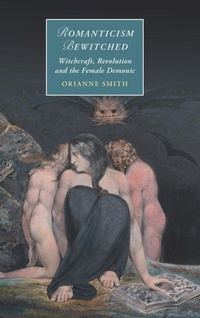
Romanticism Bewitched
Witchcraft, Revolution and the Female Demonic
Published on 4. June 2026
Book
Hardback
328 pages
978-1-009-65002-1 (ISBN)
Description
The Romantic-era witch was a remarkably flexible symbol of political and social disorder. The then-recent seventeenth-century witch hunts had already revealed deep anxieties about the subversive potential of women, and the witches who stalk the pages of Gothic poetry and prose or glare menacingly from works of art by Henry Fuseli and William Blake embody revolutionary anger and the possibility of radical social transformation. Despite the fears surrounding such figures, however, the Romantic period also saw witchcraft open up in conceptually new ways, enabling writers and artists to envision alternative means of interacting in the world that were not predicated on the subordination of women and other marginalized groups. Here, Orianne Smith embarks on an interdisciplinary reimagining of witchcraft, women's writing, religion, and social reform, providing original insights on the history of witchcraft and its influence on public discourse, literature and art.
More details
Series
Language
English
Place of publication
Cambridge
United Kingdom
Target group
College/higher education
Illustrations
Worked examples or Exercises
Dimensions
Height: 235 mm
Width: 157 mm
Thickness: 22 mm
Weight
627 gr
ISBN-13
978-1-009-65002-1 (9781009650021)
Copyright in bibliographic data and cover images is held by Nielsen Book Services Limited or by the publishers or by their respective licensors: all rights reserved.
Schweitzer Classification
Person
Orianne Smith is Professor of English and Affiliate Professor of Gender and Women's Studies at the University of Maryland, Baltimore County. Her first book, Romantic Women Writers, Revolution and Prophecy: Rebellious Daughters, 1786 -1826 (2013, paperback 2015), also published in the Cambridge Studies in Romanticism series, received the British Association of Romantic Studies (BARS) Biennial First book Award in 2015.
Content
Introduction: witchcraft and revolution; Part I. Romanticism Bewitched: 1. Visualizing witchcraft; 2. Gothic witches; 3. Charlotte Smith and Maria Edgeworth: gender and black magic; 4. The Shelleys on history and the female demonic; Part II. Walter Scott Bewitched: 5. The Waverley Novels, demonology, and 'The Wizard of the North'; 6. Guy mannering: gender, magic, and translation; 7. Specimens of female enthusiasm and witchcraft: the antiquary, Ivanhoe, and the pirate; 8. The demonization of domesticity: Scott's The Bride of Lammermoor and Baillie's witchcraft; Bibliography; Index.