

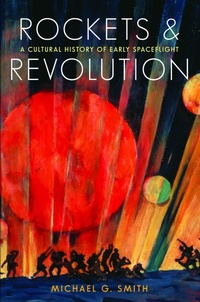
Rockets and Revolution
A Cultural History of Early Spaceflight
Published on 1. December 2014
Book
Hardback
448 pages
978-0-8032-5522-7 (ISBN)
Description
Rockets and Revolution offers a multifaceted study of the race toward space in the first half of the twentieth century, examining how the Russian, European, and American pioneers competed against one another in the early years to acquire the fundamentals of rocket science, engineer simple rockets, and ultimately prepare the path for human spaceflight.
Between 1903 and 1953, Russia matured in radical and dramatic ways as the tensions and expectations of the Russian revolution drew it both westward and spaceward. European and American industrial capacities became the models to imitate and to surpass. The burden was always on Soviet Russia to catch up-enough to achieve a number of remarkable "firsts" in these years, from the first national rocket society to the first comprehensive surveys of spaceflight. Russia rose to the challenges of its Western rivals time and again, transcending the arenas of science and technology and adapting rocket science to popular culture, science fiction, political ideology, and military programs.
While that race seemed well on its way to achieving the goal of space travel and exploring life on other planets, during the second half of the twentieth century these scientific advances turned back on humankind with the development of the intercontinental ballistic missile and the coming of the Cold War.
Between 1903 and 1953, Russia matured in radical and dramatic ways as the tensions and expectations of the Russian revolution drew it both westward and spaceward. European and American industrial capacities became the models to imitate and to surpass. The burden was always on Soviet Russia to catch up-enough to achieve a number of remarkable "firsts" in these years, from the first national rocket society to the first comprehensive surveys of spaceflight. Russia rose to the challenges of its Western rivals time and again, transcending the arenas of science and technology and adapting rocket science to popular culture, science fiction, political ideology, and military programs.
While that race seemed well on its way to achieving the goal of space travel and exploring life on other planets, during the second half of the twentieth century these scientific advances turned back on humankind with the development of the intercontinental ballistic missile and the coming of the Cold War.
Reviews / Votes
"For anyone familiar with the history of spaceflight-particularly in America-this book will be immensely rewarding."-Hunter Hollins, Quest "Highly recommended."-Midwest Book Review "Rockets and Revolution brings a variety of new sources and a refreshing perspective into the debates about the cultural dimensions of spaceflight."-Slava Gerovitch, CritCom "Rockets and Revolution succeeds in offering a cultural history of the space age."-Paul Josephson, American Historical Review "A remarkably rich study."-Michael K. Launer, Slavic and East European Journal "A refreshing perspective on the universal thrust for space exploration."-Colin Burgess, Outward Odyssey series editor and author of Liberty Bell 7: The Suborbital Mercury Flight of Virgil I. GrissomMore details
Language
English
Place of publication
Lincoln
United States
Target group
College/higher education
Professional and scholarly
Product notice
Cloth over boards
Illustrations
4 photographs, 30 illustrations, 4 tables
Dimensions
Height: 236 mm
Width: 161 mm
Thickness: 40 mm
Weight
796 gr
ISBN-13
978-0-8032-5522-7 (9780803255227)
Copyright in bibliographic data and cover images is held by Nielsen Book Services Limited or by the publishers or by their respective licensors: all rights reserved.
Schweitzer Classification
Other editions
Additional editions
E-Book
12/2014
University of Nebraska Press
€42.99
Available for download
Person
Michael G. Smith is an associate professor of history at Purdue University.
Content
List of Illustrations
List of Tables
Introduction
Part 1. The Surveillance of Outer Space and the Russian Empire
1. Envisioning the Biological Universe
2. Mystical Economies of Earth and Space
3. The Mechanics of Interplanetary Travel
Part 2. The Mastery of Time and the Bolshevik Revolution
4. Lyrical Cosmism of the Russian Revolution
5. The Pioneers and the Spaceflight Imperative
6. Rocket Spaceships as Science Fictions
7. The Origins and Ends of Life on Earth
Part 3. The Rise of Rocket Science and the Soviet Union
8. The First Foundations of Astronautics
9. A Race into the Stratosphere
10. Stalinism and the Genesis of Cosmonautics
Conclusion
Notes
Selected Bibliography
Index
List of Tables
Introduction
Part 1. The Surveillance of Outer Space and the Russian Empire
1. Envisioning the Biological Universe
2. Mystical Economies of Earth and Space
3. The Mechanics of Interplanetary Travel
Part 2. The Mastery of Time and the Bolshevik Revolution
4. Lyrical Cosmism of the Russian Revolution
5. The Pioneers and the Spaceflight Imperative
6. Rocket Spaceships as Science Fictions
7. The Origins and Ends of Life on Earth
Part 3. The Rise of Rocket Science and the Soviet Union
8. The First Foundations of Astronautics
9. A Race into the Stratosphere
10. Stalinism and the Genesis of Cosmonautics
Conclusion
Notes
Selected Bibliography
Index