

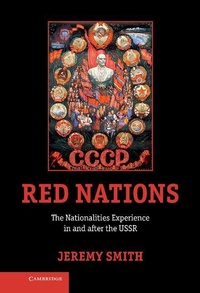
Red Nations
The Nationalities Experience in and after the USSR
Published on 12. September 2013
Book
Hardback
412 pages
978-0-521-11131-7 (ISBN)
Description
Red Nations offers an illuminating and informative overview of how the non-Russian republics of the Soviet Union experienced communist rule. It surveys the series of historical events that contributed to the break-up of the Soviet Union and evaluates their continuing resonance across post-soviet states today. Drawing from the latest research, Professor Smith offers comprehensive coverage of the revolutionary years, the early Soviet policies of developing nations, Stalin's purges and deportations of small nationalities, and the rise of independence movements. Through a single, unified narrative, this book illustrates how, in the post-Stalin period, many of the features of the modern nation state emerged. Both scholars and students will find this an indispensable contribution to the history of the dissolution of the USSR, the reconstruction of post-Soviet society, and its impact on non-Russian citizens from the years of the Russian Revolution through to the present day.
Reviews / Votes
'Jeremy Smith has given us the first comprehensive account of the turns and twists of Soviet nationality policies from the revolution to the present. An acknowledged expert on the USSR's practices among non-Russian peoples, Smith shows how nations were constructed and reconstructed by an ostensibly internationalist socialist state that both promoted ethnic cultures but also exiled whole peoples to eradicate perceived threats to the regime. The importance of his story should not be underestimated. The heritage of Soviet aspirations, achievements, and brutal impositions continues after the collapse of communism and remains the ground on which fifteen new states build their future.' Ronald Grigor Suny, Charles Tilly Collegiate Professor of Social and Political History, University of Michigan 'Jeremy Smith directs his detailed research and attention in this book to the history of these non-Russian peoples within the Soviet Union from 1920 up to its dismantling in 1991.' Morning Star 'In sum, the overall conception of this volume breaks new ground, which deserves continued attention from scholars, and more accessible treatment. The volume raises our awareness of how the legal perspective may be helpful and even essential for understanding virtually any aspect of the Cold War.' Sergei Antonov, The Russian ReviewMore details
Language
English
Place of publication
Cambridge
United Kingdom
Target group
Professional and scholarly
College/higher education
Illustrations
6 Tables, black and white
Dimensions
Height: 235 mm
Width: 157 mm
Thickness: 27 mm
Weight
745 gr
ISBN-13
978-0-521-11131-7 (9780521111317)
Copyright in bibliographic data and cover images is held by Nielsen Book Services Limited or by the publishers or by their respective licensors: all rights reserved.
Schweitzer Classification
Other editions
Additional editions
Book
09/2013
Cambridge University Press
€47.10
Shipment within 15-20 days
E-Book
09/2013
Cambridge University Press
€25.49
Available for download
E-Book
08/2013
1st Edition
Cambridge University Press
€29.49
Available for download
Person
Jeremy Smith is Professor of Russian History and Politics at the Karelian Institute, University of Eastern Finland, having lectured in Russian history at the University of Birmingham for eleven years. He has been a Visiting Researcher at Helsinki's Aleksanteri Institute and a Visiting Professor at the University of Michigan. He has written extensively on the non-Russian nationalities of the Soviet Union, including two books, The Bolsheviks and the National Question, 1917-1923 and The Fall of Soviet Communism, 1985-1991. He has received major research grants for projects on social unrest in the Soviet Union in the 1920s, the politics and government of the USSR in the Khrushchev era, and Georgian nationalism and Soviet power in the 1950s, and is one of the organisers of the EU-Central Asia Monitoring programme. In 2001 he was elected to the International Commission on the Russian Revolution.
Content
1. Introduction: the prison-house of nations; 2. Dispersal and reunion: revolution and Civil War in the Borderlands; 3. Bolshevik nationality policies and the formation of the USSR; 4. Nation-building the Soviet way; 5. Surviving the Stalinist onslaught, 1928-41; 6. The Great Patriotic War and after; 7. Deportations; 8. Territorial expansion and the Baltic exception; 9. Destalinisation and the revival of the Republics; 10. Stability and national development: the Brezhnev years, 1964-82; 11. From reform to dissolution, 1982-91; 12. Nation-making in the post-Soviet states; 13. The orphans of the Soviet Union: Chechnya, Nagorno, Karabakh, Abkhazia, South Ossetia and Transdniester; Conclusion.