

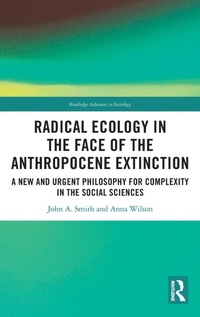
Radical Ecology in the Face of the Anthropocene Extinction
A New and Urgent Philosophy for Complexity in the Social Sciences
1st Edition
Published on 14. June 2024
Book
Hardback
196 pages
978-1-032-50811-5 (ISBN)
Description
This book has two interlocking ambitions. The first is to steer what we purposefully call the idioms of critical philosophy towards a more ecologically informed paradigm. The second is to recognise that what has rightly come to be called The Anthropocene extinction is not and cannot be treated as simply a scientific fact but rather a socio-political and ecological dispute of immense complexity.
We start with an exploration of the consequences of a critical tradition which, under the name Enlightenment, has placed humanity at its centre and chance as its most general - and problematic - characteristic. We argue that this leads to a schizophrenic relationship between radical critique and science which can be avoided if we take the implications of biosemiotics seriously and develop a new, ecologically informed social science. We argue that in practice this means that for science to be practical in addressing the Anthropocene extinction, we have to recognise that it operates in a historically emergent, highly differentiated technopolitical ecology. Science, as it is currently commonly understood and used, is not ecological enough.
This book will interest social scientists interested in not only describing and critiquing but also understanding and responding to the complex problems facing humanity; scientists wanting to make sense of social phenomena; those educating the next generation of social scientists; and climate activists and policy-makers.
We start with an exploration of the consequences of a critical tradition which, under the name Enlightenment, has placed humanity at its centre and chance as its most general - and problematic - characteristic. We argue that this leads to a schizophrenic relationship between radical critique and science which can be avoided if we take the implications of biosemiotics seriously and develop a new, ecologically informed social science. We argue that in practice this means that for science to be practical in addressing the Anthropocene extinction, we have to recognise that it operates in a historically emergent, highly differentiated technopolitical ecology. Science, as it is currently commonly understood and used, is not ecological enough.
This book will interest social scientists interested in not only describing and critiquing but also understanding and responding to the complex problems facing humanity; scientists wanting to make sense of social phenomena; those educating the next generation of social scientists; and climate activists and policy-makers.
More details
Series
Language
English
Place of publication
London
United Kingdom
Publishing group
Taylor & Francis Ltd
Target group
College/higher education
General and Postgraduate
Dimensions
Height: 240 mm
Width: 161 mm
Thickness: 16 mm
Weight
476 gr
ISBN-13
978-1-032-50811-5 (9781032508115)
Copyright in bibliographic data and cover images is held by Nielsen Book Services Limited or by the publishers or by their respective licensors: all rights reserved.
Schweitzer Classification
Other editions
Additional editions
John A. Smith | Anna Wilson
Radical Ecology in the Face of the Anthropocene Extinction
A New and Urgent Philosophy for Complexity in the Social Sciences
Book
08/2025
1st Edition
Routledge
€62.90
Shipment within 10-20 days
John A. Smith | Anna Wilson
Radical Ecology in the Face of the Anthropocene Extinction
A New and Urgent Philosophy for Complexity in the Social Sciences
E-Book
06/2024
1st Edition
Routledge
€60.49
Available for download
John A. Smith | Anna Wilson
Radical Ecology in the Face of the Anthropocene Extinction
A New and Urgent Philosophy for Complexity in the Social Sciences
E-Book
06/2024
1st Edition
Routledge
€60.49
Available for download
Persons
John A. Smith has taught at Goldsmiths College, University of London; Lancaster University; and Greenwich University. He is a sociologist and a painter trained at the Royal College of Art. He is interested in sociological theory, philosophy and visual culture, and has published in all of these areas.
Anna Wilson is a transdisciplinary researcher with a background in nuclear physics, currently working in the School of Education at the University of Glasgow.
Anna Wilson is a transdisciplinary researcher with a background in nuclear physics, currently working in the School of Education at the University of Glasgow.
Content
Introduction
PART 1: A radical ecological philosophy
1 Reforming the philosophy of the Enlightenment: Chance as a second-order phenomenon and post-humanism
2 Auto-eco-organisation as ontology: The sciences of emergence
3 Auto-exo-reference as epistemology: A biosemiotics approach
4 Materialist neo-Darwinism and its discontents: Debates in the modern synthesis; the ecology of physical and semantic causality; end-directedness and its consequences for an ecological social science
5 The evolutionary ecology of the social: The adaptive unconscious, the mammalian emotions, the significance of approximation end-directed dynamics; social systems as differentiated, adaptive dynamics
PART 2: The Anthropocene extinction
6 Summary of Part 1 and methodology for Part 2
7 Three case studies
8 The Anthropocene extinction: Explicit evidence and implicit epistemology
9 Global governance and its discontents "in practice": Radically incompatible perspectives: political, economic, cultural and scientific conflicts
10 In place of a conclusion: Imperatives and ambiguities
Bibliography
Index
PART 1: A radical ecological philosophy
1 Reforming the philosophy of the Enlightenment: Chance as a second-order phenomenon and post-humanism
2 Auto-eco-organisation as ontology: The sciences of emergence
3 Auto-exo-reference as epistemology: A biosemiotics approach
4 Materialist neo-Darwinism and its discontents: Debates in the modern synthesis; the ecology of physical and semantic causality; end-directedness and its consequences for an ecological social science
5 The evolutionary ecology of the social: The adaptive unconscious, the mammalian emotions, the significance of approximation end-directed dynamics; social systems as differentiated, adaptive dynamics
PART 2: The Anthropocene extinction
6 Summary of Part 1 and methodology for Part 2
7 Three case studies
8 The Anthropocene extinction: Explicit evidence and implicit epistemology
9 Global governance and its discontents "in practice": Radically incompatible perspectives: political, economic, cultural and scientific conflicts
10 In place of a conclusion: Imperatives and ambiguities
Bibliography
Index