

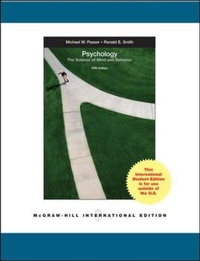
Psychology: The Science of Mind and Behavior
5th Edition
Published on 16. August 2010
Book
Paperback/Softback
816 pages
978-0-07-122164-1 (ISBN)
Description
Psychology: The Science of Mind and Behavior imparts students with a scientific understanding of the field of psychology while showing them the impact on their day-to-day existence. A simple conceptual framework within the text emphasizes relations between biological, psychological, and environmental levels of analysis and portrays the focus of modern psychology. Through a variety of features, the text challenges students to think critically about psychology as a science and its impact on their lives.To help students study more effectively and efficiently, a groundbreaking adaptive questioning diagnostic and personalized study plan help students "know what they know" while guiding them to master these concepts through engaging interactivities, exercises, and readings. Now available with Connect Psychology, Psychology: The Science of Mind and Behavior follows the science behind psychology, leading students through the process of critical examination.
More details
Persons
Ronald E. Smith, Ph.D., is Professor of Psychology and Director of Clinical Psychology Training at the University of Washington, where he also has served as Area Head of the Social Psychology and Personality area. He received his bachelors degree from Marquette University and his PhD from Southern Illinois University, where he had dual specializations in clinical and physiological psychology. His major research interests are in anxiety, stress and coping, and in performance enhancement research and intervention. Dr. Smith is a Fellow of the American Psychological Association. He received a Distinguished Alumnus Award from the UCLA Neuropsychiatric Institute for his contributions to the field of mental health. He has published more than 160 scientific articles and book chapters in his areas of interest and has authored or co-authored 23 books on introductory psychology, human performance enhancement, and personality, including Introduction to Personality: Toward an Integration, with Walter Mischel and Yuichi Shoda (Wiley, 2004). An award-winning teacher, he has more than 15 years of experience in teaching the introductory psychology course.
Michael W. Passer, Ph.D., coordinates the introductory psychology program at the University of Washington, which enrolls about 2,500 students per year, and also is the faculty coordinator of training for new teaching assistants (TAs). He received his bachelors degree from the University of Rochester and his PhD in Psychology from the University of California, Los Angeles, with a specialization in social psychology. Dr. Passer has been a faculty member at the University of Washington since 1977. A former Danforth Foundation Fellow and University of Washington Distinguished Teaching Award finalist, Dr. Passer has had a career-long love of teaching. Each academic year he teaches introductory psychology twice and a required pre-major course in research methods. Dr. Passer developed and teaches a graduate course on the Teaching of Psychology, which prepares students for careers in the college classroom, and also has taught courses in social psychology and attribution theory. He has published more than 20 scientific articles and chapters, primarily in the areas of attribution, stress, and anxiety, and has taught the introductory psychology course for 20 years.
Michael W. Passer, Ph.D., coordinates the introductory psychology program at the University of Washington, which enrolls about 2,500 students per year, and also is the faculty coordinator of training for new teaching assistants (TAs). He received his bachelors degree from the University of Rochester and his PhD in Psychology from the University of California, Los Angeles, with a specialization in social psychology. Dr. Passer has been a faculty member at the University of Washington since 1977. A former Danforth Foundation Fellow and University of Washington Distinguished Teaching Award finalist, Dr. Passer has had a career-long love of teaching. Each academic year he teaches introductory psychology twice and a required pre-major course in research methods. Dr. Passer developed and teaches a graduate course on the Teaching of Psychology, which prepares students for careers in the college classroom, and also has taught courses in social psychology and attribution theory. He has published more than 20 scientific articles and chapters, primarily in the areas of attribution, stress, and anxiety, and has taught the introductory psychology course for 20 years.
Content
Chapter 1: The Science of PsychologyChapter 2: Studying Behavior ScientificallyChapter 3: Genes, Environment, and BehaviorChapter 4: The Brain and BehaviorChapter 5: Sensation and PerceptionChapter 6: States of ConsciousnessChapter 7: Learning: The Role of ExperienceChapter 8: MemoryChapter 9: Language and ThinkingChapter 10: IntelligenceChapter 11: Motivation and EmotionChapter 12: Development Over the Life SpanChapter 13: PersonalityChapter 14: Health and Well-BeingChapter 15: Psychological DisordersChapter 16: Treatment of Psychological DisordersChapter 17: Social Thinking and Behavior