

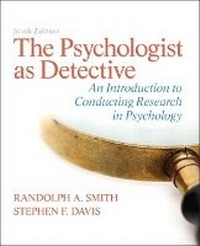
The Psychologist as Detective
An Introduction to Conducting Research in Psychology
6th Edition
Published on 30. October 2012
Book
Hardback
456 pages
978-0-205-85907-8 (ISBN)
Description
Understanding psychological research by finding a problem, discovering the clues, and evaluating the evidence.
The Psychologist as Detectives introduces students to the research process. The authors treat psychological research as a detective case in which a problem is presented, clues are discovered, evidence is evaluated, and a report is prepared for consideration by peers.
Learning Goals
Upon completing this book, readers will be able to:
Think critically about research and research methods
Analyze research as a problem solving procedure
Develop research skills by looking at examples of research studies
Evaluate evidence from a research study and prepare a report or summary of the case
The Psychologist as Detectives introduces students to the research process. The authors treat psychological research as a detective case in which a problem is presented, clues are discovered, evidence is evaluated, and a report is prepared for consideration by peers.
Learning Goals
Upon completing this book, readers will be able to:
Think critically about research and research methods
Analyze research as a problem solving procedure
Develop research skills by looking at examples of research studies
Evaluate evidence from a research study and prepare a report or summary of the case
Reviews / Votes
"The writing style of the book is great. It is definitely non intimidating for students. The authors do a great job in the clarity and readability of the material."- Judy Correa Kaiser, Saint Ambrose University
"It makes research design and statistics approachable and students are able to grasp the material well."
- Deborah Ragin, Montclair State University
"The writing style is enjoyable. The writers write like they are talking to a student. It is approachable and easy to understand. I have not seen this in other experimental psychology textbooks."
- Rebecca Regeth, California University of Pennsylvania
"I love the writing style of this text. The subject level, the clarity of the arguments, the readability and interest is very appropriate the new investigators that this class prepares. The chapter organization presents a natural flow and development of the subject matter based on progression and relevance,"
- Own Johnson, Tennessee State University
More details
Other editions
New editions
Randolph Smith | Stephen Davis
Revel Access Code for Psychologist as Detective, The
An Introduction to Conducting Research in Psychology, Updated Edition
Software
07/2015
6th Edition
Pearson
€152.24
Article not available
Randolph A. Smith | Stephen F. Davis
The Psychologist as Detective
An Introduction to Conducting Research in Psychology: International Edition
Book
10/2012
6th Edition
Pearson
€251.47
Article is exhausted; no reprint
Previous edition

Randolph A. Smith | Stephen F. Davis
The Psychologist as Detective
An Introduction to Conducting Research in Psychology: United States Edition
Book
03/2009
5th Edition
Pearson
€115.47
Article exhausted; check for reprint
Persons
Randolph A. (Randy) Smith is Professor and Chair of Psychology at Lamar University. Randy completed his undergraduate degree at the University of Houston and PhD at Texas Tech University in experimental psychology (specialties in human learning/memory and statistics). Randy taught at Ouachita Baptist University in Arkansas for 26 years, chaired Kennesaw State University's Psychology Department for four years, and became Chair of Lamar University's Psychology Department in 2007. His professional work centers on the scholarship of teaching and learning. Randy served for 12 years as Editor of the Society for the Teaching of Psychology's journal Teaching of Psychology and subsequently served as Editor of the Psi Chi Journal of Undergraduate Research.
He has written several book chapters and articles and made numerous presentations dealing with varied aspects of teaching, applying social psychology to teaching, and assessment of teaching. He has worked with high school teachers grading AP exams since the test's inception and has served as Faculty Advisor for TOPSS (Teachers of Psychology in Secondary Schools). He is a member of the American Psychological Association (a Fellow of Divisions 1 and 2-General Psychology and Teaching) and a Fellow of the Association for Psychological Science. In 2006, Randy received the American Psychological Foundation's Charles L. Brewer Distinguished Teaching of Psychology Award and the University System of Georgia Regents' Scholarship of Teaching and Learning Award.
Stephen F. Davis is Roe R. Cross Distinguished Professor Emeritus of Psychology at Emporia State University in Emporia, Kansas. Currently he is Visiting Distinguished Professor of Psychology at Texas Wesleyan University and Distinguished Guest Professor at Morningside College. In 2002-2003 he was the Knapp Distinguished Professor of Arts and Sciences at the University of San Diego. He received his bachelor's and master's degrees in psychology from Southern Methodist University and his PhD in experimental psychology from Texas Christian University. In 2007 he was awarded the honorary Doctor of Humane Letters degree by Morningside College. His research, which always includes student assistants, has investigated such diverse topics as academic dishonesty, learning versus grade orientation of students, Type A personality, the Impostor Phenomenon, and the behavioral effects of ingesting toxic metals. He is the author of more than 300 journal articles, 31 books, and more than 900 convention presentations.
Steve's teaching abilities have drawn acclaim on the national level. He has received the National Distinguished Teaching of Psychology Award from the American Psychological Foundation and the Teaching Excellence Award from Division Two (Society for the Teaching of Psychology) of the American Psychological Association. His professional accomplishments also include serving as president of the Southwestern Psychological Association, the Southern Society for Philosophy and Psychology, and Division Two of the American Psychological Association. He also served as the National President of Psi Chi (The National Honor Society in Psychology). He has been elected as a Fellow of the American Psychological Association, the American Psychological Society, and the American Association of Applied and Preventive Psychology.
He has written several book chapters and articles and made numerous presentations dealing with varied aspects of teaching, applying social psychology to teaching, and assessment of teaching. He has worked with high school teachers grading AP exams since the test's inception and has served as Faculty Advisor for TOPSS (Teachers of Psychology in Secondary Schools). He is a member of the American Psychological Association (a Fellow of Divisions 1 and 2-General Psychology and Teaching) and a Fellow of the Association for Psychological Science. In 2006, Randy received the American Psychological Foundation's Charles L. Brewer Distinguished Teaching of Psychology Award and the University System of Georgia Regents' Scholarship of Teaching and Learning Award.
Stephen F. Davis is Roe R. Cross Distinguished Professor Emeritus of Psychology at Emporia State University in Emporia, Kansas. Currently he is Visiting Distinguished Professor of Psychology at Texas Wesleyan University and Distinguished Guest Professor at Morningside College. In 2002-2003 he was the Knapp Distinguished Professor of Arts and Sciences at the University of San Diego. He received his bachelor's and master's degrees in psychology from Southern Methodist University and his PhD in experimental psychology from Texas Christian University. In 2007 he was awarded the honorary Doctor of Humane Letters degree by Morningside College. His research, which always includes student assistants, has investigated such diverse topics as academic dishonesty, learning versus grade orientation of students, Type A personality, the Impostor Phenomenon, and the behavioral effects of ingesting toxic metals. He is the author of more than 300 journal articles, 31 books, and more than 900 convention presentations.
Steve's teaching abilities have drawn acclaim on the national level. He has received the National Distinguished Teaching of Psychology Award from the American Psychological Foundation and the Teaching Excellence Award from Division Two (Society for the Teaching of Psychology) of the American Psychological Association. His professional accomplishments also include serving as president of the Southwestern Psychological Association, the Southern Society for Philosophy and Psychology, and Division Two of the American Psychological Association. He also served as the National President of Psi Chi (The National Honor Society in Psychology). He has been elected as a Fellow of the American Psychological Association, the American Psychological Society, and the American Association of Applied and Preventive Psychology.
Content
Chapter 1 Psychological Research and the Research Methods Course
Chapter 2 Developing a Good Research Idea and Conducting an Ethical Project
Chapter 3 Qualitative Research Methods
Chapter 4 Nonexperimental Methods: Descriptive Methods, Correlational Studies, Ex Post Facto Studies, Survey and Questionnaires, Sampling, and Basic Research Strategies
Chapter 5 Using the Scientific Method in Psychology
Chapter 6 Conducting a Good Experiment I: Variables and Control
Chapter 7 Conducting a Good Experiment II: Final Considerations, Unanticipated Influences, and Cross-Cultural Issues
Chapter 8 Internal and External Validity
Chapter 9 Using Statistics to Answer Questions
Chapter 10 Designing, Conducting, Analyzing, and Interpreting Experiments with Two Groups
Chapter 11 Designing, Conducting, Analyzing, and Interpreting Experiments with More than Two Groups
Chapter 12 Designing, Conducting, Analyzing, and Interpreting Experiments with Multiple Independent Variables
Chapter 13 Alternative Research Designs
Chapter 14 Writing and Assembling an APA-Format Research Report
Chapter 2 Developing a Good Research Idea and Conducting an Ethical Project
Chapter 3 Qualitative Research Methods
Chapter 4 Nonexperimental Methods: Descriptive Methods, Correlational Studies, Ex Post Facto Studies, Survey and Questionnaires, Sampling, and Basic Research Strategies
Chapter 5 Using the Scientific Method in Psychology
Chapter 6 Conducting a Good Experiment I: Variables and Control
Chapter 7 Conducting a Good Experiment II: Final Considerations, Unanticipated Influences, and Cross-Cultural Issues
Chapter 8 Internal and External Validity
Chapter 9 Using Statistics to Answer Questions
Chapter 10 Designing, Conducting, Analyzing, and Interpreting Experiments with Two Groups
Chapter 11 Designing, Conducting, Analyzing, and Interpreting Experiments with More than Two Groups
Chapter 12 Designing, Conducting, Analyzing, and Interpreting Experiments with Multiple Independent Variables
Chapter 13 Alternative Research Designs
Chapter 14 Writing and Assembling an APA-Format Research Report