

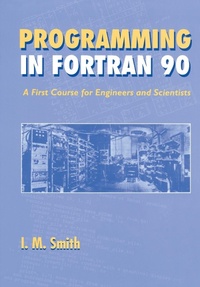
Programming in Fortran 90
A First Course for Engineers and Scientists
1st Edition
Published on 30. January 1995
Book
Paperback/Softback
224 pages
978-0-471-94185-9 (ISBN)
Description
Fortran 90 is the most radical revision ever of this popular language, bringing it up to date with current thinking in programming language development. This is the first book aimed directly at problem solving for Engineers and Scientists using the new features of Fortran 90. It can be used as a complete text for students learning Fortran for the first time. It is also a conversion text for those updating from Fortran 77, as differences between Fortran 90 and Fortran 77 are outlined. Array handling and subroutine structures are dealt with as these are a prominent feature of engineers' programs. Emphasis is put on problem exercises for students and on substantial case histories. Model answers to all exercises and cases are given. The programs are available on the Internet via anonymous ftp.
More details
Language
English
Place of publication
New York
United States
Target group
College/higher education
Professional and scholarly
Product notice
Paperback (trade)
Unsewn / adhesive bound
Dimensions
Height: 244 mm
Width: 170 mm
Thickness: 12 mm
Weight
399 gr
ISBN-13
978-0-471-94185-9 (9780471941859)
Copyright in bibliographic data and cover images is held by Nielsen Book Services Limited or by the publishers or by their respective licensors: all rights reserved.
Schweitzer Classification
Person
I. M. Smith is the author of Programming in Fortran 90: A First Course for Engineers and Scientists, published by Wiley.
Content
Getting Going: Names, TYPEs, Simple Input/Output and ProgramStructure.
Simple Arithmetic.
Simple Intrinsic Procedures.
Repetition.
Conditions.
More on Input/Output: CHARACTERs and FORMAT Specifications.
Arrays.
Yet More on Input/Output: FILEs.
Subprograms: FUNCTIONs and SUBROUTINEs.
Additional Language Features.
Libraries of External SUBROUTINEs.
Case Studies.
Appendices.
Index.
Simple Arithmetic.
Simple Intrinsic Procedures.
Repetition.
Conditions.
More on Input/Output: CHARACTERs and FORMAT Specifications.
Arrays.
Yet More on Input/Output: FILEs.
Subprograms: FUNCTIONs and SUBROUTINEs.
Additional Language Features.
Libraries of External SUBROUTINEs.
Case Studies.
Appendices.
Index.