

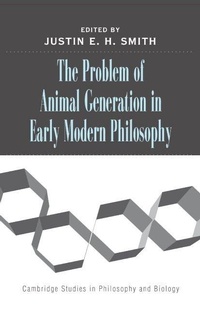
The Problem of Animal Generation in Early Modern Philosophy
Published on 22. May 2006
Book
Hardback
472 pages
978-0-521-84077-4 (ISBN)
Description
In this volume Smith examines the early modern science of generation, which included the study of animal conception, heredity, and fetal development. Analyzing how it influenced the contemporary treatment of traditional philosophical questions, it also demonstrates how philosophical pre-suppositions about mechanism, substance, and cause informed the interpretations offered by those conducting empirical research on animal reproduction. Composed of essays written by an international team of leading scholars, the book offers a fresh perspective on some of the basic problems in early modern philosophy. It also considers how these basic problems manifested themselves within an area of scientific inquiry that had not previously received much consideration by historians of philosophy.
Reviews / Votes
"This rich volume aims at helping historians "to gain a fresh perspective on some of the basic problems of early modern philosophy," by studying how these problems manifest themselves in discussions of animal generation.... the volume can easily be recommended to historians of early modern philosophy and experts alike."--S a n d e r W. d e B o e r, Journal of the History of Philosophy
More details
Series
Language
English
Place of publication
Cambridge
United Kingdom
Target group
Professional and scholarly
Dimensions
Height: 235 mm
Width: 157 mm
Thickness: 32 mm
Weight
911 gr
ISBN-13
978-0-521-84077-4 (9780521840774)
Copyright in bibliographic data and cover images is held by Nielsen Book Services Limited or by the publishers or by their respective licensors: all rights reserved.
Schweitzer Classification
Other editions
Additional editions
Justin E. H. Smith
The Problem of Animal Generation in Early Modern Philosophy
Book
09/2012
1st Edition
Cambridge University Press
€60.70
Shipment within 15-20 days
Justin E. H. Smith
The Problem of Animal Generation in Early Modern Philosophy
E-Book
06/2006
1st Edition
Cambridge University Press
€38.49
Available for download
Person
Justin Smith is assistant professor of philosophy at Concordia University in Montreal. A scholar of early modern philosophy, he has contributed to The Leibniz Review, History of Philosophy Quarterly, and the British Journal for the History of Philosophy.
Content
Part I. The Dawning of a New Era: 1. The comparative study of animal development: from Aristotle to William Harvey J. G. Lennox; 2. Monsters, nature, and generation from the Renaissance to the Early Modern period: the emergence of medical thought Annie Bitbol-Hesperies; Part II. The Cartesian Programme: 3. Descartes' experiments and the generation of animals Vincent Aucante; 4. Imagination and the problem of heredity in Cartesian embryology Justin E. H. Smith; Part III. The Gassdendian Alternative: 5. The soul as vehicle for genetic information: Pierre Gassendi's account of inheritance Saul Fisher; 6. Atoms and minds in Walter Charleton's theory of animal generation Andreas Blank; Part IV. Second-Wave Mechanism and the Return of Animal Souls, 1650-1700: 7 Animal generation and substance in Sennert and Leibniz Richard T. W. Arthur; 8. Malebranche on animal generation: pre-existence and the microscope Andrew J. Pyle; 9. Spontaneous and sexual generation in Ann Conway's Principles Deborah Boyle; 10 'Animal' as category: Pierre Bayle's 'Rorarius' Dennis Des Chene; Part V. Between Epigenesis and Pre-Existence: The Debate Intensifies, 1700-70: 11. Method and cause: the Cartesian context of the Haller-Wolff debate Karen Detlefsen; 12. Soul power: G. E. Stahl and the debate on animal generation Francesco Paolo di Ceglia; 13. Charles Bonnet's neo-Leibnizian theory of organic bodies Francois Duchesneau; Part VI. Kant and His Contemporaries on Development and the Problem of Organized Matter: 14. Kant's early views on epigenesis: the role of Maupertuis John Zammito; 15. Blumenbach and Kant on the formative drive: mechanism and teleology in nature Brandon Look; 16. Kant and the speculative sciences of origins Catherine Wilson; 17. Kant and evolution Michael Ruse.