

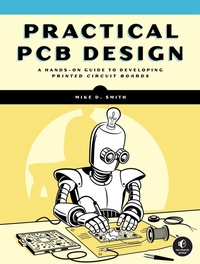
Practical PCB Design
A Hands-On Guide to Developing Printed Circuit Boards
Will be published approx. on 5. January 2027
Book
Paperback/Softback
280 pages
978-1-7185-0404-2 (ISBN)
Description
Based on a popular university course, this book is a fun, practical guide to designing printed circuit boards (PCBs) for readers of all skill levels - no industry experience required. Readers will learn to transform a breadboard prototype into a professional-grade PCB. More than that, this book bridges the gap between a basic understanding of electronic design and the methods used to manufacture those designs in a reliable, consistent, and scalable manner. Software-agnostic exercises are provided throughout, allowing readers to try out new concepts no matter what design platform is used. By the end, they'll be ready to develop their own custom electronics.
More details
Language
English
Place of publication
San Francisco
United States
Product notice
Paperback (trade)
Dimensions
Height: 235 mm
Width: 178 mm
Weight
368 gr
ISBN-13
978-1-7185-0404-2 (9781718504042)
Copyright in bibliographic data and cover images is held by Nielsen Book Services Limited or by the publishers or by their respective licensors: all rights reserved.
Schweitzer Classification
Person
Mike D. Smith is the founder of Bold Circuits LLC and has taught PCB design at the University of Rhode Island for nearly a decade. He developed his course after recognizing that most resources either assume expert-level knowledge or focus narrowly on specific software, leaving students without the conceptual foundation they need. He has spent more than 25 years in electronics design and manufacturing.
Content
Introduction
Part I: From Idea to Schematic
Chapter 1: Design Considerations
Chapter 2: Creating Component Symbols
Chapter 3: Making a Schematic
Part II: Physical Design
Chapter 4: Component Footprints and Packages
Chapter 5: The Layers of a PCB
Chapter 6: Planning a PCB's Structure
Chapter 7: Component Placement
Chapter 8: Routing Techniques and Vias
Part III: Preparing for Production
Chapter 9: Refining a Design
Chapter 10: Design Reviews
Chapter 11: Building Your Board
Chapter 12: Testing
Appendix A: Design Software
Appendix B: Resources
Glossary
Part I: From Idea to Schematic
Chapter 1: Design Considerations
Chapter 2: Creating Component Symbols
Chapter 3: Making a Schematic
Part II: Physical Design
Chapter 4: Component Footprints and Packages
Chapter 5: The Layers of a PCB
Chapter 6: Planning a PCB's Structure
Chapter 7: Component Placement
Chapter 8: Routing Techniques and Vias
Part III: Preparing for Production
Chapter 9: Refining a Design
Chapter 10: Design Reviews
Chapter 11: Building Your Board
Chapter 12: Testing
Appendix A: Design Software
Appendix B: Resources
Glossary