

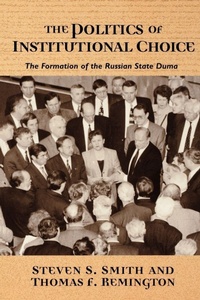
The Politics of Institutional Choice
The Formation of the Russian State Duma
Published on 10. December 2000
Book
Paperback/Softback
176 pages
978-0-691-05737-8 (ISBN)
Description
Events in Russia since the late 1980s have created a rare opportunity to watch the birth of democratic institutions close at hand. Here Steven Smith and Thomas Remington provide the first intensive, theoretically grounded examination of the early development of the State Duma, the lower house of the Russian Federation's parliament created by the 1993 constitution. They offer an integrated account of the choices made by the newly elected members of the Duma in establishing basic operating arrangements: an agenda-setting governing body, a standing committee system, an electoral law, and a party system. Not only do these decisions promise to have lasting consequences for the post-communist Russian regime, but they also enable the authors to test assumptions about politicians' goals from the standpoint of institutional theory. Smith and Remington challenge in particular the notion, derived from American contexts, that politicians pursue a single, overarching goal in the creation of institutions. They argue that politicians have multiple political goals--career, policy, and partisan--that drive their choices.
Among Duma members, the authors detect many cross currents of interests, generated by the mixed electoral system, which combines both single-member districts and proportional representation, and by sharp policy divisions and an emerging party system. Elected officials may shift from concentrating on one goal to emphasizing another, but political contexts can help determine their behavior. This book brings a fresh perspective to numerous theories by incorporating first-hand accounts of major institutional choices and placing developments in their actual context.
Among Duma members, the authors detect many cross currents of interests, generated by the mixed electoral system, which combines both single-member districts and proportional representation, and by sharp policy divisions and an emerging party system. Elected officials may shift from concentrating on one goal to emphasizing another, but political contexts can help determine their behavior. This book brings a fresh perspective to numerous theories by incorporating first-hand accounts of major institutional choices and placing developments in their actual context.
Reviews / Votes
"A model of theoretically sophisticated, judiciously written and rigorously executed comparative political science."--M. Steven Fish, Slavic Review "A major addition to our understanding both of how institutions came to be formed as they were in Russia and how they are functioning."--Karen Dawisha, Journal of Politics "This book will undoubtedly prove to be indispensable reading for any serious student of post-Soviet Russian politics."--John T. Ishiyana, International PoliticsMore details
Language
English
Place of publication
New Jersey
United States
Target group
Professional and scholarly
College/higher education
Product notice
Paperback (trade)
Dimensions
Height: 234 mm
Width: 156 mm
Thickness: 11 mm
Weight
304 gr
ISBN-13
978-0-691-05737-8 (9780691057378)
Copyright in bibliographic data and cover images is held by Nielsen Book Services Limited or by the publishers or by their respective licensors: all rights reserved.
Schweitzer Classification
Other editions
Additional editions
Steven S. Smith | Thomas F. Remington
The Politics of Institutional Choice
The Formation of the Russian State Duma
E-Book
11/2000
1st Edition
Princeton University Press
€171.95
Available for download
Persons
Steven S. Smith is a McKnight University Distinguished Professor of Political Science and Law at the University of Minnesota. He is the author of The American Congress and Call to Order: Floor Politics in the House and Senate. He has coauthored Committees in Congress, Managing Uncertainty in the House of Representatives, and Politics or Principle? Filibustering in the United States Senate.
Thomas F. Remington is Claus M. Halle Distinguished Professor for Global Learning at Emory University. His books include Politics in Russia, Parliaments in Transition, The Truth of Authority: Ideology and Communication in the Soviet Union, and Building Socialism in Bolshevik Russia.
Thomas F. Remington is Claus M. Halle Distinguished Professor for Global Learning at Emory University. His books include Politics in Russia, Parliaments in Transition, The Truth of Authority: Ideology and Communication in the Soviet Union, and Building Socialism in Bolshevik Russia.
Content
List of Illustrations vi List of Tables vii Preface ix List of Abbreviations xi ONE: Choosing legislative Institutions in Russia 3 TWO: Forming a Parliamentary Party System 27 THREE: Creating the Council of the Duma 54 FOUR: Setting a Framework for Party-Committee Relations 72 FIVE: Choosing an Electoral System 93 SIX: Party Discipline in the Russian Duma 116 SEVEN: Institutional Choice 137 Appendix on Data and Methods 161 References 169 Index 177