

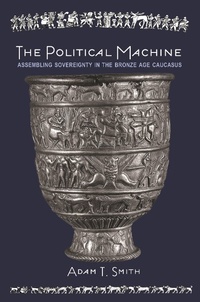
The Political Machine
Assembling Sovereignty in the Bronze Age Caucasus
Published on 7. July 2015
Book
Hardback
264 pages
978-0-691-16323-9 (ISBN)
Description
The Political Machine investigates the essential role that material culture plays in the practices and maintenance of political sovereignty. Through an archaeological exploration of the Bronze Age Caucasus, Adam Smith demonstrates that beyond assemblies of people, polities are just as importantly assemblages of things--from ballots and bullets to crowns, regalia, and licenses. Smith looks at the ways that these assemblages help to forge cohesive publics, separate sovereigns from a wider social mass, and formalize governance--and he considers how these developments continue to shape politics today. Smith shows that the formation of polities is as much about the process of manufacturing assemblages as it is about disciplining subjects, and that these material objects or "machines" sustain communities, orders, and institutions. The sensibilities, senses, and sentiments connecting people to things enabled political authority during the Bronze Age and fortify political power even in the contemporary world.
Smith provides a detailed account of the transformation of communities in the Caucasus, from small-scale early Bronze Age villages committed to egalitarianism, to Late Bronze Age polities predicated on radical inequality, organized violence, and a centralized apparatus of rule. From Bronze Age traditions of mortuary ritual and divination to current controversies over flag pins and Predator drones, The Political Machine sheds new light on how material goods authorize and defend political order.
Smith provides a detailed account of the transformation of communities in the Caucasus, from small-scale early Bronze Age villages committed to egalitarianism, to Late Bronze Age polities predicated on radical inequality, organized violence, and a centralized apparatus of rule. From Bronze Age traditions of mortuary ritual and divination to current controversies over flag pins and Predator drones, The Political Machine sheds new light on how material goods authorize and defend political order.
Reviews / Votes
"The coherence and brevity of the book reflects its development from the 2013 Rostovtzeff Lecture Series at New York University. The book can be read quickly, and its significance for evolutionary studies can be assimilated thoughtfully. It deserves to be read broadly by academics, graduate students and an interested public."--Timothy Earle, Antiquity "I most strongly recommend this as a book with which to argue, for all interested in the newest forms of theory concerning politics and objects, as well as anyone examining ancient Eurasian cultural forms and connections."--Chris Gosden, American Anthropologist "The Political Machine surely succeeds in bringing the political back into the mainstream of archaeological theory. Smith's provocative work will be studied by all interested in ontology and the epistemology of things, and by archaeological theorists."--Geoffrey D. Summers, Bryn Mawr Classical ReviewMore details
Series
Language
English
Place of publication
New Jersey
United States
Target group
College/higher education
Professional and scholarly
Product notice
Trade binding
Illustrations
9 Maps
Dimensions
Height: 239 mm
Width: 155 mm
Thickness: 28 mm
Weight
567 gr
ISBN-13
978-0-691-16323-9 (9780691163239)
Copyright in bibliographic data and cover images is held by Nielsen Book Services Limited or by the publishers or by their respective licensors: all rights reserved.
Schweitzer Classification
Other editions
Additional editions
E-Book
07/2015
1st Edition
Princeton University Press
from
€133.95
Available for download
Person
Adam T. Smith is professor of anthropology and chair of the Department of Anthropology at Cornell University. He is the author of The Political Landscape and the coauthor of The Archaeology and Geography of Ancient Transcaucasian Societies, Volume 1.
Content
Preface ix Introduction: Reverse Engineering the Polity 1 The Conditions of Sovereignty 4 Machine Politics 7 Bodies and Things 11 Into the Caucasus 16 Schematic 20 Part I: The Machinery of Sovereignty Chapter 1. On Assemblages and Machines 27 Things and Objects 29 The Exile of Things 33 Nature Morte 40 The Assemblage Assembled 43 The Efficacy of Machines 48 Sense, Sensibility, and Sentiment 54 Chapter 2. On The Matter of Sovereignty 59 Sovereignty Disassembled 61 Prehistory and the Political 64 Archaeologies of Sovereignty 67 Assembly and Assemblage 72 Origin Myths 73 Wayward Things and the Dual Sovereign 78 Exit Objects 1: Liberal Theory and Things 81 Exit Objects 2: Marx and Matter 83 Sovereign Matter, Governmental Machines 86 The Sovereign Conditions 91 Part II: Assembling Sovereignty Chapter 3. The Civilization Machine in the Early Bronze Age 97 The Kura-Araxes 102 Sensibility 105 Sense 110 Sentiment 122 An Early Bronze Age Public 125 Chapter 4. The War Machine in the Middle Bronze Age 127 The Caucasus in Transition 130 Sensibility 138 Sense 144 Sentiment 148 Territorialization and Contradiction 151 Chapter 5. The Political Machine in the Late Bronze Age 154 The Caucasus at the Beginning of the Late Bronze Age 157 Sensibility 165 Sense 171 Sentiment 178 The Enduring Political Machine 183 Conclusion 186 Erebuni-Yerevan 188 Brother Axe 194 References Cited 197 Index 233