

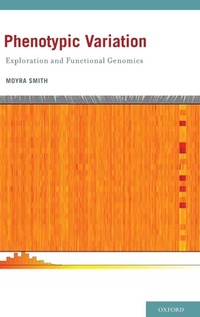
Phenotypic Variation
Exploration and Functional Genomics
Published on 3. February 2011
Book
Hardback
252 pages
978-0-19-537963-1 (ISBN)
Description
During the past two decades international collaborative studies have yielded extensive information on genome sequences, genome architecture and their variations. The challenge we now face is to understand how these variations impact structure and function of organelles, physiological systems and phenotype. The goal of this book is to present steps in the pathways of exploration to connect genotype to phenotype and to consider how alterations in genomes impact disease.
In this book the author reviews published research in functional genomics carried out primarily since 2006 that sheds light on aspects of phenotypic variation. The goal of functional genomics is to gain insight into mechanisms through which specific changes in genome transcripts and regulation induce changes in proteins, pathways, organelles, cellular and tissue functions, morphology and ultimately in phenotype.
Topics reviewed include investigations in genome architecture, gene structure, gene regulation epigenetic modifications and function of organelles including mitochondria, and the endosome lysosome system. New insights into neurodevelopment and neurobehavioral disorders gained through functional genomic research are presented. Aspects of genomic studies in complex common diseases are reviewed. Molecular genetic variations and aberrations in cellular mechanisms involved in protein quality surveillance play a role in late onset diseases and one chapter deals with this topic. Molecular analyses of genes and proteins continue to shed light on the pathogenesis of malformation syndromes and specific examples of such studies are presented.
There is growing evidence that late onset disorders such as Parkinson disease, are frequently the end result of defects in functioning of components in different pathways and examples of these are discussed. There is evidence that genetic variation determines differences in response to environmental insults. Genetic variations in complement factor genes are an example of this and are discussed in the context of macular degeneration and pathogenesis of hemolytic uremic syndrome in response exposure to E coli Shiga toxin. In the final chapter the author briefly summarizes key features of the cascade of events that constitute functional genomics.
In this book the author reviews published research in functional genomics carried out primarily since 2006 that sheds light on aspects of phenotypic variation. The goal of functional genomics is to gain insight into mechanisms through which specific changes in genome transcripts and regulation induce changes in proteins, pathways, organelles, cellular and tissue functions, morphology and ultimately in phenotype.
Topics reviewed include investigations in genome architecture, gene structure, gene regulation epigenetic modifications and function of organelles including mitochondria, and the endosome lysosome system. New insights into neurodevelopment and neurobehavioral disorders gained through functional genomic research are presented. Aspects of genomic studies in complex common diseases are reviewed. Molecular genetic variations and aberrations in cellular mechanisms involved in protein quality surveillance play a role in late onset diseases and one chapter deals with this topic. Molecular analyses of genes and proteins continue to shed light on the pathogenesis of malformation syndromes and specific examples of such studies are presented.
There is growing evidence that late onset disorders such as Parkinson disease, are frequently the end result of defects in functioning of components in different pathways and examples of these are discussed. There is evidence that genetic variation determines differences in response to environmental insults. Genetic variations in complement factor genes are an example of this and are discussed in the context of macular degeneration and pathogenesis of hemolytic uremic syndrome in response exposure to E coli Shiga toxin. In the final chapter the author briefly summarizes key features of the cascade of events that constitute functional genomics.
Reviews / Votes
"Painstakingly curates an impressive swath of very serious science published in [Smith's] field of functional genomics up until 2009, and is modest in its claims about how we can currently apply the findings to medicine." -- European Journal of Human GeneticsMore details
Language
English
Place of publication
New York
United States
Target group
Professional and scholarly
Illustrations
16 illustrations
Dimensions
Height: 240 mm
Width: 161 mm
Thickness: 18 mm
Weight
552 gr
ISBN-13
978-0-19-537963-1 (9780195379631)
Copyright in bibliographic data and cover images is held by Nielsen Book Services Limited or by the publishers or by their respective licensors: all rights reserved.
Schweitzer Classification
Other editions
Additional editions
E-Book
01/2011
1st Edition
OUP eBook
€60.49
Available for download
Person
Moyra Smith, MD, PhD, has been conducting research in human genetics since 1965. She served as Clinical geneticist and Director of the Newborn screening Program at the University of California Irvine for 19 years and is currently Professor Emeritus at that institution. Her latest research includes studies of nuclear and mitochondrial genomics in autism
Content
Table of Contents
Chapter 1. Phenotype and Functional Genomics: Introduction
Chapter 2. Evolution
Chapter 3. Genomic architecture and copy number changes
Chapter 4. Linkage, association and linkage disequilibrium
Chapter 5. Regulation of transcription, splicing and translation: impact of perturbation on phenotype
Chapter 6. Mitochondria: genome, functions and phenotype
Chapter 7. Quality surveillance
Chapter 8. Neurodevelopment and functional genomics
Chapter 9. Neurobehavioral disorders
Chapter 10. Molecular analyses of malformation syndromes
Chapter 11. Multiple pathways including environmental factors that lead to a specific phenotype with later onset
Epilogue
Chapter 1. Phenotype and Functional Genomics: Introduction
Chapter 2. Evolution
Chapter 3. Genomic architecture and copy number changes
Chapter 4. Linkage, association and linkage disequilibrium
Chapter 5. Regulation of transcription, splicing and translation: impact of perturbation on phenotype
Chapter 6. Mitochondria: genome, functions and phenotype
Chapter 7. Quality surveillance
Chapter 8. Neurodevelopment and functional genomics
Chapter 9. Neurobehavioral disorders
Chapter 10. Molecular analyses of malformation syndromes
Chapter 11. Multiple pathways including environmental factors that lead to a specific phenotype with later onset
Epilogue