

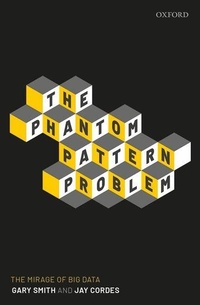
The Phantom Pattern Problem
The Mirage of Big Data
Published on 24. September 2020
Book
Hardback
240 pages
978-0-19-886416-5 (ISBN)
Description
Pattern-recognition prowess served our ancestors well, but today we are confronted by a deluge of data that is far more abstract, complicated, and difficult to interpret. The number of possible patterns that can be identified relative to the number that are genuinely useful has grown exponentially - which means that the chances that a discovered pattern is useful is rapidly approaching zero.
Patterns in data are often used as evidence, but how can you tell if that evidence is worth believing? We are hard-wired to notice patterns and to think that the patterns we notice are meaningful. Streaks, clusters, and correlations are the norm, not the exception. Our challenge is to overcome our inherited inclination to think that all patterns are significant, as in this age of Big Data patterns are inevitable and usually coincidental.
Through countless examples, The Phantom Pattern Problem is an engaging read that helps us avoid being duped by data, tricked into worthless investing strategies, or scared out of getting vaccinations.
Patterns in data are often used as evidence, but how can you tell if that evidence is worth believing? We are hard-wired to notice patterns and to think that the patterns we notice are meaningful. Streaks, clusters, and correlations are the norm, not the exception. Our challenge is to overcome our inherited inclination to think that all patterns are significant, as in this age of Big Data patterns are inevitable and usually coincidental.
Through countless examples, The Phantom Pattern Problem is an engaging read that helps us avoid being duped by data, tricked into worthless investing strategies, or scared out of getting vaccinations.
Reviews / Votes
...a worthwhile and enjoyable read, and so I happily recommend the book to anyone interested in the epistemological issues raised by Big Data. * Frank Cabrera, Metascience *More details
Edition
1
Language
English
Place of publication
Oxford
United Kingdom
Target group
Professional and scholarly
Product notice
sewn/stitched
Cloth over boards
Dimensions
Height: 200 mm
Width: 133 mm
Thickness: 19 mm
Weight
382 gr
ISBN-13
978-0-19-886416-5 (9780198864165)
Copyright in bibliographic data and cover images is held by Nielsen Book Services Limited or by the publishers or by their respective licensors: all rights reserved.
Schweitzer Classification
Other editions
Additional editions
E-Book
09/2020
1st Edition
OUP eBook
€27.49
Available for download
E-Book
09/2020
1st Edition
OUP eBook
€27.49
Available for download
Persons
Gary Smith is the Fletcher Jones Professor of Economics at Pomona College. Gary Smith is the Fletcher Jones Professor of Economics at Pomona College. He received his Ph.D. in Economics from Yale University and was an Assistant Professor there for seven years. He has won two teaching awards and written more than eighty academic papers and thirteen books.
Jay Cordes is a data scientist who enjoys tackling challenging problems, including how to guide future data scientists away from the common pitfalls he saw in the corporate world. He earned a Math degree from Pomona College and more recently graduated from UC Berkeley's Master of Information and Data Science (MIDS) program.
Jay Cordes is a data scientist who enjoys tackling challenging problems, including how to guide future data scientists away from the common pitfalls he saw in the corporate world. He earned a Math degree from Pomona College and more recently graduated from UC Berkeley's Master of Information and Data Science (MIDS) program.
Content
1: Survival of the Sweaty Patter-Processors
2: Predicting What is Predictable
3: Duped and Deceived
4: Fooled Again and Again
5: The Paradox of Big Data
6: Fruitless Searches
7: The Reproducibility Crisis
8: Who Stepped In It?
9: Seeing Things for What They Are
2: Predicting What is Predictable
3: Duped and Deceived
4: Fooled Again and Again
5: The Paradox of Big Data
6: Fruitless Searches
7: The Reproducibility Crisis
8: Who Stepped In It?
9: Seeing Things for What They Are