

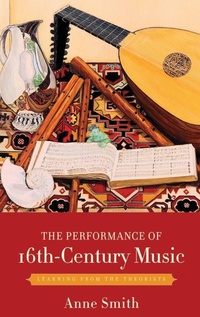
The Performance of 16th-Century Music
Learning from the Theorists
Published on 14. April 2011
Book
Hardback
256 pages
978-0-19-974262-2 (ISBN)
Description
Modern musical training tends to focus primarily on performance practices of the Classical and Romantic periods, and most performers come to the music of the Renaissance with well-honed but anachronistic ideas and concepts. As a result, elemental differences between 16th-century repertoire and that of later epochs tend to be overlooked-yet it is just these differences which can make a performance truly stunning.
The Performance of 16th-Century Music offers a remedy for the performer, presenting the information and guidance that will enable them to better understand the music and advance their technical and expressive abilities. Drawing from nearly 40 years of performing, teaching, and studying this repertoire and its theoretical sources, renowned early music specialist Anne Smith outlines several major areas of technical knowledge and skill needed to perform the music of this period. She takes the reader through part-books and choirbooks; solmization; rhythmic inequality; and elements of structure in relation to rhetoric of the time; while familiarizing them with contemporary criteria and standards of excellence for performance. Through The Performance of 16th-Century Music, today's musicians will gain fundamental insight into how 16th-century polyphony functions, and the tools necessary to perform this repertoire to its fullest and glorious potential.
The Performance of 16th-Century Music offers a remedy for the performer, presenting the information and guidance that will enable them to better understand the music and advance their technical and expressive abilities. Drawing from nearly 40 years of performing, teaching, and studying this repertoire and its theoretical sources, renowned early music specialist Anne Smith outlines several major areas of technical knowledge and skill needed to perform the music of this period. She takes the reader through part-books and choirbooks; solmization; rhythmic inequality; and elements of structure in relation to rhetoric of the time; while familiarizing them with contemporary criteria and standards of excellence for performance. Through The Performance of 16th-Century Music, today's musicians will gain fundamental insight into how 16th-century polyphony functions, and the tools necessary to perform this repertoire to its fullest and glorious potential.
Reviews / Votes
an engaging and useful study. * Richard Wistreich, Early Music * Ann Smith ... does an immense service to performers, and especially to students, not only by bringing relevant quotations together, but also by contextualizing them without in any other way over-simplifying their ambiguities. ...we should expect nothing less of someone who has devoted her working life to developing and imparting such understanding. * Richard Wistreich, Early Music *More details
Language
English
Place of publication
New York
United States
Target group
Professional and scholarly
Illustrations
4 music examples, 8 halftones, 96 line illustrations
Dimensions
Height: 240 mm
Width: 161 mm
Thickness: 19 mm
Weight
555 gr
ISBN-13
978-0-19-974262-2 (9780199742622)
Copyright in bibliographic data and cover images is held by Nielsen Book Services Limited or by the publishers or by their respective licensors: all rights reserved.
Schweitzer Classification
Other editions
Additional editions
Book
04/2011
Oxford University Press Inc
€63.40
Shipment within 15-20 days
E-Book
03/2011
1st Edition
OUP eBook
€29.49
Available for download
E-Book
03/2011
1st Edition
OUP eBook
€29.49
Available for download
Person
For almost forty years, 16th-century music - particularly on renaissance flutes - has been one of Anne Smith's central interests. She has spent most of that time at the Schola Cantorum Basiliensis in Basel, which provides an ideal environment for live research on historical performance practice.
Content
ABOUT THE COMPANION WEB SITE; PREFACE; APPENDIX: MODAL CHARACTERISTICS; BIBLIOGRAPHY; INDEX