

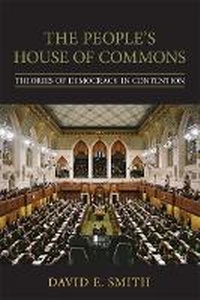
The People's House of Commons
Theories of Democracy in Contention
Published on 21. April 2007
Book
Paperback/Softback
192 pages
978-0-8020-9465-0 (ISBN)
Description
Canada's House of Commons has come under considerable attack in recent years. Many critics have contended that the House has been unresponsive to public opinion, and that its party leaders have too much control, while leaving individual MPs essentially powerless. The House has also faced challenges by the courts since the introduction of the Charter, a powerful bureaucracy equipped with specialized knowledge, and new telecommunications systems that are redefining the transfer of information.
Through an examination of academic, judicial, political, and legal commentary, The People's House of Commons explores the role of the House as a public institution. While addressing much of the criticism that has been levelled at the House, David E. Smith considers the competing political models and inherent tensions and their affect on public understanding. Smith maintains that court decisions are transforming the political system from one dominated by parties to one that promotes individual participation. He argues that reforms such as fixed election dates or stronger parliamentary committees have constitutional significance since their implementation would alter the practice of responsible government, which for more than a century has been a party government.
A definitive work by one of Canada's foremost experts in the field of political science, The People's House of Commons explores the ramifications of many of the changes currently being proposed to Canada's political system, with particular reference to their affect on prerogative power, parliamentary privilege, party discipline, bicameralism, and the role of the opposition.
Through an examination of academic, judicial, political, and legal commentary, The People's House of Commons explores the role of the House as a public institution. While addressing much of the criticism that has been levelled at the House, David E. Smith considers the competing political models and inherent tensions and their affect on public understanding. Smith maintains that court decisions are transforming the political system from one dominated by parties to one that promotes individual participation. He argues that reforms such as fixed election dates or stronger parliamentary committees have constitutional significance since their implementation would alter the practice of responsible government, which for more than a century has been a party government.
A definitive work by one of Canada's foremost experts in the field of political science, The People's House of Commons explores the ramifications of many of the changes currently being proposed to Canada's political system, with particular reference to their affect on prerogative power, parliamentary privilege, party discipline, bicameralism, and the role of the opposition.
More details
Language
English
Place of publication
Toronto
Canada
Target group
College/higher education
Product notice
Paperback (trade)
Dimensions
Height: 229 mm
Width: 152 mm
Thickness: 14 mm
Weight
360 gr
ISBN-13
978-0-8020-9465-0 (9780802094650)
Copyright in bibliographic data and cover images is held by Nielsen Book Services Limited or by the publishers or by their respective licensors: all rights reserved.
Schweitzer Classification
Person
David E. Smith is adjunct faculty in the Department of Politics and Public Administration and a member of the Yeates School of Graduate Studies at Ryerson University.
Content
Preface The State of the Commons Parliamentary Democracy Constitutional Democracy Electoral Democracy What Is the House? Who Are the People? The People's House of Commons and Its StudyConclusionNotes Bibliography Index