

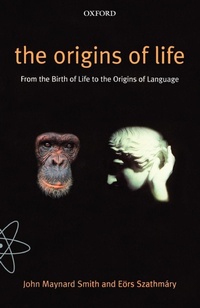
Origins of Life
From the Birth of Life to the Origin of Language
Published on 16. March 2000
Book
Paperback/Softback
192 pages
978-0-19-286209-9 (ISBN)
Description
Living organisms are astonishingly complex. And the more we know about them - their biochemistry, their anatomy, their behaviour - the more astonishing are the detailed adaptations that we discover. How could this complexity have arisen?
Most of us are familiar with Darwin's theory of evolution by natural selection. The idea behind it being that, in nature, those individuals best able to survive and reproduce will transmit the characteristics that enabled them to do so to their offspring, leading to the evolution of traits beneficial to the organism. Although Darwin's idea is simple - perhaps because it is so simple - it is hard to believe that it is able to explain the complexity of the living world. We can breed cows that produce more milk compared with earlier generations, say, but we cannot breed pigs that fly, or horses that can talk: there would be no promising variants that we could select and breed from. Where, then, does the variation come from that has made possible the evolution of ever-increasing complexity in the wonderfully adapted organisms we see around us? In answering this central question, John Maynard Smith and Eors Szathmary present for a general readership a novel picture of evolution. Their basic idea is that evolution depends on changes in the information that is passed between generations, and that there have been a number of 'major transitions' in the way that information is stored and transmitted. These transitions include the appearance of the first replicating molecules - the origin of life itself; the origin of cells; reproduction by sexual means; the appearance of multicellular plants and animals; the emergence of cooperation and of animal societies; and the unique language ability of humans.
Here, then, is an accessible account of contemporary biology on the grandest scale, from the birth of life to the origin of language. Containing many original ideas, and covering many of the most fundamental ideas in biology, this important and deeply interesting book will appeal both to readers with little prior knowledge of science and to biologists themselves.
Most of us are familiar with Darwin's theory of evolution by natural selection. The idea behind it being that, in nature, those individuals best able to survive and reproduce will transmit the characteristics that enabled them to do so to their offspring, leading to the evolution of traits beneficial to the organism. Although Darwin's idea is simple - perhaps because it is so simple - it is hard to believe that it is able to explain the complexity of the living world. We can breed cows that produce more milk compared with earlier generations, say, but we cannot breed pigs that fly, or horses that can talk: there would be no promising variants that we could select and breed from. Where, then, does the variation come from that has made possible the evolution of ever-increasing complexity in the wonderfully adapted organisms we see around us? In answering this central question, John Maynard Smith and Eors Szathmary present for a general readership a novel picture of evolution. Their basic idea is that evolution depends on changes in the information that is passed between generations, and that there have been a number of 'major transitions' in the way that information is stored and transmitted. These transitions include the appearance of the first replicating molecules - the origin of life itself; the origin of cells; reproduction by sexual means; the appearance of multicellular plants and animals; the emergence of cooperation and of animal societies; and the unique language ability of humans.
Here, then, is an accessible account of contemporary biology on the grandest scale, from the birth of life to the origin of language. Containing many original ideas, and covering many of the most fundamental ideas in biology, this important and deeply interesting book will appeal both to readers with little prior knowledge of science and to biologists themselves.
Reviews / Votes
I can recommend this book as a thoroughly interesting read * Biologist 01/02/2002 * exhilarating reading ... challenging ... stimulates the reader to think deeply on the many issues it raises. * Margaret Ginzburg, Science and Christian belief, Vol.13, No.1, April 2001 * ...the authors provide a clear-eyed review of a large part of modern biology. * Scientific American * ...the book is well written, stimulating, and full of information nuggets. * Choice *More details
Language
English
Place of publication
Oxford
United Kingdom
Target group
College/higher education
Professional and scholarly
Illustrations
line illustrations
Dimensions
Height: 198 mm
Width: 129 mm
Thickness: 11 mm
Weight
211 gr
ISBN-13
978-0-19-286209-9 (9780192862099)
Copyright in bibliographic data and cover images is held by Nielsen Book Services Limited or by the publishers or by their respective licensors: all rights reserved.
Schweitzer Classification
Other editions
Additional editions
E-Book
03/2000
1st Edition
OUP eBook
€18.49
Available for download
E-Book
03/2000
1st Edition
OUP eBook
€18.49
Available for download
Persons
John Maynard Smith is Professor in the School of Biological Sciences at the University of Sussex. Eors Szathmary is Professor in the Collegium Bupapest.
Content
PREFACE; 1. LIFE AND INFORMATION; 2. THE MAJOR TRANSITIONS; 3. FROM CHEMISTRY TO HEREDITY; 4. FROM THE RNA WORLD TO THE MODERN WORLD; 5. FROM HEREDITY TO SIMPLE CELLS; 6. THE ORIGIN OF EUKARYOTIC CELLS; 7. THE ORIGIN OF SEX; 8. GENETIC CONFLICT; 9. LIVING TOGETHER; 10. THE EVOLUTION OF MANY-CELLED ORGANISMS; 11. ANIMAL SOCIETIES; 12. FROM ANIMAL TO HUMAN SOCIETIES; 13. THE ORIGIN OF LANGUAGE; GLOSSARY; NOTES; FURTHER READING; INDEX