

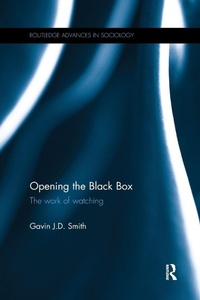
Opening the Black Box
The Work of Watching
1st Edition
Published on 1. June 2016
Book
Paperback/Softback
184 pages
978-1-138-20004-3 (ISBN)
Description
Closed Circuit Television (CCTV) cameras are a prominent, if increasingly familiar, feature of urbanism. They symbolize the faith that spatial authorities place in technical interventions for the treatment of social problems. CCTV was principally introduced to sterilize municipalities, to govern conducts and to protect properties. Vast expenditure has been committed to these technologies without a clear sense of how precisely they influence things. CCTV cameras might appear inanimate, but Opening the Black Box shows them to be vital mediums within relational circulations of supervision.
The book principally excavates the social relations entwining the everyday application of CCTV. It takes the reader on a journey from living beneath the camera, to working behind the lens. Attention focuses on the labour exerted by camera operators as they source and process distanced spectacles. These workers are paid to scan monitor screens in search of disorderly vistas, visualizing stimuli according to its perceived riskiness and/or allurement. But the projection of this gaze can draw an unsettling reflection. It can mean enduring behavioural extremities as an impotent witness. It can also entail making spontaneous decisions that determine the course of justice.
Opening the Black Box, therefore, contemplates the seductive and traumatic dimensions of monitoring telemediated 'riskscapes' through the prism of camera circuitry. It probes the positioning of camera operators as 'vicarious' custodians of a precarious social order and engages their subjective experiences. It reveals the work of watching to be an ambiguous practice: as much about managing external disturbances on the street as managing internal disruptions in the self.
The book principally excavates the social relations entwining the everyday application of CCTV. It takes the reader on a journey from living beneath the camera, to working behind the lens. Attention focuses on the labour exerted by camera operators as they source and process distanced spectacles. These workers are paid to scan monitor screens in search of disorderly vistas, visualizing stimuli according to its perceived riskiness and/or allurement. But the projection of this gaze can draw an unsettling reflection. It can mean enduring behavioural extremities as an impotent witness. It can also entail making spontaneous decisions that determine the course of justice.
Opening the Black Box, therefore, contemplates the seductive and traumatic dimensions of monitoring telemediated 'riskscapes' through the prism of camera circuitry. It probes the positioning of camera operators as 'vicarious' custodians of a precarious social order and engages their subjective experiences. It reveals the work of watching to be an ambiguous practice: as much about managing external disturbances on the street as managing internal disruptions in the self.
Reviews / Votes
"As the role of watching and collection of personal data is increasingly devolved to wide-range of actors, it is important to understand how this monitoring may be shaped by existing social positions. Why, for example, do some surveillance agents become 'crime fighters' or 'sympathisers' or 'whistleblowers'? Opening the Black Box has raised these questions and in doing so the author has made a significant and enduring contribution to the field. The book will become essential reading for those interested in surveillance studies, criminology, urban studies, and organization studies."- Michael McCahill, University of Hull, Surveillance and Society"By challenging the way we understand CCTV, Gavin Smith is in effect opening up a field as important today as that opened up by the early critical analyses of police work in the late 1960s... It is the focus on the work of watching, in the end, that sets this book apart from a mass of more or less predictable analyses and commentaries on CCTV."- Pat O'Malley, University of Sydney, Australia, Theoretical Criminology
"Opening the Black Box is an excellent statement on the subjectivities of supervision work, with tantalising theoretical innovations present. It is written in a lively and imaginative fashion, with the reader skilfully led through what it is to be a CCTV worker." - Ashlin Lee, University of Tasmania in (2016), Journal of Sociology, pp. 610 - 612, 52 (3)
More details
Series
Language
English
Place of publication
London
United Kingdom
Publishing group
Taylor & Francis Ltd
Target group
College/higher education
Illustrations
1 s/w Abbildung, 1 s/w Zeichnung
1 Line drawings, black and white; 1 Illustrations, black and white
Dimensions
Height: 234 mm
Width: 156 mm
Thickness: 11 mm
Weight
319 gr
ISBN-13
978-1-138-20004-3 (9781138200043)
Copyright in bibliographic data and cover images is held by Nielsen Book Services Limited or by the publishers or by their respective licensors: all rights reserved.
Schweitzer Classification
Other editions
Additional editions
Book
10/2014
1st Edition
Routledge
€230.50
Shipment within 15-20 days
E-Book
10/2014
1st Edition
Routledge
€59.49
Available for download
E-Book
10/2014
1st Edition
Routledge
€59.49
Available for download
Person
Gavin J.D. Smith is a Senior Lecturer in Sociology at the Australian National University. He is the author of many reviews, book chapters, journal articles and media reports on the social impacts and implications of surveillance diffusion. His current research explicates the dynamic interplay between systems and subjects of surveillance, particularly the interpretive meanings people attribute to their visibility and the labour they invest in managing their ascribed `data-body'.
Content
Part I: Problematizing and Contextualizing Watching Practices 1. Towards Supervisory Circulations: Circuitry coordinates 2. Engaging Circuitries: Researching supervisory circulations Part II: Engaging the Means of Watching 3. Instigating Circuitries: Inception and reception 4. Construing Circuitries: Supervisory projection 5. Bearing Circuitries: Supervisory subjection 6. Sustaining Circuitries: Supervisory aberration