

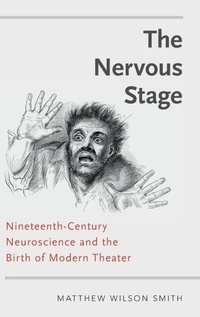
The Nervous Stage
Nineteenth-century Neuroscience and the Birth of Modern Theatre
Published on 16. November 2017
Book
Hardback
238 pages
978-0-19-064408-6 (ISBN)
Description
Nineteenth-century investigations into the nervous system produced extraordinary discoveries that changed ways of thinking far beyond the scientific community. Over the course of the century, scientists began to conceive of the subject not principally as soul, mind, or even brain, but instead as a complex of organically interacting mechanisms, many of them operating more or less autonomously and unconsciously. Meanwhile, theatrical works of the time by Shelley, Wagner, Dickens, Buchner, Zola, and Strindberg, sought to play directly on the nerves of the spectators through non-representational means, comprising a coherent genre Matthew Wilson Smith has dubbed the "theaters of sensation."
The Nervous Stage examines the relations between theatrical practices and the scientific study of the nervous system, arguing that to a significant degree, modern theater emerged out of the interaction between these two apparently disparate fields. In six chapters, The Nervous Stage makes three fundamental contributions to scholarship on comparative literature, specifically in the areas of drama/performance, cognitive literary studies, and the beginnings of global modernism. Through a series of revisionist readings of specific theatrical works and artists, Smith demonstrates that a number of literary texts were deeply engaged in dialogue with the neurological sciences of their period, and that an appreciation of this dialogue helps us better to understand their significance for their own historical period as well as for our own. Furthermore, it argues that a number of lesser-known works--ranging from certain "closet dramas" such as Shelley's The Cenci to popular melodramas such as Augustin Daly's Under the Gaslight--had much greater cultural significance than has been acknowledged heretofore.
The Nervous Stage examines the relations between theatrical practices and the scientific study of the nervous system, arguing that to a significant degree, modern theater emerged out of the interaction between these two apparently disparate fields. In six chapters, The Nervous Stage makes three fundamental contributions to scholarship on comparative literature, specifically in the areas of drama/performance, cognitive literary studies, and the beginnings of global modernism. Through a series of revisionist readings of specific theatrical works and artists, Smith demonstrates that a number of literary texts were deeply engaged in dialogue with the neurological sciences of their period, and that an appreciation of this dialogue helps us better to understand their significance for their own historical period as well as for our own. Furthermore, it argues that a number of lesser-known works--ranging from certain "closet dramas" such as Shelley's The Cenci to popular melodramas such as Augustin Daly's Under the Gaslight--had much greater cultural significance than has been acknowledged heretofore.
Reviews / Votes
The book's nuanced and profound exploration of how emerging neurophysiological ideas intertwined with performance both onstage and off makes this text essential reading to anyone interested in the medicalized subject or in the effect of neuroscience uponthe cultural history of Western Europe. * Mia Levenson, Theatre Journal * Smith's deep readings successfully portray what he sets out to show: the neural turn, one might call it, where nerves are seen as intrinsically theatrical and quintessentially modern. Exploring questions of agency and subjectivity, his book on theatre's centrality for interdisciplinary reflection features the theatre as nervous and nerves as theatrical (in the truest sense of the Greek theasthai: 'to behold'). The author's narrow neural focus as applied to a broad spectrum of materials is enlightening for interdisciplinary readers, and particularly intriguing for those interested in modern comparative literature and theatre studies. * Martina Kolb, Modern Language Review * This is a highly recommendable book, which will pique the interest not only of an eager band of nineteenth-century historians of science, but also of scholars throughout the humanities. * Marta Ferrer, The British Society for Literature and Science * Drawing especially on Nicholas Daly, Joseph Roach, Rae Beth Gordon, Stanton B. Garner, Jr., and Alan Richardson, Matthew Wilson Smith traces a trajectory through acting, melodrama, opera, naturalism, expressionism, and Artaudian theatre to argue that the nineteenth- century "theatre of sensation" [...] served as a template for modern performance. In The Nervous Stage, Smith uses six horizontal case studies to sketch an impressionistic narrative, offering some quite brilliant exegeses of his texts. The focus on depth over breadth means that Smith presents a theorization of what makes theatre modern, rather than a vertical history of modernist theatre [...] [A] significant contribution. * Modern Drama * ... given the prominence of the figures and theories discussed, Wilson Smith undeniably delivers what he sets out to do: a novel reading of theatre that stands in close relation to developments in the study of neuroscience. For me, he also offers a conception of neuroscience refreshed by its influence on us being not only via direct therapeutic innovations, but by complex, subtle and pervasive influences on our self-conception. * Matthew Broome, Times Higher Education * ... this brilliant study is destined to become a standard in the field. ... Summing Up: Highly recommended. Graduate students, researchers, faculty. * D. B. Wilmeth, CHOICE *More details
Language
English
Place of publication
New York
United States
Target group
College/higher education
Dimensions
Height: 240 mm
Width: 161 mm
Thickness: 17 mm
Weight
526 gr
ISBN-13
978-0-19-064408-6 (9780190644086)
Copyright in bibliographic data and cover images is held by Nielsen Book Services Limited or by the publishers or by their respective licensors: all rights reserved.
Schweitzer Classification
Other editions
Additional editions
Matthew Wilson Smith
The Nervous Stage
Nineteenth-century Neuroscience and the Birth of Modern Theatre
E-Book
10/2017
OUP eBook
€19.99
Available for download
Matthew Wilson Smith
The Nervous Stage
Nineteenth-century Neuroscience and the Birth of Modern Theatre
E-Book
10/2017
OUP eBook
€25.49
Available for download
Person
Matthew Wilson Smith is Associate Professor of German Studies and Theater & Performance Studies at Stanford University. He is the author of The Total Work of Art: From Bayreuth to Cyberspace (Routledge, 2007) and the editor of Georg Buechner: The Major Works (Norton, 2011)
Content
Introduction
Chapter 1: The Emptying of Gesture: Neurology and the British Romantic Stage
Chapter 2: From Gestures to Nerves: Woyzeck and the Barbel Fish
Chapter 3: The Nervous System: Melodrama, Railway Trauma, and Systemic Risk
Chapter 4: The Inner Drama of the Body: Wagner's Neural Aesthetics
Chapter 5: Theatre's Revenge: Charcot and the Grand Guignol
Chapter 6: The Prison-house of Nerves: Zola and Strindberg
Conclusion
Chapter 1: The Emptying of Gesture: Neurology and the British Romantic Stage
Chapter 2: From Gestures to Nerves: Woyzeck and the Barbel Fish
Chapter 3: The Nervous System: Melodrama, Railway Trauma, and Systemic Risk
Chapter 4: The Inner Drama of the Body: Wagner's Neural Aesthetics
Chapter 5: Theatre's Revenge: Charcot and the Grand Guignol
Chapter 6: The Prison-house of Nerves: Zola and Strindberg
Conclusion