

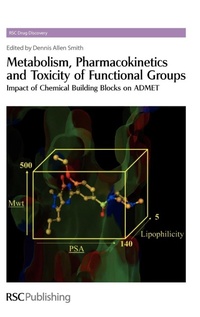
Metabolism, Pharmacokinetics and Toxicity of Functional Groups
Impact of Chemical Building Blocks on ADMET
Published on 9. April 2010
Book
Hardback
544 pages
978-1-84973-016-7 (ISBN)
Description
Until now, the area of drug metabolism and pharmacokinetics has been lacking in texts written for the Medicinal Chemist. This outstanding book, aimed at postgraduate medicinal chemists and those working in industry, fills this gap in the literature. Written by medicinal chemists and ADMET scientists with a combined experience of around 300 years, this aid to discovering drugs addresses the absorption, distribution, metabolism, excretion and toxicity (ADMET) issues associated with drugs. The book starts by describing drug targets and their structural motifs before moving on to explain ADMET for the medicinal chemist. It is the functional groups which most profoundly influence the drug molecules of which they form a part. They characterise the pharmacology, are essential to the activity, and alter the ADMET characteristics of each drug. Their effects follow a pattern, thus allowing medicinal chemists to predict and overcome potential challenges. For this reason, the Editors have taken the unique approach of dividing the remainder of the book into chapters which each focus on a different functional group. They describe drugs containing the functional group under consideration, explain why the group is there, and outline its physicochemical properties before going on to detail the ADMET issues. Where possible, prodrugs and bioisosteres, which may give alternative ADMET outcomes, are described. The chapters cross refer where similar matters are covered but individual chapters can be used in a stand alone manner. The book ends with a discussion of future targets and chemistry needs.
More details
Series
Language
English
Place of publication
Cambridge
United Kingdom
Target group
Professional and scholarly
Product notice
Unsewn / adhesive bound
Dimensions
Height: 243 mm
Width: 164 mm
Thickness: 35 mm
Weight
937 gr
ISBN-13
978-1-84973-016-7 (9781849730167)
Copyright in bibliographic data and cover images is held by Nielsen Book Services Limited or by the publishers or by their respective licensors: all rights reserved.
Schweitzer Classification
Other editions
Additional editions
Dennis A. Smith
Metabolism, Pharmacokinetics and Toxicity of Functional Groups
Impact of Chemical Building Blocks on ADMET
E-Book
04/2010
1st Edition
Royal Society of Chemistry
€201.99
Available for download
Complete work / Part of the work
Drug Discovery Series Set
2010-2014
Other
06/2015
Royal Society of Chemistry
€7,798.50
Article not available at the moment
Person
Professor Dennis Smith has worked in the pharmaceutical industry for 32 years after gaining his Ph.D from the University of Manchester. For 20 years he was at Pfizer Global Research and Development, Sandwich where he was Vice President-Pharmacokinetics, Dynamics and Metabolism. For the past 2 years he has been a Pfizer Academic Research Fellow working on a part-time basis. His research interests and publications span all aspects of Drug Discovery and Development particularly where drug metabolism knowledge can impact on the design of more efficacious and safer drugs. During this 30-year span he has helped in the Discovery and Development of eight marketed NCEs. He has authored over 100 publications including two books.
Content
Drug targets and their structural motifs;
ADMET for the medicinal chemist;
Carboxlic acids and their isosteres;
Primary, secondary and tertiary amines and isosteres;
Sulphonamide as an essential group;
1, 2 and 3 ring phenyl and heterocyclic cores;
Heterocycles and phenyls as essential pharmacophore groups;
Peptides and peptidomimetic cores;
Peptides and peptidomimetics as functional groups;
Transition state functions;
Alcohols and carbonyls;
Future targets and chemistry needs;
ADMET for the medicinal chemist;
Carboxlic acids and their isosteres;
Primary, secondary and tertiary amines and isosteres;
Sulphonamide as an essential group;
1, 2 and 3 ring phenyl and heterocyclic cores;
Heterocycles and phenyls as essential pharmacophore groups;
Peptides and peptidomimetic cores;
Peptides and peptidomimetics as functional groups;
Transition state functions;
Alcohols and carbonyls;
Future targets and chemistry needs;