

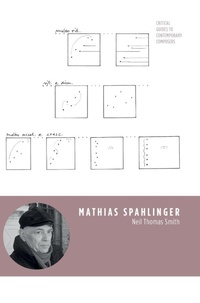
Mathias Spahlinger
Published on 26. April 2021
Book
Hardback
208 pages
978-1-78938-334-8 (ISBN)
Description
The first book-length study in English of composer Mathias Spahlinger, one of Germany's leading practitioners of contemporary music. One of the most stimulating and provocative figures on the new music scene on Germany, he has long been a touchstone for leftist, 'critical' composition there, yet his work has received very little attention in Anglophone scholarship until now.
Born in 1944, Spahlinger has risen only gradually to prominence in his native Germany and for many years was considered an outsider within the contemporary music scene. Yet, his position as one of the most venerable exponents of post-WWII modernism in his homeland is now undeniable: his music is regularly performed, he has received commissions from many of the major orchestras and new music groups in Germany, and in 2014 he received the Grossen Berliner Kunstpreis (Berlin Art Prize - Grand Prize) from the city's Akademie der Kuenste (Academy of Arts).
Spahlinger is, however, becoming increasingly known as a significant figure within later twentieth-century music - in 2015, a festival in Chicago focused exclusively on his music, and he was a keynote speaker at a conference on Compositional Aesthetics and the Political at Goldsmiths, University of London.
This new book provides an essential reference for scholars of new music and twentieth-century modernism. There are no other book-length studies of Spahlinger in English, though there is a monograph and a book of essays in German, and books of interviews. This original work promises a more critical perspective upon the composer and his aesthetics and political ideas compared to previous publications. The illustrations include musical examples.
Its primary market will be a specialist musicological readership, including academics, researchers and composers, but the writing style such that it could be accessible also to undergraduates interested in the field. The discussion of aesthetic debates in post-war Germany, and the interesting reading of the work of Jacques Ranciere, means that it could also have significant appeal across the disciplines of philosophy and critical theory.
Born in 1944, Spahlinger has risen only gradually to prominence in his native Germany and for many years was considered an outsider within the contemporary music scene. Yet, his position as one of the most venerable exponents of post-WWII modernism in his homeland is now undeniable: his music is regularly performed, he has received commissions from many of the major orchestras and new music groups in Germany, and in 2014 he received the Grossen Berliner Kunstpreis (Berlin Art Prize - Grand Prize) from the city's Akademie der Kuenste (Academy of Arts).
Spahlinger is, however, becoming increasingly known as a significant figure within later twentieth-century music - in 2015, a festival in Chicago focused exclusively on his music, and he was a keynote speaker at a conference on Compositional Aesthetics and the Political at Goldsmiths, University of London.
This new book provides an essential reference for scholars of new music and twentieth-century modernism. There are no other book-length studies of Spahlinger in English, though there is a monograph and a book of essays in German, and books of interviews. This original work promises a more critical perspective upon the composer and his aesthetics and political ideas compared to previous publications. The illustrations include musical examples.
Its primary market will be a specialist musicological readership, including academics, researchers and composers, but the writing style such that it could be accessible also to undergraduates interested in the field. The discussion of aesthetic debates in post-war Germany, and the interesting reading of the work of Jacques Ranciere, means that it could also have significant appeal across the disciplines of philosophy and critical theory.
Reviews / Votes
'While on the one hand, Neil Thomas Smith succeeds in filling up a void in academic literature on Spahlinger in English, his writing exceeds that purpose by bringing Spahlinger's work into a general cultural and political context.[...] What is perhaps the most remarkable aspect of Smith's book is the detailed analysis of many notable works of Spahlinger, which generations of composers will find very useful after listening to the music. On the whole therefore, this very enlightening book illustrates how one of the most influential composers at the dawn of the 21st century put thought and sound into the wholeness of his unique works that continue to intrigue the global artistic community.' -- Jonas Baes, Popular Music 'Smith's book is a valuable contribution to contemporary music scholarship and to the debates around modernism and political aesthetics, particularly in the UK, where such things are far less frequently discussed.The main strength of Smith's book is its much needed overview of Spahlinger's works and aesthetic. Smith divides this into four principal themes - musique concrete instrumentale, order, open form and perception - within each of which he analyses and provides critical commentary upon representative compositions. [...] Smith writes concisely and perceptively about the music and its themes.' -- Tim Rutherford-Johnson, Tempo
More details
Series
Language
English
Place of publication
United Kingdom
Publishing group
Intellect
Target group
Professional and scholarly
Illustrations
40 Halftones, black and white
Dimensions
Height: 250 mm
Width: 175 mm
Thickness: 16 mm
Weight
564 gr
ISBN-13
978-1-78938-334-8 (9781789383348)
Copyright in bibliographic data and cover images is held by Nielsen Book Services Limited or by the publishers or by their respective licensors: all rights reserved.
Schweitzer Classification
Other editions
Additional editions
Persons
Neil Thomas Smith is a researcher and composer based in Edinburgh. He is currently a postdoctoral researcher at the Maastricht Centre for the Innovation of Classical Music.
Martin Iddon is a musicologist and composer. He studied musicology and composition at the University of Durham and University of Cambridge with John Butt and Ian Cross (musicology), as well as Robin Holloway and Fabrice Fitch (composition), and has studied composition privately with Chaya Czernowin, Steven Kazuo Takasugi, Ole Luetzow-Holm and Steve Martland. His articles have been published in journals such as Musical Quarterly, Twentieth-Century Music and Contemporary Music Review. His music has been performed in Great Britain, Germany, Canada, Spain, Italy and the USA, and has been shortlisted by Sound and Music. He currently lectures at the University of Leeds.
Martin Iddon is a musicologist and composer. He studied musicology and composition at the University of Durham and University of Cambridge with John Butt and Ian Cross (musicology), as well as Robin Holloway and Fabrice Fitch (composition), and has studied composition privately with Chaya Czernowin, Steven Kazuo Takasugi, Ole Luetzow-Holm and Steve Martland. His articles have been published in journals such as Musical Quarterly, Twentieth-Century Music and Contemporary Music Review. His music has been performed in Great Britain, Germany, Canada, Spain, Italy and the USA, and has been shortlisted by Sound and Music. He currently lectures at the University of Leeds.
Content
Introduction
Part 1
Modernism Underestimated
Biography and Context: Spahlinger and Twentieth-Century Germany
Part 2
Musique Concrete Instrumentale
Order
Open Form
Perception
Conclusion
Mathias Spahlinger: List of Works
Part 1
Modernism Underestimated
Biography and Context: Spahlinger and Twentieth-Century Germany
Part 2
Musique Concrete Instrumentale
Order
Open Form
Perception
Conclusion
Mathias Spahlinger: List of Works