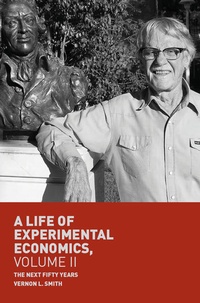
A Life of Experimental Economics, Volume II
Description
This sequel to A Life of Experimental Economics, Volume I, continues the intimate history of Vernon Smith's personal and professional maturation after a dozen years at Purdue. The scene now shifts to twenty-six transformative years at the University of Arizona, then to George Mason University, and his recognition by the Nobel Prize Committee in 2002. The book ends with his most recent decade at Chapman University.
At Arizona Vernon and his students studied asset trading markets and learned how wrong it had been to suppose that price bubbles could not occur where markets were full-information transparent. Their work in computerization of the lab facilitated very complex supply and demand experiments in natural gas pipeline, communication and electricity markets that paved the way for implementing, through decentralized market processes, the liberalization of industries traditionally believed to be "natural" monopolies. The "Smart ComputerAssisted Market" was born. Smith's move to George Mason University greatly facilitated government and industry work in tandem with various public and private entities, whereas his relocation to Chapman University coincided with the Great Recession, whose similarity with the Depression was evident in his research. There he integrated two fundamental kinds of markets with laboratory experiments: Consumer non-durables, the supply and demand for which was stable in the lab and in the economy, and durable assets whose bubble tendencies made them unstable in the lab as well as in the economy-witness the great housing-mortgage market bubble run-up of 1997-2007.
This book's conversational style and emphasis on the backstory of published research accomplishments allows readers an exclusive peak into how and why economists pursue their work. It's a must-read for those interested in experimental economics, the housing crisis, and economic history.
Reviews / Votes
"The creator of the field of experimental economics has crafted a superbly written two volume treatise that reads like a novel. Like all great novels, it contains one great character: the classical liberal Smith, himself." (Steve H. Hanke, The Johns Hopkins University, USA)
"Combines personal and professional reflections with 20
th
century economic history. Economics and philosophy in a life of intellect, curiosity, enthusiasm, and purpose." (Lynne Kiesling, Purdue University, USA)
"Read
A Life
, absorb its lessons, and strive to follow its example--be a life-long learner." (Peter Boettke, University Professor of Economics and Philosophy, George Mason University, USA)
"
A Life
filled with reflexive self-questioning, and a commitment to activism on behalf of racial, social and political equality." (Peter McLaren, Distinguished Professor in Critical Studies, Chapman University, USA; Chair Professor, Northeast Normal University, China)
"Smith's fascinating tale will resonate with all who are willing to let observation and experience change their minds-essential reading for aspiring scholars." (Shyam Sunder, Yale University, USA)
"I felt privileged to consume this beautiful tome, and be charmed by its author on every page." (Thomas Hazlett, Hugh H. Macaulay Endowed Professor of Economics, Clemson University, USA)
"Drug store delivery boy at age 12, activist in Congress of Racial Equality, Vernon's life is simple, humble, unpretentious and with a bias toward honesty and justice." (Robert Trivers, Evolutionary theorist, sociobiologist, 2007 Crafoord Prize winner and author, Wild Life)
"Vernon's opinions are provocative. They were formed in a lifetime of extraordinary achievements and insights, and a deeply humanistic attitude." (Andreas Ortmann, Professor of Experimental and Behavioural Economics , School of Economics, UNSW Business School, Australia)
"A 90-year journey from a one-room school in Kansas through scientific discovery with a fairy-tail ending." (Charles Holt, A. Willis Robertson Professor of Political Economy, University of Virginia, USA)
"Every young creative economist should read, and the deadwood in academia shun, this memoir." (Herbert Gintis, Santa Fe Institute, USA)
More details
Other editions
Additional editions