

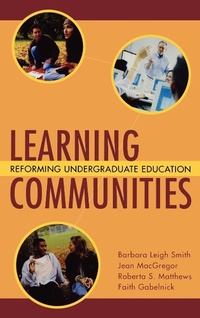
Learning Communities
Reforming Undergraduate Education
1st Edition
Published on 21. September 2004
Book
Hardback
416 pages
978-0-7879-1036-5 (ISBN)
Description
Learning Communities is a groundbreaking book that shows how learning communities (LCs) can be a flexible and effective approach to enhancing student learning, promoting curricular coherence, and revitalizing faculty. Written by Barbara Leigh Smith, Jean MacGregor, Roberta S. Matthews, and Faith Gabelnick3/4acclaimed national leaders in the learning communities movement3/4this important book provides the historical, conceptual, and philosophical context for LCs and clearly demonstrates that they can be a key element in institutional transformation.
Reviews / Votes
"... the authors provide a lucid and comprehensive overview."(Authors Journal Compilation, Winter 2007)"...is a superb resource of ideas and experiences worthy ofbeing examined at length." (The Midwest Book Review)"Every college teacher should read this comprehensive andinsightful analysis of one of the most important pedagogicalmovements in contemporary higher education."
--Alexander W. Astin, Allan M. Carter Professor of HigherEducation, University of California, Los Angeles
"An essential resource for anyone interested in learningcommunities by the leaders in the field. Framed by years ofexperience, the authors provide invaluable insights into how onebegins, sustains, and improves learning communities on both two-and four-year campuses. A must-read."
--Vincent Tinto, distinguished university professor and chair,Higher Education Program, Syracuse University
"Conceptual and practical, comprehensive and illustrative.This magnificent volume proves the learning communities movementhas come of age."
--Peter Ewell, vice president, National Center for Higher EducationManagement Systems (NCHEMS)
"This book contains a wealth of information, not onlyabout learning communities, but about the efforts of highereducation to improve learning through actively engaging students inthe process."
--K. Patricia Cross, professor of higher education, emerita,University of California, Berkeley
More details
Language
English
Place of publication
New York
United States
Publishing group
John Wiley & Sons Inc
Target group
Professional and scholarly
Product notice
sewn/stitched
Cloth over boards
Dimensions
Height: 235 mm
Width: 157 mm
Thickness: 27 mm
Weight
755 gr
ISBN-13
978-0-7879-1036-5 (9780787910365)
Copyright in bibliographic data and cover images is held by Nielsen Book Services Limited or by the publishers or by their respective licensors: all rights reserved.
Schweitzer Classification
Persons
Barbara Leigh Smith is a Senior Scholar at the Washington Centerfor Improving the Quality of Undergraduate Education, an emeritusmember of the faculty, and former provost and vice president foracademic affairs at The Evergreen State College. Smith and JeanMacGregor are founders of the Washington Center for Improving theQuality of Undergraduate Education which has led learning communitydevelopment for twenty years.
Jean MacGregor is a Senior Scholar at the Washington Center forImproving the Quality of Undergraduate Education and teaches in themaster of environmental studies program at The Evergreen StateCollege.
Roberta S. Matthews is provost and vice president for academicaffairs and professor of English at Brooklyn College.
Faith Gabelnick was president emerita of Pacific University,Forest Grove, Oregon, and president of Gabelnick ConsultingInstitute.
Jean MacGregor is a Senior Scholar at the Washington Center forImproving the Quality of Undergraduate Education and teaches in themaster of environmental studies program at The Evergreen StateCollege.
Roberta S. Matthews is provost and vice president for academicaffairs and professor of English at Brooklyn College.
Faith Gabelnick was president emerita of Pacific University,Forest Grove, Oregon, and president of Gabelnick ConsultingInstitute.
Content
Introduction.
The Authors.
PART ONE: The Contemporary and Historical Context ofLearning Communities.
1. Learning Communities and Undergraduate Education Reform.
2. Learning Community History: Education for What? Education forWhom?
PART TWO: Learning Community Structures andPractices.
3. Learning Community Curricular Structures.
4. Core Practices in Learning Communities.
PART THREE: Rich Arenas for Reform.
5. General Education, the First Year of College, and LearningCommunities.
6. Success for All: Learning Communities in Basic Skills andEnglish as a Second Language Settings.
PART FOUR: Initiating and Strengthening LearningCommunities.
7. Information and Feedback: Using Assessment to Strengthen andSustain Learning Communities.
8. Recruiting and Supporting Learning Community Teachers.
9. Initiating and Sustaining Learning Communities.
PART FIVE: Conclusion.
10. The Future of Learning Communities.
References.
Notes.
Name Index.
Subject Index.
The Authors.
PART ONE: The Contemporary and Historical Context ofLearning Communities.
1. Learning Communities and Undergraduate Education Reform.
2. Learning Community History: Education for What? Education forWhom?
PART TWO: Learning Community Structures andPractices.
3. Learning Community Curricular Structures.
4. Core Practices in Learning Communities.
PART THREE: Rich Arenas for Reform.
5. General Education, the First Year of College, and LearningCommunities.
6. Success for All: Learning Communities in Basic Skills andEnglish as a Second Language Settings.
PART FOUR: Initiating and Strengthening LearningCommunities.
7. Information and Feedback: Using Assessment to Strengthen andSustain Learning Communities.
8. Recruiting and Supporting Learning Community Teachers.
9. Initiating and Sustaining Learning Communities.
PART FIVE: Conclusion.
10. The Future of Learning Communities.
References.
Notes.
Name Index.
Subject Index.