

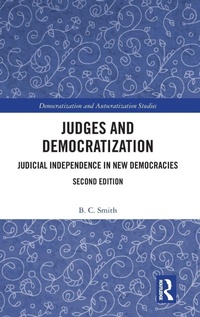
Judges and Democratization
Judicial Independence in New Democracies
2nd Edition
Published on 18. November 2022
Book
Hardback
292 pages
978-1-032-36945-7 (ISBN)
Description
This second edition examines judicial independence as an aspect of democratization based on the premise that democracy cannot be consolidated without the rule of law of which judicial independence is an indispensable part.
It pays particular attention to the restraints placed upon judicial independence and examines the reforms which are being applied, or remain to be adopted, in order to guard against the different kinds of interference which prevent judicial decisions being taken in a wholly impartial way. Focusing on the growing authoritarianism in the new democracies of Eastern Europe, Latin America, Asia and Africa, the book analyses the paradox of judicial activism arising from the independence endowed upon the judiciary and the rights bestowed on citizens by post-authoritarian constitutions. Finally, it asks how judicial accountability can be made compatible with the preservation of judicial independence when the concept of an accountable, independent judiciary appears to be a contradiction in terms.
This book will be of key interest to scholars and students of judicial studies, democratization and autocratization studies, constitutionalism, global governance, and more broadly comparative government/politics, human rights and comparative public law.
It pays particular attention to the restraints placed upon judicial independence and examines the reforms which are being applied, or remain to be adopted, in order to guard against the different kinds of interference which prevent judicial decisions being taken in a wholly impartial way. Focusing on the growing authoritarianism in the new democracies of Eastern Europe, Latin America, Asia and Africa, the book analyses the paradox of judicial activism arising from the independence endowed upon the judiciary and the rights bestowed on citizens by post-authoritarian constitutions. Finally, it asks how judicial accountability can be made compatible with the preservation of judicial independence when the concept of an accountable, independent judiciary appears to be a contradiction in terms.
This book will be of key interest to scholars and students of judicial studies, democratization and autocratization studies, constitutionalism, global governance, and more broadly comparative government/politics, human rights and comparative public law.
More details
Series
Edition
2nd edition
Language
English
Place of publication
London
United Kingdom
Publishing group
Taylor & Francis Ltd
Target group
College/higher education
Postgraduate and Undergraduate Advanced
Illustrations
8 s/w Abbildungen, 8 s/w Zeichnungen, 1 s/w Tabelle
1 Tables, black and white; 8 Line drawings, black and white; 8 Illustrations, black and white
Dimensions
Height: 240 mm
Width: 161 mm
Thickness: 21 mm
Weight
622 gr
ISBN-13
978-1-032-36945-7 (9781032369457)
Copyright in bibliographic data and cover images is held by Nielsen Book Services Limited or by the publishers or by their respective licensors: all rights reserved.
Schweitzer Classification
Other editions
Additional editions
Book
05/2024
2nd Edition
Routledge
€64.10
Shipment within 10-20 days
E-Book
11/2022
2nd Edition
Routledge
€55.49
Available for download
E-Book
11/2022
2nd Edition
Routledge
€55.49
Available for download
Previous edition
Book
02/2017
1st Edition
Routledge
€185.70
Article exhausted; check for reprint
Person
B. C. Smith is Emeritus Professor of Political Science, University of Dundee, UK.
Content
Introduction 1. The rule of law and democracy 2. The rule of law and judicial independence 3. Undermining judicial independence 4. Judicial bias 5. Judicial reform 6. Reforming judicial behaviour 7. Managing the judiciary 8. Judicial activism 9. Judicial accountability 10. Conclusion: the dilemma of judicial independence