

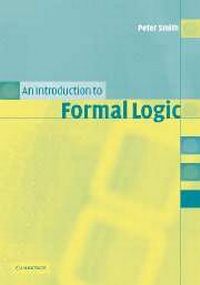
An Introduction to Formal Logic
Published on 6. November 2003
Book
Hardback
366 pages
978-0-521-81033-3 (ISBN)
Description
Formal logic provides us with a powerful set of techniques for criticizing some arguments and showing others to be valid. These techniques are relevant to all of us with an interest in being skilful and accurate reasoners. In this highly accessible book, Peter Smith presents a guide to the fundamental aims and basic elements of formal logic. He introduces the reader to the languages of propositional and predicate logic, and then develops formal systems for evaluating arguments translated into these languages, concentrating on the easily comprehensible 'tree' method. His discussion is richly illustrated with worked examples and exercises. A distinctive feature is that, alongside the formal work, there is illuminating philosophical commentary. This book will make an ideal text for a first logic course, and will provide a firm basis for further work in formal and philosophical logic.
More details
Language
English
Place of publication
Cambridge
United Kingdom
Target group
College/higher education
Professional and scholarly
Dimensions
Height: 255 mm
Width: 180 mm
Thickness: 28 mm
Weight
874 gr
ISBN-13
978-0-521-81033-3 (9780521810333)
Copyright in bibliographic data and cover images is held by Nielsen Book Services Limited or by the publishers or by their respective licensors: all rights reserved.
Schweitzer Classification
Other editions
New editions
Peter Smith
An Introduction to Formal Logic
Book
06/2020
2nd Edition
Cambridge University Press
€141.12
Article exhausted; check different version
Additional editions
Peter Smith
Introduction to Formal Logic
E-Book
11/2003
Cambridge University Press
€27.99
Available for download
Person
Peter Smith's publications include The Philosophy of Mind (1986) and Explaining Chaos (1998).
Content
1. What is logic?; 2. Validity and soundness; 3. Patterns of inference; 4. The counterexample technique; 5. Proofs; 6. Validity and arguments; 7. Three propositional connectives; 8. The syntax of PL; 9. The semantics of PL; 10. 'A's and 'B's, 'P's and 'Q's; 11. Truth functions; 12. Tautologies; 13. Tautological entailment; 14. PLC and the material conditional; 15. More on the material conditional; 16. Introducing PL trees; 17. Rules for PL trees; 18. PLC trees; 19. PL trees vindicated; 20. Trees and proofs; 21. Quantifiers; 22. QL introduced; 23. QL explored; 24. More QL translations; 25. Introducing QL trees; 26. The syntax of QL; 27. Q-valuations; 28. Q-validity; 29. More on QL trees; 30. QL trees vindicated; 31. Extensionality; 32. Identity; 33. The language QL=; 34. Descriptions and existence; 35. Trees for identity; 36. Functions.