

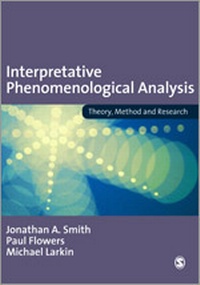
Interpretative Phenomenological Analysis
Theory, Method and Research
1st Edition
Published on 21. May 2009
Book
Paperback/Softback
232 pages
978-1-4129-0834-4 (ISBN)
Description
'It is not often I can use "accessible" and "phenomenology" in the same sentence, but reading the new book, Interpretative Phenomenological Analysis...certainly provides me the occasion to do so. I can say this because these authors provide an engaging and clear introduction to a relatively new analytical approach' - The Weekly Qualitative Report
Interpretative phenomenological analysis (IPA) is an increasingly popular approach to qualitative inquiry. This handy text covers its theoretical foundations and provides a detailed guide to conducting IPA research.
Extended worked examples from the authors' own studies in health, sexuality, psychological distress and identity illustrate the breadth and depth of IPA research.
Each of the chapters also offers a guide to other good exemplars of IPA research in the designated area. The final section of the book considers how IPA connects with other contemporary qualitative approaches like discourse and narrative analysis and how it addresses issues to do with validity. The book is written in an accessible style and will be extremely useful to students and researchers in psychology and related disciplines in the health and social sciences.
Interpretative phenomenological analysis (IPA) is an increasingly popular approach to qualitative inquiry. This handy text covers its theoretical foundations and provides a detailed guide to conducting IPA research.
Extended worked examples from the authors' own studies in health, sexuality, psychological distress and identity illustrate the breadth and depth of IPA research.
Each of the chapters also offers a guide to other good exemplars of IPA research in the designated area. The final section of the book considers how IPA connects with other contemporary qualitative approaches like discourse and narrative analysis and how it addresses issues to do with validity. The book is written in an accessible style and will be extremely useful to students and researchers in psychology and related disciplines in the health and social sciences.
Reviews / Votes
'I have been using this book since it was published - recommending it to undergraduate and postgraduate students both as the definitive account of the IPA approach and as an accessible introduction to experiential qualitative research more broadly. The chapters on designing an IPA study, collecting and analysing data, and writing up an IPA study in particular are excellent...This book remains an invaluable addition to the toolkit of resources for teachers and students of qualitative research, and I thoroughly recommend it to both' -Psychology: Learning and Teaching, Volume 9, Number 1
More details
Language
English
Place of publication
Thousand Oaks
United States
Target group
College/higher education
Dimensions
Height: 242 mm
Width: 170 mm
Weight
424 gr
ISBN-13
978-1-4129-0834-4 (9781412908344)
Copyright in bibliographic data and cover images is held by Nielsen Book Services Limited or by the publishers or by their respective licensors: all rights reserved.
Schweitzer Classification
Other editions
New editions
Jonathan A. Smith | Paul Flowers | Michael Larkin
Interpretative Phenomenological Analysis
Theory, Method and Research
Book
12/2021
2nd Edition
SAGE Publications Ltd
€52.55
Shipment within 15-20 days
Persons
Jonathan A. Smith is Professor of Psychology at Birkbeck University of London, UK where he leads the interpretative phenomenological analysis (IPA) research group. He has written many articles applying IPA to a range of areas in health, clinical and social psychology. He is co- author (with Paul Flowers and Michael Larkin) of Interpretative Phenomenological Analysis: Theory, Method and Research (Sage, 2009). He also has a wider interest in qualitative psychology generally and has co-edited a number of books in the area.
Content
PART ONE: DOING IPA: Theory and Method
The Theoretical Foundations of IPA
Planning an IPA Research Study
Collecting Data
Analysis
Writing up
PART TWO: IPA RESEARCH
Health and Illness
Sex and Sexuality
Psychological Distress
Life Transitions and Identity
PART THREE: CURRENT ISSUES FOR IPA
Assessing Validity
The Relationship between IPA and Other Approaches
Conclusion and Reflections on Future Developments
The Theoretical Foundations of IPA
Planning an IPA Research Study
Collecting Data
Analysis
Writing up
PART TWO: IPA RESEARCH
Health and Illness
Sex and Sexuality
Psychological Distress
Life Transitions and Identity
PART THREE: CURRENT ISSUES FOR IPA
Assessing Validity
The Relationship between IPA and Other Approaches
Conclusion and Reflections on Future Developments