

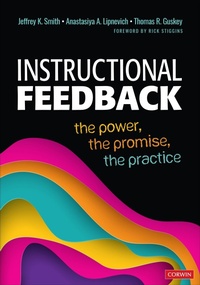
Instructional Feedback
The Power, the Promise, the Practice
1st Edition
Published on 4. July 2023
Book
Paperback/Softback
128 pages
978-1-5443-8521-1 (ISBN)
Description
Implement evidence-based feedback practices that move learners forward
Feedback is essential to successful instruction and improved student performance, but learners often dread and dismiss feedback and its effectiveness can vary. Thus, sharing intentions, clarifying success criteria, knowing what type of feedback to provide and when, and activating students as owners of their learning are essential feedback functions.
Instructional Feedback presents a comprehensive summary of the most recent research on instructional feedback and describes its successful implementation. With a focus on evidence-based approaches adapted to specific contexts, the authors use common classroom situations to demystify feedback and place it within a broad instructional context, along with definitions, characteristics, and precautions about its effect on students' emotions and behaviors. Inside you'll find:
Coverage of all grades and concentrations, including math, language arts, music, art, and science
Peer feedback, self-assessment, and subject-specific nuances
Student and teacher examples of feedback and suggestions for improvement
Engaging and concise, Instructional Feedback discusses why feedback is so powerful, how it is promising, and what it looks like in practice.
Feedback is essential to successful instruction and improved student performance, but learners often dread and dismiss feedback and its effectiveness can vary. Thus, sharing intentions, clarifying success criteria, knowing what type of feedback to provide and when, and activating students as owners of their learning are essential feedback functions.
Instructional Feedback presents a comprehensive summary of the most recent research on instructional feedback and describes its successful implementation. With a focus on evidence-based approaches adapted to specific contexts, the authors use common classroom situations to demystify feedback and place it within a broad instructional context, along with definitions, characteristics, and precautions about its effect on students' emotions and behaviors. Inside you'll find:
Coverage of all grades and concentrations, including math, language arts, music, art, and science
Peer feedback, self-assessment, and subject-specific nuances
Student and teacher examples of feedback and suggestions for improvement
Engaging and concise, Instructional Feedback discusses why feedback is so powerful, how it is promising, and what it looks like in practice.
More details
Language
English
Place of publication
Thousand Oaks
United States
Publishing group
SAGE Publications Inc
Target group
Professional and scholarly
Dimensions
Height: 175 mm
Width: 254 mm
Thickness: 11 mm
Weight
262 gr
ISBN-13
978-1-5443-8521-1 (9781544385211)
Copyright in bibliographic data and cover images is held by Nielsen Book Services Limited or by the publishers or by their respective licensors: all rights reserved.
Schweitzer Classification
Persons
Jeffrey Smith is Professor and formerly Dean of the College of Education at the University of Otago in New Zealand. He earned his bachelor's degree from Princeton and his PhD from the University of Chicago. He taught at Rutgers University in New Jersey for 29 years where he was Chair of the Educational Psychology Department. He moved to New Zealand in 2005 and has been there ever since. While teaching at Rutgers, Jeff served as a consultant to the Metropolitan Museum of Art, where he was the Head of their Office of Research and Evaluation. He has written over 100 research articles and 10 books on assessment and the psychology of aesthetics, including being co-editor of The Cambridge Handbook on Instructional Feedback.
Anastasiya Lipnevich is Professor of Educational Psychology at Queens College and the Graduate Center of the City University of New York. Originally from Belarus, Dr. Lipnevich received her combined Master's degree in Clinical Psychology, Education, and Italian language from the Belarusian State Pedagogical University, followed by her Master's in Counselling Psychology from Rutgers University, USA. She then earned her Ph.D. in Educational Psychology (Learning, Cognition, Development concentration), also from Rutgers University. She co-edited two books - Psychosocial skills and School Systems in the 21st Century (Lipnevich, Preckel, and Roberts, 2016; Springer) and the Cambridge Handbook of Instructional Feedback (Lipnevich and Smith, 2018; Cambridge University Press) and numerous articles. She may be contacted at www.anastasiyalipnevich.com or a.lipnevich@gmail.com
Thomas R. Guskey, PhD, is Professor Emeritus in the College of Education at the University of Kentucky. A graduate of the University of Chicago's renowned Measurement, Evaluation, and Statistical Analysis (MESA) program, he began his career in education as a middle school teacher, served as an administrator in the Chicago Public Schools, and was the first Director of the Center for the Improvement of Teaching and Learning, a national educational research center. He is the author/editor of twenty-seven books and over three hundred articles published in prominent research journals as well as Educational Leadership, Kappan, and The School Administrator.
Dr. Guskey served on the Policy Research Team of the National Commission on Teaching and America's Future, and on the task force to develop the National Standards for Professional Development. He was named a Fellow in the American Educational Research Association and was awarded the Association's prestigious Relating Research to Practice Award. He was also awarded Learning Forward's Outstanding Contribution to the Field Award and Phi Delta Kappan's Distinguished Educator Award. Perhaps most unique, in the 158-year history of his undergraduate institution, Thiel College, he is one of only three graduates to receive the Outstanding Alumnus Award and be inducted into the Thiel College Athletic Hall of Fame.
His most recent books include Implementing Mastery Learning (2023), Instructional Feedback: The Power, the Promise, the Practice (with Smith & Lipnevich, 2023); Get Set, Go! Creating Successful Grading and Reporting Systems (2020), What We Know About Grading (with Brookhart, 2019), and On Your Mark: Challenging the Conventions of Grading and Reporting (2015). He may be contacted by email at guskey@uky.edu, Twitter at @tguskey, or at www.tguskey.com.
Anastasiya Lipnevich is Professor of Educational Psychology at Queens College and the Graduate Center of the City University of New York. Originally from Belarus, Dr. Lipnevich received her combined Master's degree in Clinical Psychology, Education, and Italian language from the Belarusian State Pedagogical University, followed by her Master's in Counselling Psychology from Rutgers University, USA. She then earned her Ph.D. in Educational Psychology (Learning, Cognition, Development concentration), also from Rutgers University. She co-edited two books - Psychosocial skills and School Systems in the 21st Century (Lipnevich, Preckel, and Roberts, 2016; Springer) and the Cambridge Handbook of Instructional Feedback (Lipnevich and Smith, 2018; Cambridge University Press) and numerous articles. She may be contacted at www.anastasiyalipnevich.com or a.lipnevich@gmail.com
Thomas R. Guskey, PhD, is Professor Emeritus in the College of Education at the University of Kentucky. A graduate of the University of Chicago's renowned Measurement, Evaluation, and Statistical Analysis (MESA) program, he began his career in education as a middle school teacher, served as an administrator in the Chicago Public Schools, and was the first Director of the Center for the Improvement of Teaching and Learning, a national educational research center. He is the author/editor of twenty-seven books and over three hundred articles published in prominent research journals as well as Educational Leadership, Kappan, and The School Administrator.
Dr. Guskey served on the Policy Research Team of the National Commission on Teaching and America's Future, and on the task force to develop the National Standards for Professional Development. He was named a Fellow in the American Educational Research Association and was awarded the Association's prestigious Relating Research to Practice Award. He was also awarded Learning Forward's Outstanding Contribution to the Field Award and Phi Delta Kappan's Distinguished Educator Award. Perhaps most unique, in the 158-year history of his undergraduate institution, Thiel College, he is one of only three graduates to receive the Outstanding Alumnus Award and be inducted into the Thiel College Athletic Hall of Fame.
His most recent books include Implementing Mastery Learning (2023), Instructional Feedback: The Power, the Promise, the Practice (with Smith & Lipnevich, 2023); Get Set, Go! Creating Successful Grading and Reporting Systems (2020), What We Know About Grading (with Brookhart, 2019), and On Your Mark: Challenging the Conventions of Grading and Reporting (2015). He may be contacted by email at guskey@uky.edu, Twitter at @tguskey, or at www.tguskey.com.
Content
About the Authors
Foreword
Chapter 1: Introduction: What is Instructional Feedback All About?
Chapter 2: Feedback from the Perspective of the Learner
Chapter 3: Characteristics of Effective Feedback Messages
Chapter 4: What is Feedback?
Chapter 5: Feedback to Parents and Caregivers
Chapter 6: Grades as Feedback
Chapter 7: Efficiency and Efficacy in Feedback
Chapter 8: Examples of Instructional Feedback
Chapter 9: Feedback for Teachers: What Feedback Do Teachers Find Most Useful?
Chapter 10: Bringing It All Together
References
Foreword
Chapter 1: Introduction: What is Instructional Feedback All About?
Chapter 2: Feedback from the Perspective of the Learner
Chapter 3: Characteristics of Effective Feedback Messages
Chapter 4: What is Feedback?
Chapter 5: Feedback to Parents and Caregivers
Chapter 6: Grades as Feedback
Chapter 7: Efficiency and Efficacy in Feedback
Chapter 8: Examples of Instructional Feedback
Chapter 9: Feedback for Teachers: What Feedback Do Teachers Find Most Useful?
Chapter 10: Bringing It All Together
References