

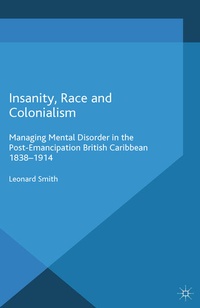
Insanity, Race and Colonialism
Managing Mental Disorder in the Post-Emancipation British Caribbean, 1838-1914
Published on 1. January 2014
Book
Paperback/Softback
X, 285 pages
978-1-349-43998-0 (ISBN)
Description
Despite emancipation from the evils of enslavement in 1838, most people of African origin in the British West Indian colonies continued to suffer serious material deprivation and racial oppression. This book examines the management and treatment of those who became insane, in the period until the Great War.
Reviews / Votes
"A richly-researched and wide-ranging study, that forces readers to think again about the history of psychiatry, about empire, and about its impact on the Caribbean." - James H. Mills, Professor of Modern History, Centre for the Social History Of Health and Healthcare (CSHHH) Glasgow, University of Strathclyde, UK
More details
Series
Edition
1st ed. 2014
Language
English
Place of publication
London
United Kingdom
Target group
Professional and scholarly
Illustrations
X, 285 p.
Dimensions
Height: 216 mm
Width: 140 mm
Thickness: 17 mm
Weight
376 gr
ISBN-13
978-1-349-43998-0 (9781349439980)
DOI
10.1057/9781137318053
Schweitzer Classification
Other editions
Additional editions
L. Smith
Insanity, Race and Colonialism
Managing Mental Disorder in the Post-Emancipation British Caribbean, 1838-1914
Book
10/2014
Palgrave Macmillan
€53.49
Shipment within 10-20 days
Person
Leonard Smith is Honorary Senior Research Fellow at the University of Birmingham, UK. He has written extensively on the history of provision for the insane in the 18th and 19th centuries. His publications include 'Cure, Comfort and Safe Custody': Public Lunatic Asylums in early Nineteenth-Century England (1999) and Lunatic Hospitals in Georgian England, 1750-1830 (2007). He has worked in mental health services since 1973.
Content
Introduction 1. Caribbean Institutions in Context 2. The Early Lunatic Asylums 3. Scandal in Jamaica - The Kingston Lunatic Asylum 4. Reform - The Jamaica Lunatic Asylum 5. Colonial Asylums in Transition 6. Pathways to the Asylum 7. The Patient Challenge 8. The Colonial Asylum Regime Conclusion