

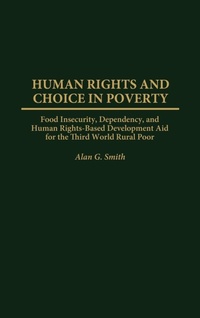
Human Rights and Choice in Poverty
Food Insecurity, Dependency, and Human Rights-Based Development Aid for the Third World Rural Poor
Published on 30. August 1997
Book
Hardback
192 pages
978-0-275-95826-8 (ISBN)
Description
This interdisciplinary study applies human rights theory to the problems of rural poverty in the Third World. Considering the interdependence of minimal food and health security with minimal assurance of basic freedoms, political scientist Alan G. Smith traces the linkage to the need of the food-insecure to seek clientelistic dependencies on better-off neighbors-relationships that often operate to restrict freedom of choice. In contrast to conventional rural development aid, which can introduce new client dependency if pursued alone, Smith stresses the need to find other forms of aid that would provide the option of assured minimal survival while avoiding the constraints imposed by dependency. Arguing for bolstering bottom-up human rights momentum, he suggests the transfer of appropriate tools into the hands of the target group. Recipients would make use of them to enhance autonomous food-crop production, thereby making client dependency a matter of choice rather than necessity.
Smith illustrates the Third World predicament of food insecurity leading to infringement of rights by drawing together empirical evidence from Bangladesh, Botswana, and Tanzania. He further argues that respect for human rights involves a duty on the part of advantaged nations to address the Third World predicament with practical measures fully consistent with human rights, and for each of these three country cases, Smith recommends direct locally specific minimalist aid. His model, its practical illustration, and recommendations should be valuable to academics and students in the fields of rural sociology, anthropology, and political science-especially those focusing on human rights, poverty, and Third World development-as well as bureaucrats and consultants in the development aid field.
Smith illustrates the Third World predicament of food insecurity leading to infringement of rights by drawing together empirical evidence from Bangladesh, Botswana, and Tanzania. He further argues that respect for human rights involves a duty on the part of advantaged nations to address the Third World predicament with practical measures fully consistent with human rights, and for each of these three country cases, Smith recommends direct locally specific minimalist aid. His model, its practical illustration, and recommendations should be valuable to academics and students in the fields of rural sociology, anthropology, and political science-especially those focusing on human rights, poverty, and Third World development-as well as bureaucrats and consultants in the development aid field.
More details
Language
English
Place of publication
United States
Publishing group
Bloomsbury Publishing Plc
Target group
College/higher education
Professional and scholarly
Dimensions
Height: 235 mm
Width: 157 mm
Thickness: 15 mm
Weight
437 gr
ISBN-13
978-0-275-95826-8 (9780275958268)
Copyright in bibliographic data and cover images is held by Nielsen Book Services Limited or by the publishers or by their respective licensors: all rights reserved.
Schweitzer Classification
Other editions
Additional editions
Alan G. Smith
Human Rights and Choice in Poverty
Food Insecurity, Dependency, and Human Rights-Based Development Aid for the Third World Rural Poor
E-Book
08/1997
1st Edition
Praeger Publishers Inc
€65.99
Available for download
Person
ALAN G. SMITH is Associate Professor of Political Science at Central Connecticut State University. His publications relating to human rights and development have appeared in the Journal of Social Studies, in the yearbook Human Rights in Developing Countries, and in reports and papers of human rights institutes.
Content
Preface The Predicament and Its Background The Theoretical Model Poverty, Clientelistic Dependency, and the Target Group Indicator in Bangladesh, Botswana, and Tanzania The Choice Structure Conclusion: The Remedy Bibliography Index