

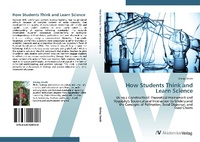
How Students Think and Learn Science
Using a Constructivist Theoretical Framework and Vygotsky's Socio-cultural Interaction to Understand the Concepts of Pollination, Seed Dispersal, and Food Chains
Published on 30. May 2012
Book
Paperback/Softback
224 pages
978-3-639-42012-8 (ISBN)
Description
Revision with unchanged content. Science learning may be perceived difficult because of complex content of some concepts. Can development and quality of socio-cultural interaction with adults and capable peers enable students to more easily construct an understanding of science following standards? This research investigates students' conceptual understanding of ecological interdependency in food chains, pollination, and seed dispersal across k-12 and college using a constructivist theoretical framework. Responses to interview questions were categorized as either everyday or scientific concepts and as a transition through Lev Vygotsky's Zone of Proximal Development (ZPD). The research should help answer the following: Did students vary across concepts and grade levels? What is the dynamic nature of the ZPD continuum that enables teachers to plan in order to individualize instruction? How can teachers engage students to reflect and reconstruct understanding through formal concepts and socio-cultural interactions? How can teachers help students use tools, such as language and thought, to increase cultural capital in the form of enhanced understanding and problem solving? This book is directed primarily to professionals in biology and science education and other interested educators.
More details
Language
English
Product notice
Paperback (trade)
Unsewn / adhesive bound
Dimensions
Height: 220 mm
Width: 150 mm
Thickness: 15 mm
Weight
352 gr
ISBN-13
978-3-639-42012-8 (9783639420128)
Copyright in bibliographic data and cover images is held by Nielsen Book Services Limited or by the publishers or by their respective licensors: all rights reserved.
Schweitzer Classification
Person
Ph.D., biology and science education instructor; art, science, and educational consultant; test writer utilizing State and National standards of learning; aviation enthusiast; degrees from Appalachian State University, Duke University, and North Carolina State University; Durham and Raleigh, North Carolina and southwestern Virginia.