

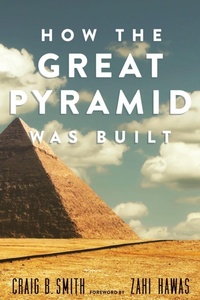
How the Great Pyramid Was Built
Published on 30. January 2018
Book
Paperback/Softback
304 pages
978-1-58834-622-3 (ISBN)
Description
Going beyond even the expertise of archaeologists and historians, world-class engineer Craig B. Smith explores the planning and engineering behind the incredible Great Pyramid of Giza. How would the ancient Egyptians have developed their building plans, devised work schedules, managed laborers, solved specific design and engineering problems, or even improvised on the job? The answers are here, along with dazzling, one-of-a-kind color photographs and beautiful hand-drawn illustrations of tools, materials, and building techniques the ancient masters used. In his foreword to the book, Egypt's Undersecretary of State for the Giza Monuments Zahi Hawass explains the importance of understanding the Great Pyramid as a straightforward construction project.
More details
Language
English
Place of publication
Washington, DC
United States
Dimensions
Height: 229 mm
Width: 152 mm
Thickness: 18 mm
Weight
500 gr
ISBN-13
978-1-58834-622-3 (9781588346223)
Copyright in bibliographic data and cover images is held by Nielsen Book Services Limited or by the publishers or by their respective licensors: all rights reserved.
Schweitzer Classification
Other editions
Additional editions
Craig B. Smith
How the Great Pyramid Was Built
E-Book
02/2018
1st Edition
Smithsonian Books
€19.49
Available for download
Previous edition

Craig Smith
How the Great Pyramid Was Built
Book
12/2004
Smithsonian Books
€45.72
Article exhausted; check for reprint
Person
Craig B. Smith is a retired president and chairman of DMJM H+N, an international architecture, engineering, and construction management firm. He began his career as an assistant professor of engineering at UCLA and later co-founded ANCO Engineers, Inc. He held senior leadership roles at AECOM Technology Corporation, including executive vice president and chief operating officer.Smith has extensive experience in energy and power systems, having worked on a wide range of electrical generation facilities, including nuclear, hydroelectric, geothermal, and solar. He is the author of more than 100 technical papers and multiple books on engineering and energy. He holds degrees in electrical and nuclear engineering from Stanford University and UCLA, including a Ph.D. in engineering.