

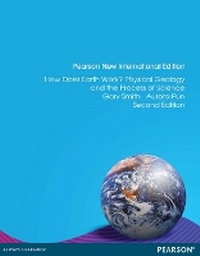
How Does Earth Work? Physical Geology and the Process of Science
Pearson New International Edition
2nd Edition
Published on 1. November 2013
Book
Paperback/Softback
644 pages
978-1-292-04242-8 (ISBN)
Description
For introductory courses in physical geology.
Encouraging students to observe, discover, and visualise, How Does Earth Work engages students with an inquiry-based learning method that develops a solid interpretation of introductory geology. Like geology detectives, students learn to think through the scientific process and uncover evidence that explains earth's mysteries.
Encouraging students to observe, discover, and visualise, How Does Earth Work engages students with an inquiry-based learning method that develops a solid interpretation of introductory geology. Like geology detectives, students learn to think through the scientific process and uncover evidence that explains earth's mysteries.
More details
Edition
2nd edition
Language
English
Place of publication
Harlow
United Kingdom
Target group
Professional and scholarly
Dimensions
Height: 276 mm
Width: 216 mm
Thickness: 26 mm
Weight
1432 gr
ISBN-13
978-1-292-04242-8 (9781292042428)
Copyright in bibliographic data and cover images is held by Nielsen Book Services Limited or by the publishers or by their respective licensors: all rights reserved.
Schweitzer Classification
Other editions
Additional editions
Gary Smith | Aurora Pun
How Does Earth Work? Physical Geology and the Process of Science
Pearson New International Edition
E-Book
10/2013
2nd Edition
Pearson Education Limited
€51.35
Available for download
Content
1. Why Study Earth?
2. Minerals: Building Blocks of the Planet
3. Rocks and Rock-Forming Processes
4. Formation of Magma and Igneous Rocks
5. Formation of Sediment and Sedimentary Rocks
6. Formation of Metamorphic Rocks
7. Earth Materials as Time Keepers
8. Journey to the Center of Earth
9. Making Earth
10. Motion Inside Earth
11. Deformation of Rocks
12. Global Tectonics: Plates and Plumes
13. Tectonics and Surface Relief
14. Soil Formation and Landscape Stability
15. Mass Movements: Landscapes in Motion
16. Streams: Flowing Water Shapes the Landscape
17. Water Flowing Underground
18. Glaciers: Cold-Climate Sculptors of Continents
19. Shorelines: Changing Landscapes Where Land Meets Sea
20. Wind: A Global Geologic Process
21. Global Warming: Real-time Change in the Earth System
2. Minerals: Building Blocks of the Planet
3. Rocks and Rock-Forming Processes
4. Formation of Magma and Igneous Rocks
5. Formation of Sediment and Sedimentary Rocks
6. Formation of Metamorphic Rocks
7. Earth Materials as Time Keepers
8. Journey to the Center of Earth
9. Making Earth
10. Motion Inside Earth
11. Deformation of Rocks
12. Global Tectonics: Plates and Plumes
13. Tectonics and Surface Relief
14. Soil Formation and Landscape Stability
15. Mass Movements: Landscapes in Motion
16. Streams: Flowing Water Shapes the Landscape
17. Water Flowing Underground
18. Glaciers: Cold-Climate Sculptors of Continents
19. Shorelines: Changing Landscapes Where Land Meets Sea
20. Wind: A Global Geologic Process
21. Global Warming: Real-time Change in the Earth System