

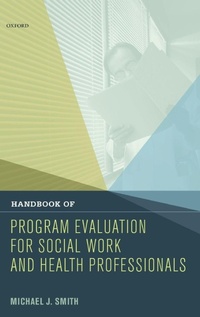
Handbook of Program Evaluation for Social Work and Health Professionals
1st Edition
Published on 18. February 2010
Book
Hardback
400 pages
978-0-19-515843-4 (ISBN)
Description
Evaluation is crucial for determining the effectiveness of social programs and interventions. In this nuts and bolts handbook, social work and health care professionals are shown how evaluations should be done, taking the intimidation and guesswork out of this essential task. Current perspectives in social work and health practice, such as the strengths perspective, consumer empowerment, empowerment evaluation, and evidence-based practice, are linked to evaluation concepts throughout the book to emphasize their importance.
This book makes evaluation come alive with comprehensive examples of each different type of evaluation, such as a strengths-based needs assessment in a local community, a needs assessment for Child Health Plus programs, comprehensive program descriptions of HIV services and community services for the aged, a model for goals and objectives in programs for people with mental illness, a monitoring study of private practice social work, and process evaluations of a Medicare advocacy program and a health advocacy program to explain advance directives. Equal emphasis is given to both quantitative and qualitative data analysis with real examples that make statistics and concepts in qualitative analysis un-intimidating.
By integrating both evaluation and research methods and assuming no previous knowledge of research, this book makes an excellent reference for professionals working in social work and health settings who are now being called upon to conduct or supervise program evaluation and may need a refresher on research methods. With a pragmatic approach that includes survey design, data collection methods, sampling, analysis, and report writing, it is also an excellent text or classroom resource for students new to the field of program evaluation.
This book makes evaluation come alive with comprehensive examples of each different type of evaluation, such as a strengths-based needs assessment in a local community, a needs assessment for Child Health Plus programs, comprehensive program descriptions of HIV services and community services for the aged, a model for goals and objectives in programs for people with mental illness, a monitoring study of private practice social work, and process evaluations of a Medicare advocacy program and a health advocacy program to explain advance directives. Equal emphasis is given to both quantitative and qualitative data analysis with real examples that make statistics and concepts in qualitative analysis un-intimidating.
By integrating both evaluation and research methods and assuming no previous knowledge of research, this book makes an excellent reference for professionals working in social work and health settings who are now being called upon to conduct or supervise program evaluation and may need a refresher on research methods. With a pragmatic approach that includes survey design, data collection methods, sampling, analysis, and report writing, it is also an excellent text or classroom resource for students new to the field of program evaluation.
Reviews / Votes
"There could have been no better time than now for Michael J. Smith's Handbook of Program Evaluation for Social Work and Health Professions. This is a well-organized, well-written, step-by-step guide to conceptualizing, designing, implementing, and reporting a wide array of program evaluation initiatives within the framework of client empowerment, consumer evaluation, and a strengths-based perspective. -- Journal of Teaching in Social WorkMore details
Language
English
Place of publication
New York
United States
Target group
Professional and scholarly
Professionals working in social work and health settings, professionals who administer programs and need evaluation essentials and skills, students in graduate program evaluation courses in social work and health, students in Continuing Education courses with an evaluation focus, and organizations that want to get their staff into program evaluation issues and methods.
Dimensions
Height: 240 mm
Width: 161 mm
Thickness: 26 mm
Weight
763 gr
ISBN-13
978-0-19-515843-4 (9780195158434)
Copyright in bibliographic data and cover images is held by Nielsen Book Services Limited or by the publishers or by their respective licensors: all rights reserved.
Schweitzer Classification
Other editions
Additional editions
E-Book
01/2010
1st Edition
OUP eBook
€54.99
Available for download
Person
Professor Social Work, Hunter College
Content
1. An Introduction to Program Evaluation
2. Types of Program Evaluation Studies
3. New Trends and Issues in Program Evaluation: The Strengths Perspective, Consumer Empowerment, Empowerment Evaluation, and Evidence-Based Practice (EBP)
4. Describing the Program
5. Needs Assessment Studies
6. Determining Program Goals
7. Formative Evaluations: Program Monitoring and Process Evaluations
8. Designing the Evaluation Study
9. Implementing the Evaluation Study and Analyzing the Data
10. Writing the Report and Implementing the Findings
2. Types of Program Evaluation Studies
3. New Trends and Issues in Program Evaluation: The Strengths Perspective, Consumer Empowerment, Empowerment Evaluation, and Evidence-Based Practice (EBP)
4. Describing the Program
5. Needs Assessment Studies
6. Determining Program Goals
7. Formative Evaluations: Program Monitoring and Process Evaluations
8. Designing the Evaluation Study
9. Implementing the Evaluation Study and Analyzing the Data
10. Writing the Report and Implementing the Findings