

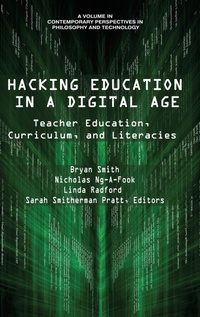
Hacking Education in a Digital Age
Teacher Education, Curriculum, and Literacies
Published on 26. March 2018
Book
Hardback
204 pages
978-1-64113-201-5 (ISBN)
Description
In this collection, the authors put forth different philosophical conceptions of 'hacking education' in response to the educational, societal, and technological demands of the 21st century. Teacher Educators are encouraged to draw on the collection to rethink how 'hacking education' can be understood simultaneously as a 'praxis' informed by desires for malice, as well as a creative site for us to reconsider the possibilities and limitations of teaching and learning in a digital era.
How do we hack beyond the limits of circumscribed experiences, regulated subjective encounters with knowledge and the limits imposed by an ever constrained 21st century schooling system in the hopes of imagining better and more meaningful futures?
How do we foster ingenuity and learning as the end itself (and not learning as economic imperative) in a world where technology, in part, positions individuals as zombie-like and as an economic end in itself?
Can we 'hack' education in such a way that helps to mitigate the black hat hacking that increasingly lays ruin to individual lives, government agencies, and places of work?
How can we, as educators, facilitate the curricular and pedagogical processes of reclaiming the term hacking so as to remember and remind ourselves that hacking's humble roots are ultimately pedagogical in its very essence?
As a collection of theoretical and pedagogical pieces, the chapters in the collection are of value to both scholars and practitioners who share the same passion and commitment to changing, challenging and reimagining the script that all too often constrains and prescribes particular visions of education. Those who seek to question the nature of teaching and learning and who seek to develop a richer theoretical vocabulary will benefit from the insightful and rich collection of essays presented in this collection. In this regard, the collection offers something for all who might wish to rethink the fundamental dynamics of education or, as Morpheus asks of Neo in The Matrix, bend the rules of conventional ways of knowing and being.
How do we hack beyond the limits of circumscribed experiences, regulated subjective encounters with knowledge and the limits imposed by an ever constrained 21st century schooling system in the hopes of imagining better and more meaningful futures?
How do we foster ingenuity and learning as the end itself (and not learning as economic imperative) in a world where technology, in part, positions individuals as zombie-like and as an economic end in itself?
Can we 'hack' education in such a way that helps to mitigate the black hat hacking that increasingly lays ruin to individual lives, government agencies, and places of work?
How can we, as educators, facilitate the curricular and pedagogical processes of reclaiming the term hacking so as to remember and remind ourselves that hacking's humble roots are ultimately pedagogical in its very essence?
As a collection of theoretical and pedagogical pieces, the chapters in the collection are of value to both scholars and practitioners who share the same passion and commitment to changing, challenging and reimagining the script that all too often constrains and prescribes particular visions of education. Those who seek to question the nature of teaching and learning and who seek to develop a richer theoretical vocabulary will benefit from the insightful and rich collection of essays presented in this collection. In this regard, the collection offers something for all who might wish to rethink the fundamental dynamics of education or, as Morpheus asks of Neo in The Matrix, bend the rules of conventional ways of knowing and being.
More details
Series
Language
English
Place of publication
Charlotte
United States
Publishing group
Emerald Publishing Inc
Target group
Professional and scholarly
Dimensions
Height: 240 mm
Width: 161 mm
Thickness: 16 mm
Weight
476 gr
ISBN-13
978-1-64113-201-5 (9781641132015)
Copyright in bibliographic data and cover images is held by Nielsen Book Services Limited or by the publishers or by their respective licensors: all rights reserved.
Schweitzer Classification
Content
Acknowledgments.
Introduction-Hacking Education in the 21st Century; Bryan Smith, Nicholas Ng-A-Fook, Linda Radford, and Sarah Smitherman Pratt.
Chapter 1. An Existential Hack of Neoliberal Discourses in Education; Sean Wiebe.
Chapter 2. Hacking Minds: Curriculum Mentis, Noosphere, Internet, Matrix, Web; Yu-Ling Lee and Stephen Petrina.
Chapter 3. If the Stars Are Spotlights, I Wanted the Sun: Hacking Children's Literature in Raziel Reid's When Everything Feels Like the Movies; Linda Radford.
Chapter 4. Curricula of Identity-Subjectivity in Distributed Social Media Spaces; Paul Eaton.
Chapter 5. Hacking The Matrix: Teacher Ontology at the Abyss of the Zizekian Real; Brian Gilbert.
Chapter 6. Cyborg Politics: Body-Data Assemblages and the Limits of Institutional Resistance; Nichole Grant and Pamela Rogers.
Chapter 7. New Literacy Threshold Concepts as a Life Hack; Patricia Altass and Sean Wiebe.
Chapter 8. Hacking Structures: Educational Technology Programs, Evaluation, and Transformation; Michelle Hagerman, Leigh Wolf, and Heather Woods.
Chapter 9. Digital Learning as Aesthetic Experience: A Call for a Meaning-Full Curriculum; Mei Wu Hoyt and Milan Jilka.
Chapter 10. Hacking My Way Through Digital Discomforts as a Literacy Teacher Educator; Elisabeth Johnson.
About the Authors.
Introduction-Hacking Education in the 21st Century; Bryan Smith, Nicholas Ng-A-Fook, Linda Radford, and Sarah Smitherman Pratt.
Chapter 1. An Existential Hack of Neoliberal Discourses in Education; Sean Wiebe.
Chapter 2. Hacking Minds: Curriculum Mentis, Noosphere, Internet, Matrix, Web; Yu-Ling Lee and Stephen Petrina.
Chapter 3. If the Stars Are Spotlights, I Wanted the Sun: Hacking Children's Literature in Raziel Reid's When Everything Feels Like the Movies; Linda Radford.
Chapter 4. Curricula of Identity-Subjectivity in Distributed Social Media Spaces; Paul Eaton.
Chapter 5. Hacking The Matrix: Teacher Ontology at the Abyss of the Zizekian Real; Brian Gilbert.
Chapter 6. Cyborg Politics: Body-Data Assemblages and the Limits of Institutional Resistance; Nichole Grant and Pamela Rogers.
Chapter 7. New Literacy Threshold Concepts as a Life Hack; Patricia Altass and Sean Wiebe.
Chapter 8. Hacking Structures: Educational Technology Programs, Evaluation, and Transformation; Michelle Hagerman, Leigh Wolf, and Heather Woods.
Chapter 9. Digital Learning as Aesthetic Experience: A Call for a Meaning-Full Curriculum; Mei Wu Hoyt and Milan Jilka.
Chapter 10. Hacking My Way Through Digital Discomforts as a Literacy Teacher Educator; Elisabeth Johnson.
About the Authors.