

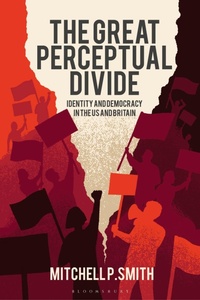
The Great Perceptual Divide
Identity and Democracy in the U.S. and Britain
Will be published approx. on 3. September 2026
Book
Paperback/Softback
272 pages
979-8-216-39490-7 (ISBN)
Description
Examines the role of identity in fostering deep perceptual divides in both American and British politics, ultimately addressing the question: how do we make sense of the divisive political landscape we find ourselves in?
We dwell in parallel universes. An identity-based gulf in perception has emerged in recent years in both the U.K and the U.S. Elements of identity involving a sense of one's place in society, of who belongs and who does not, of the role of government, and of the meaning of "freedom" all shape what individuals are willing and unwilling to believe. As these elements of identity have become more tightly bundled together, identity-based divisions have deepened, yielding the Great Perceptual Divide. In the U.S., this divide has tended to fold neatly into the gulf between the two main political parties, while in Britain Brexit has shaped the fault line between "Leavers" and "Remainers," competing identities that have endured beyond the process of exiting the European Union.
What are the consequences of this identity-driven perceptual divide? By focusing on the role of identity as a source of the political divide, this book analyzes specific dynamics such as the systematic undermining of authoritative institutions and information sources, the demand for misinformation, a perversion of political accountability, and the displacement of substantive policy debate by culture wars. The book concludes with actionable paths forward in an effort to lead society back to good-willed partisanship.
We dwell in parallel universes. An identity-based gulf in perception has emerged in recent years in both the U.K and the U.S. Elements of identity involving a sense of one's place in society, of who belongs and who does not, of the role of government, and of the meaning of "freedom" all shape what individuals are willing and unwilling to believe. As these elements of identity have become more tightly bundled together, identity-based divisions have deepened, yielding the Great Perceptual Divide. In the U.S., this divide has tended to fold neatly into the gulf between the two main political parties, while in Britain Brexit has shaped the fault line between "Leavers" and "Remainers," competing identities that have endured beyond the process of exiting the European Union.
What are the consequences of this identity-driven perceptual divide? By focusing on the role of identity as a source of the political divide, this book analyzes specific dynamics such as the systematic undermining of authoritative institutions and information sources, the demand for misinformation, a perversion of political accountability, and the displacement of substantive policy debate by culture wars. The book concludes with actionable paths forward in an effort to lead society back to good-willed partisanship.
More details
Language
English
Place of publication
New York
United States
Publishing group
Bloomsbury Publishing Plc
Target group
College/higher education
Dimensions
Height: 229 mm
Width: 152 mm
Thickness: 25 mm
Weight
454 gr
ISBN-13
979-8-216-39490-7 (9798216394907)
Copyright in bibliographic data and cover images is held by Nielsen Book Services Limited or by the publishers or by their respective licensors: all rights reserved.
Schweitzer Classification
Other editions
Additional editions
E-Book
approx. 08/2026
Bloomsbury Academic
€24.99
Available for download
E-Book
approx. 08/2026
Bloomsbury Academic
€24.99
Available for download
Person
Mitchell P. Smith is Professor and Director of the School of International Affairs at Penn State University, USA.
Content
Introduction
1. The Great Perceptual Divide
2. The Stunting of Policy Debate
3. Undermining Authoritative Institutions
4. The Demand for Misinformation
5. The Perversion of Political Accountability
6. Acknowledging the Role of Identity
1. The Great Perceptual Divide
2. The Stunting of Policy Debate
3. Undermining Authoritative Institutions
4. The Demand for Misinformation
5. The Perversion of Political Accountability
6. Acknowledging the Role of Identity