

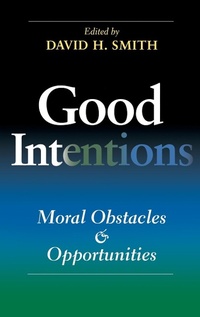
Good Intentions
Moral Obstacles and Opportunities
Published on 4. May 2005
Book
Hardback
256 pages
978-0-253-34531-8 (ISBN)
Description
It seems self-evident that giving is a good thing. But there are profound arguments against a social stress on giving, many of them couched in the language of justice. In this book, scholars from a variety of fields associated with philanthropy discuss the moral issues surrounding efforts to do good. The chapters are arranged in five parts: "Important Exemplars," "Deciding Whom to Help," "Issues for Religious Communities," "The Importance and Insufficiency of Charity," and "Retrospect and Prospect."
The contributors are David M. Craig, Elliot N. Dorff, David C. Hammack, Amy A. Kass, John Langan, S.J., Paul Pribbenow, Paul G. Schervish, David H. Smith, William M. Sullivan, Philip Turner, and Patricia H. Werhane.
The contributors are David M. Craig, Elliot N. Dorff, David C. Hammack, Amy A. Kass, John Langan, S.J., Paul Pribbenow, Paul G. Schervish, David H. Smith, William M. Sullivan, Philip Turner, and Patricia H. Werhane.
Reviews / Votes
"Besides helpful editorial material, this work includes ten papers that were presented in a seminar sponsored by the Center on Philanthropy at Indiana Univ. (part of the IU School of Liberal Arts at Indiana Univ.-Purdue Univ. Indianapolis). All of the essays address philanthropy-its definition, relationships, motives, forms, history, and precepts. Amy Kass discusses what philanthropy meant to Booker T. Washington: largely education in black self-help. What it meant to Jane Addams, Paul Pribbenow explains, is the common work of citizens. Secular standards for the morality of philanthropy are the subject of essays by Patricia Werhane and Paul Schervish, and by David Craig in the best of the essays. Religious standards for the moral aspects of philanthropy are the subject of essays by Elliot Dorff (Jewish), Philip Turner (Protestant), and John Langan (Catholic). David Hammack provides a fascinating history of American nonprofit organizations. The final essay by William Sullivan gives readers reason to worry because American inequality is increasing at the same time that effective, democratically based philanthropy is decreasing. Those who can learn much from this book include not only philanthropic givers and takers, such as foundation executives, college administrators, and church leaders, but also moral philosophers, theologians, and government officials. Summing Up: Recommended. Lower-level undergraduates and above; general readers."-J. M. Betz, Villanova University , 2006jan CHOICE"Although some readers may find certain essays more valuable to them at different times than do others, this book should be read and reflected on by all who take the subject of philanthropy seriously."-Nonprofit and Voluntary Sector Quarterly
More details
Series
Language
English
Place of publication
Bloomington, IN
United States
Target group
Professional and scholarly
Product notice
Paper over boards
Illustrations
1 index
Dimensions
Height: 240 mm
Width: 161 mm
Thickness: 19 mm
Weight
571 gr
ISBN-13
978-0-253-34531-8 (9780253345318)
Copyright in bibliographic data and cover images is held by Nielsen Book Services Limited or by the publishers or by their respective licensors: all rights reserved.
Schweitzer Classification
Person
David H. Smith is former Nelson Poynter Senior Scholar, Poynter Center for the Study of Ethics and American Institutions, and Emeritus Professor of Religious Studies at Indiana University.
Content
Contents
Introduction: Doing Good David H. Smith
I. Important Exemplars
1. The Invisible Gifts of Booker T. WashingtonAmy A. Kass
2. Common Work: Jane Addams on Citizenship and PhilanthropyPaul Pribbenow
II. Deciding Whom to Help
3. The Give and Take of PhilanthropyDavid M. Craig
4. Focused Fairness in PhilanthropyPatricia H. Werhane
III.Issues for Religious Communities
5. Nonprofits and Morals: Jewish Perspectives and Methods for Resolving Some Commonly Occurring Moral IssuesElliot N. Dorff
6. Philanthropy's Inconstant Friend, ReligionPhilip Turner
IV. The Importance and Insufficiency of Charity
7. The Sense and Sensibility of Philanthropy as a Moral Citizenship of CarePaul G. Schervish
8. Philanthropy, Charity, Subsidiarity, and Solidarity: A Basis for Understanding Philanthropy in Catholic Social TeachingJohn Langan, S. J.
V. Retrospect and Prospect
9. Donors, Intermediaries, and Beneficiaries: The Changing Moral Dynamics of American Nonprofit OrganizationsDavid C. Hammack
10. Philanthropy in QuestionWilliam M. Sullivan
Postscript: An Ongoing ConversationDavid H. Smith
Contributors
Index
Introduction: Doing Good David H. Smith
I. Important Exemplars
1. The Invisible Gifts of Booker T. WashingtonAmy A. Kass
2. Common Work: Jane Addams on Citizenship and PhilanthropyPaul Pribbenow
II. Deciding Whom to Help
3. The Give and Take of PhilanthropyDavid M. Craig
4. Focused Fairness in PhilanthropyPatricia H. Werhane
III.Issues for Religious Communities
5. Nonprofits and Morals: Jewish Perspectives and Methods for Resolving Some Commonly Occurring Moral IssuesElliot N. Dorff
6. Philanthropy's Inconstant Friend, ReligionPhilip Turner
IV. The Importance and Insufficiency of Charity
7. The Sense and Sensibility of Philanthropy as a Moral Citizenship of CarePaul G. Schervish
8. Philanthropy, Charity, Subsidiarity, and Solidarity: A Basis for Understanding Philanthropy in Catholic Social TeachingJohn Langan, S. J.
V. Retrospect and Prospect
9. Donors, Intermediaries, and Beneficiaries: The Changing Moral Dynamics of American Nonprofit OrganizationsDavid C. Hammack
10. Philanthropy in QuestionWilliam M. Sullivan
Postscript: An Ongoing ConversationDavid H. Smith
Contributors
Index