

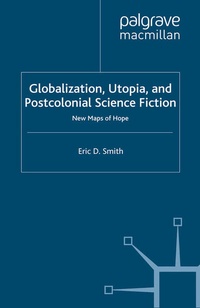
Globalization, Utopia and Postcolonial Science Fiction
New Maps of Hope
Published on 1. January 2012
Book
Paperback/Softback
VIII, 244 pages
978-1-349-34647-9 (ISBN)
Description
This study considers the recent surge of science fiction narratives from the postcolonial Third World as a utopian response to the spatial, political, and representational dilemmas that attend globalization.
Reviews / Votes
'Smith's remarkable fluency in the areas of postcolonial studies and theories of globalization and his ability to integrate the complex political-economic and philosophical discourses of his theoretical texts with provocative, insightful close readings of the fictional texts are equally impressive. This intelligent, imaginative, and sophisticated book will be an important and influential contribution to postcolonial studies, science fiction studies, contemporary literature studies, and cultural studies.' - Professor John Rieder, University of Hawai'i at M?noa, USA
More details
Edition
1st ed. 2012
Language
English
Place of publication
London
United Kingdom
Target group
Professional and scholarly
Illustrations
VIII, 244 p.
Dimensions
Height: 216 mm
Width: 140 mm
Thickness: 15 mm
Weight
327 gr
ISBN-13
978-1-349-34647-9 (9781349346479)
DOI
10.1057/9781137283573
Schweitzer Classification
Other editions
Additional editions
E-Book
09/2012
1st Edition
Palgrave Macmillan
€53.49
Available for download
Book
09/2012
Palgrave Macmillan
€53.49
Shipment within 15-20 days
Person
ERIC SMITH is Associate Professor of English at the University of Alabama in Huntsville, USA. He has published widely on Postcolonial and Modern/Postmodern British Literatures.
Content
Acknowledgments Introduction: The Desire Called Postcolonial Science Fiction "Fictions Where a Man Could Live': Worldlessness Against the Void in Salman Rushdie's Grimus 'The Only Way Out is Through': Spaces of Narrative and the Narrative of Space in Nalo Hopkinson's Midnight Robber There's No Splace Like Home: Domesticity, Difference, and the 'Long Space' of Short Fiction in Vandana Singh's The Woman Who Thought She Was a Planet Claiming the Futures That Are, or, The Cunning of History in Amitav Ghosh's The Calcutta Chromosome and Manjula Padmanabhan's Gandhi-Toxin Mob Zombies, Alien Nations, and Cities of the Undead: Monstrous Subjects and the Postmillennial Nomos in I am Legend and District 9 Third World Punks, or, Watch Out for the Worlds Behind You Conclusion: Reimagining the Material Selected Bibliography Index