

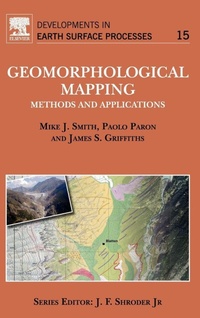
Geomorphological Mapping: Volume 15
Methods and Applications
Published on 1. November 2011
Book
Hardback
610 pages
978-0-444-53446-0 (ISBN)
Description
Geomorphological Mapping: a professional handbook of techniques and applications is a new book targeted at academics and practitioners who use, or wish to utilise, geomorphological mapping within their work. Synthesising for the first time an historical perspective to geomorphological mapping, field based and digital tools and techniques for mapping and an extensive array of case studies from academics and professionals active in the area. Those active in geomorphology, engineering geology, reinsurance, Environmental Impact Assessors, and allied areas, will find the text of immense value.
Reviews / Votes
"Geomorphological Mapping: Methods and Applications is a practical textbook that is essential reading to students and professional practitioners wishing to embark on a geomorphological project in any discipline. It is the first book of its kind, in that it brings together many topics that are normally dealt with and taught separately. These include the practicalities of completing field mapping, through to data sources and how to interrogate them and process them in a GIS. The diagrams and maps provided as examples are of a high standard. It is easily read and logically arranged, with clear co-operation between the editors and contributors." --Quaternary Science Reviews"This text explains the concepts, characteristics, makers and users of, and trends in, how modern geomorphological mapping can be applied to solve complex problems in land management, including landslide risk assessment, resource location, and changes in landforms. Following a historical overview of trends in field-based geomorphological mapping, Smith (geography, geology, and the environment, Kingston U., UK) and colleagues in the UK and the Netherlands present new digital tools and techniques, e.g., remote sensing, WebGIS, that have resulted in the use of 'non-subjective' mapping in applied research that now informs cartography, geographic information systems, and terrain analysis. The handbook includes international case studies illustrated with diagrams and color plates that exemplify the diverse applications, current limitations and potential of this methodology." --Reference and Research Book News, October 2012
More details
Series
Language
English
Place of publication
Oxford
United Kingdom
Publishing group
Elsevier Science & Technology
Target group
Professional and scholarly
Researchers and professionals in geomorphology, engineering geologists and applied geology
Product notice
Laminated cover
Dimensions
Height: 238 mm
Width: 159 mm
Thickness: 35 mm
Weight
1118 gr
ISBN-13
978-0-444-53446-0 (9780444534460)
Copyright in bibliographic data and cover images is held by Nielsen Book Services Limited or by the publishers or by their respective licensors: all rights reserved.
Schweitzer Classification
Other editions
Additional editions
E-Book
10/2011
Elsevier
€155.00
Available for download
Persons
Paolo is a Senior Lecturer at IHE Delft in the River Basin Development research group. He has more than 15 years of combined professional experience in the Humanitarian, Professional and Academic world in the areas of mapping, geology and geomorphology and remote sensing. In the last years he has been developing methods and tools for the use of UAV in hydraulic research including flood mapping as well as in ecology and soil erosion. He has worked and lived extensively in Eastern and Southern Africa with shorter assignments in Asia and East Asia, and at present he is based in Addis Ababa, Ethiopia.
Content
Section 1 - Geomorphological Mapping1. Introduction to Applied Geomorphological Mapping2. Old and New Trends in Geomorphological and Landform Mapping3. Nature and Aims of Geomorphological Mapping4. Makers and Users of Geomorphological Maps5. Geomorphological Contributions to Landslide Risk Assessment: Theory and PracticeSection 2 - Techniques in Applied Geomorphological Mapping6. Geomorphological Field Mapping7. Data Sources8. Digital Mapping: Visualisation, Iinterpretation and Quantification of Landforms9. Cartography: Design, Symbolisation and Visualisation of Geomorphological Maps10. Semi-Automated Identification and Extraction of Geomorphological Features using Digital Elevation DataSection 3 - Case Studies11. Mapping Ireland's Glaciated Continental Margin Using Marine Geophysical Data12. Submarine Geomorphology: Quantitative Methods Illustrated with the Hawaiian Volcanoes 13. Marine Geomorphology: Geomorphological Mapping and the Study of Submarine Landslides14. The Cherry Garden Landslide, Etchinghill Escarpment, Southeast England. 15. The Application of Geomorphological Mapping in the Assessment of Landslide Risk in Hong Kong16. A Geomorphological Map as a Tool for Assessing Sediment Transfer Processes in Small Catchments Prone to Debris-Flows Occurrence: A Case Study in the Bruchi Torrent (Swiss Alps)17. Geomorphological Assessment of Complex Landslide Systems Using Field Reconnaissance and Terrestrial Laser Scanning18. Digital Terrain Models From Airborne Laser Scanning for the Extraction of Natural and Anthropogenic Linear Structures19. Applied Geomorphic Mapping for Land Management in the River Murray Corridor, SE Australia20. Monitoring Braided River Change Using Terrestrial Laser Scanning and Optical Bathymeric Mapping21. Uses and Limitations of Field-Mapping of Lowland Glaciated Landscapes22. Mapping Late-Holocene Landscape Evolution and Human Impact - A Case-Study from Lower Khuzestan (SW Iran)23. Military Applied Geomorphological Mapping: Normandy Case Study24. Future Developments of Geomorphological Mapping