

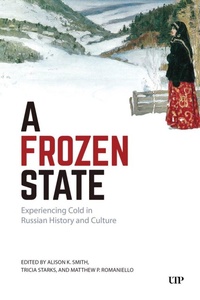
A Frozen State
Experiencing Cold in Russian History and Culture
Published on 12. May 2026
Book
Hardback
368 pages
978-1-4875-6764-4 (ISBN)
Description
Cold runs through Russian history and culture as an enemy, an opportunity, an adventure, and a metaphor. Drawing on the expertise of a broad range of scholars, this volume offers new insights into Russia's sensational history.
Early modern European travelers and thinkers found Russia's cold bewildering as something to experience and something to explain. In the nineteenth century, Russians began to reclaim the symbolism of cold, transforming it from a mark of backwardness or conservatism into a source of national pride and aesthetic beauty. It was also still feared, and cold's potential as a punishment or hardship remained through the transition into the twentieth century. Throughout, cold was also something to be mastered and exploited through Arctic expeditions and tourism, industrial development, and the conquest of natural resources in the far north.
This volume brings together a collection of essays written by historians, art historians, and literary scholars. It integrates visual sources to enliven the historical narrative and engage readers more deeply with the Russian past. Spanning the from the sixteenth to the twenty-first century, the essays offer broad chronological and thematic coverage of the significance of the cold in Russian history and culture, appealing to readers across disciplines and interests.
Early modern European travelers and thinkers found Russia's cold bewildering as something to experience and something to explain. In the nineteenth century, Russians began to reclaim the symbolism of cold, transforming it from a mark of backwardness or conservatism into a source of national pride and aesthetic beauty. It was also still feared, and cold's potential as a punishment or hardship remained through the transition into the twentieth century. Throughout, cold was also something to be mastered and exploited through Arctic expeditions and tourism, industrial development, and the conquest of natural resources in the far north.
This volume brings together a collection of essays written by historians, art historians, and literary scholars. It integrates visual sources to enliven the historical narrative and engage readers more deeply with the Russian past. Spanning the from the sixteenth to the twenty-first century, the essays offer broad chronological and thematic coverage of the significance of the cold in Russian history and culture, appealing to readers across disciplines and interests.
More details
Language
English
Place of publication
Toronto
Canada
Target group
College/higher education
Professional and scholarly
Product notice
sewn/stitched
Cloth over boards
Illustrations
29 illustrations
Dimensions
Height: 229 mm
Width: 152 mm
Thickness: 25 mm
Weight
1 gr
ISBN-13
978-1-4875-6764-4 (9781487567644)
Copyright in bibliographic data and cover images is held by Nielsen Book Services Limited or by the publishers or by their respective licensors: all rights reserved.
Schweitzer Classification
Persons
Alison K. Smith is a professor of history at the University of Toronto.
Tricia Starks is a distinguished professor of history and director of the University of Arkansas Humanities Center.
Matthew P. Romaniello is a professor and chair of history at Weber State University.
Tricia Starks is a distinguished professor of history and director of the University of Arkansas Humanities Center.
Matthew P. Romaniello is a professor and chair of history at Weber State University.
Content
List of Illustrations
Acknowledgments
Note on Transliteration and Spelling
A Frozen State: Physical, Psychological, and Cultural Resonances of Russian Cold
Alison K. Smith, Tricia Starks, and Matthew P. Romaniello
1. Was Russia Cold? Experiencing Russia's Climate in the Early Modern Era
Matthew P. Romaniello
2. No Way through the Ice: The First Russian Expeditions to Find a Northeastern Passage in the Eighteenth Century
Kristina Kuentzel-Witt
3. The Mysteries of Fatherland Geography: Siberia, Cold and Warm, in the Novels of Ivan Kalashnikov
Mark A. Soderstrom
4. The Cold Empire in the Rainforest: Russians' Survival in Lingit Aani
Michael Kraemer
5. Nature's Ice House: Frozen Mammoths and Siberian Cold
Rebecca J.H. Woods
6. Between Shivering and the Sublime: The Visuality of Cold in Late Imperial Russian Landscape Painting
Louise A. Hardiman
7. The Other Joy of the Russe: Ledianye Gory (Ice Hills) In Tsarist Russia
Alison K. Smith
8. "The cold and snow reign": Cold and Punishment in Late Imperial Russia
Sarah Badcock
9. Karelian Nature, Emotional Belonging, and the Missing Myth of the North
Tamara Polyakova
10. Golod i kholod: Hunger and Cold in Late Imperial and Early Soviet Russia
Rebecca Manley
11. Cold and Time in Yuri Rytkheu's A Dream of Polar Fog: An Ecosemiotic Approach
Katherine Bowers
12. From the Epiphany Ceremony to a New Russian Masculinity
Tricia Starks
13. Cold Ruins: Longing for the Soviet Sublime in an Arctic Circle Ghost Town
Marisa Karyl Franz
List of Contributors
Index
Acknowledgments
Note on Transliteration and Spelling
A Frozen State: Physical, Psychological, and Cultural Resonances of Russian Cold
Alison K. Smith, Tricia Starks, and Matthew P. Romaniello
1. Was Russia Cold? Experiencing Russia's Climate in the Early Modern Era
Matthew P. Romaniello
2. No Way through the Ice: The First Russian Expeditions to Find a Northeastern Passage in the Eighteenth Century
Kristina Kuentzel-Witt
3. The Mysteries of Fatherland Geography: Siberia, Cold and Warm, in the Novels of Ivan Kalashnikov
Mark A. Soderstrom
4. The Cold Empire in the Rainforest: Russians' Survival in Lingit Aani
Michael Kraemer
5. Nature's Ice House: Frozen Mammoths and Siberian Cold
Rebecca J.H. Woods
6. Between Shivering and the Sublime: The Visuality of Cold in Late Imperial Russian Landscape Painting
Louise A. Hardiman
7. The Other Joy of the Russe: Ledianye Gory (Ice Hills) In Tsarist Russia
Alison K. Smith
8. "The cold and snow reign": Cold and Punishment in Late Imperial Russia
Sarah Badcock
9. Karelian Nature, Emotional Belonging, and the Missing Myth of the North
Tamara Polyakova
10. Golod i kholod: Hunger and Cold in Late Imperial and Early Soviet Russia
Rebecca Manley
11. Cold and Time in Yuri Rytkheu's A Dream of Polar Fog: An Ecosemiotic Approach
Katherine Bowers
12. From the Epiphany Ceremony to a New Russian Masculinity
Tricia Starks
13. Cold Ruins: Longing for the Soviet Sublime in an Arctic Circle Ghost Town
Marisa Karyl Franz
List of Contributors
Index