


The First Great Awakening
Redefining Religion in British America, 1725-1775
Published on 29. August 2016
Book
Paperback/Softback
356 pages
978-1-61147-716-0 (ISBN)
Description
The First Great Awakening, an unprecedented surge in Protestant Christian revivalism in the Eighteenth Century, sparked enormous of controversy at the time and has been a source of scholarly debate ever since. Few historians have sought to write a synthetic history of the First Great Awakening, and in recent decades it has been challenged as having happened at all, being either an exaggeration or an "invention." The First Great Awakening expands the movement's geographical, theological, and sociopolitical scope. Rather than focus exclusively on the clerical elites, as earlier studies have done, it deals with them alongside ordinary people, and includes the experiences of women, African Americans, and Indians as the observers and participants they were. It challenges prevailing scholarly opinion concerning what the revivals were and what they meant to the formation of American religious identity and culture.
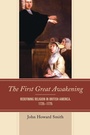
Cover image: NPG 131, George Whitefield by John Wollaston, oil on canvas, circa 1742. (c) National Portrait Gallery, London
Cover image: NPG 131, George Whitefield by John Wollaston, oil on canvas, circa 1742. (c) National Portrait Gallery, London
Reviews / Votes
Historian Smith rejects the argument that this important event in US intellectual and religious history was nothing more than the invention of the preachers of the Second Great Awakening and seeks to redefine the movement. The genesis of the Awakening, he argues, flows from German Pietism, Scots-Irish Presbyterianism, and Puritanism. Smith provides ample coverage of the major figures of the First Great Awakening-Jonathan Edwards, Gilbert Tennant, George Whitefield, and the radical James Davenport-as well as the anti-revivalist opposition of those such as Charles Chauncy. Instead of ending the Awakening in 1745, he expands it to include the southern colonies in the late 1740s and 1750s through the preaching of Baptists and Presbyterians, a revival that continued into the 1770s. Smith contends the Awakening helped plow the ground from which the American Revolution sprang. . . .[The author] includes a much broader look at 'women, African Americans, and Indians' than previous scholars have. Especially interesting is the Nativist-accommodationist struggle among Native Americans, a struggle that led to Pontiac's Rebellion. A worthwhile read for both the knowledgeable and the novice. Summing Up: Recommended. All levels/libraries. * Choice Reviews * This comprehensive synthesis of the First Great Awakening explores many facets of revivalism in mid-eighteenth century America.... The most unique and valuable contribution of this book is its characterization of radical revivalism as an essential quality of the Awakening.... Smith makes a strong case for the incorporation of radical evangelicalism into any comprehensive understanding, or redefinition, of religion in late colonial British America. * American Historical Review * John Howard Smith's The First Great Awakening stands out as a particularly lucid and reliable effort toward this new, enlarged understanding-the best to date. Smith takes into account most of the important secondary literature, which illuminates previously neglected forerunners and Revolutionary-era successors to the Whitefield-Edwards-Tennent cast of characters. . . .The book, as a whole, offers a series of important facets of the revivals, including their spread beyond white New Englanders. . . .This book shines as one of the best surveys of the Awakening in America. * Reading Religion *More details
Language
English
Place of publication
Cranbury
United States
Publishing group
Associated University Presses
Target group
College/higher education
Professional and scholarly
Dimensions
Height: 229 mm
Width: 152 mm
Thickness: 19 mm
Weight
516 gr
ISBN-13
978-1-61147-716-0 (9781611477160)
Copyright in bibliographic data and cover images is held by Nielsen Book Services Limited or by the publishers or by their respective licensors: all rights reserved.
Schweitzer Classification
Other editions
Additional editions
E-Book
12/2014
1st Edition
Fairleigh Dickinson University Press,U.S.
€56.49
Available for download
Person
John Howard Smithis associate professor of history as Texas A&M University-Commerce.
Content
Preface
Introduction: The Problem of the First Great Awakening
PART I: "No Small Appearances of a Divine Work"
Chapter 1: Vital Piety
Chapter 2: Looseness, Irreligion, and Atheism
Chapter 3: Communion-Times
Chapter 4: A Glorious Work of God's Infinite Power"
PART II: "The Late Revival of Religion"
Chapter 5: Many Thousands Flocking to Hear Him Preach the Gospel
Chapter 6: Blessed Be God That Hath Done It!
Chapter 7: Glorious Distraction
Chapter 8: Unhappy Contention
PART III: "Methinks I See Mighty Cities Rising on Every Hill"
Chapter 9: I Claim Jesus Christ to be My Right Master
Chapter 10: A Salvation from Heaven
Chapter 11: More Like True Religion than Any I Ever Observed
Chapter 12: The Seed of Dissention and Discord
Conclusion
Selected Bibliography
Index
Introduction: The Problem of the First Great Awakening
PART I: "No Small Appearances of a Divine Work"
Chapter 1: Vital Piety
Chapter 2: Looseness, Irreligion, and Atheism
Chapter 3: Communion-Times
Chapter 4: A Glorious Work of God's Infinite Power"
PART II: "The Late Revival of Religion"
Chapter 5: Many Thousands Flocking to Hear Him Preach the Gospel
Chapter 6: Blessed Be God That Hath Done It!
Chapter 7: Glorious Distraction
Chapter 8: Unhappy Contention
PART III: "Methinks I See Mighty Cities Rising on Every Hill"
Chapter 9: I Claim Jesus Christ to be My Right Master
Chapter 10: A Salvation from Heaven
Chapter 11: More Like True Religion than Any I Ever Observed
Chapter 12: The Seed of Dissention and Discord
Conclusion
Selected Bibliography
Index