

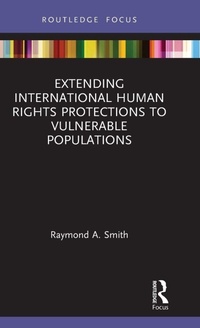
Extending International Human Rights Protections to Vulnerable Populations
1st Edition
Published on 8. October 2019
Book
Hardback
88 pages
978-0-367-22209-3 (ISBN)
Description
This book inductively develops a new typology that identifies and evaluates three principal strategies that have been, and are being, used to extend international human rights protections to new categories of vulnerable populations.
The book explicates the evolution and ongoing utility of the three strategies: categorical enlargement, conceptual expansion, and group-conscious universal application. The strategies are elucidated by case studies of nine distinct vulnerable populations: national minorities; those oppressed on the basis of caste; people with albinism; cross-cultural migrants; members of the African diaspora; Roma/Gypsies; persons affected by leprosy; older individuals; and lesbian, gay, bisexual, and transgender (LGBT) people. The book concludes by considering the utility of the three strategies for emerging vulnerable populations. It encourages discourse about the protection of vulnerable populations to move beyond a stale fixation on the texts of treaties and towards a more proactive normative framework that prioritizes the lived experiences of human beings.
Extending International Human Rights Protections to Vulnerable Populations will be of key interest to students and scholars of international human rights, to social justice advocates, to human rights practitioners, and to those working with oppressed groups, human rights law, and international relations.
The book explicates the evolution and ongoing utility of the three strategies: categorical enlargement, conceptual expansion, and group-conscious universal application. The strategies are elucidated by case studies of nine distinct vulnerable populations: national minorities; those oppressed on the basis of caste; people with albinism; cross-cultural migrants; members of the African diaspora; Roma/Gypsies; persons affected by leprosy; older individuals; and lesbian, gay, bisexual, and transgender (LGBT) people. The book concludes by considering the utility of the three strategies for emerging vulnerable populations. It encourages discourse about the protection of vulnerable populations to move beyond a stale fixation on the texts of treaties and towards a more proactive normative framework that prioritizes the lived experiences of human beings.
Extending International Human Rights Protections to Vulnerable Populations will be of key interest to students and scholars of international human rights, to social justice advocates, to human rights practitioners, and to those working with oppressed groups, human rights law, and international relations.
More details
Series
Language
English
Place of publication
London
United Kingdom
Publishing group
Taylor & Francis Ltd
Target group
College/higher education
Illustrations
2 s/w Tabellen
2 Tables, black and white
Dimensions
Height: 222 mm
Width: 145 mm
Thickness: 9 mm
Weight
268 gr
ISBN-13
978-0-367-22209-3 (9780367222093)
Copyright in bibliographic data and cover images is held by Nielsen Book Services Limited or by the publishers or by their respective licensors: all rights reserved.
Schweitzer Classification
Other editions
Additional editions
Book
09/2021
1st Edition
Routledge
€35.60
Shipment within 10-20 days
E-Book
10/2019
1st Edition
Routledge
€31.49
Available for download
E-Book
10/2019
1st Edition
Routledge
€31.49
Available for download
Person
Raymond A. Smith is an adjunct associate professor with the Center for Global Affairs at New York University (NYU) and a faculty member of the Program in Human Rights Practice at the University of Arizona, USA.
Content
Introduction 1. The Scope of Existing Protections 2. Categorical Enlargement 3. Conceptual Expansion 4. Group-Conscious Universal Application. Conclusion