

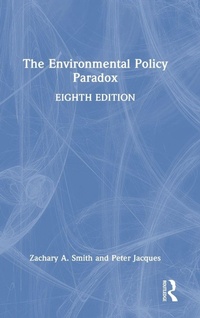
The Environmental Policy Paradox
Eighth Edition
8th Edition
Published on 29. November 2022
Book
Hardback
470 pages
978-0-367-55732-4 (ISBN)
Description
Now in its eighth edition, The Environmental Policy Paradox continues the book's tradition of offering an accessible introduction to the social, economic, legal, and political matters pertaining to environmental policy while also developing the student's own unique views. The text explains why some environmental ideas shape policy while others do not and illustrates that even when the best short- and long-term solutions to environmental problems are identified, the task of implementing these solutions is often left undone or is completed too late.
New to the eighth edition:
New topics including environmental social movements and the anti-environmental countermovements, environmental justice, corporate influence in regulatory affairs.
Analyzes the growing policy divide between the two parties, and the efforts of both Republicans and Democratic presidents to undo the policies of their predecessor.
Updated discussions of environmental justice issues.
Includes a range of visual aids in figures and tables to demonstrate trends in the topics covered.
A new co-author, Peter Jacques, recognized for his teaching and scholarship in global environmental politics and sustainability.
A must-buy for courses in Environmental Policy, Environmental Studies, and Public Policy; and as a supplement for courses in American Government and Public Administration.
New to the eighth edition:
New topics including environmental social movements and the anti-environmental countermovements, environmental justice, corporate influence in regulatory affairs.
Analyzes the growing policy divide between the two parties, and the efforts of both Republicans and Democratic presidents to undo the policies of their predecessor.
Updated discussions of environmental justice issues.
Includes a range of visual aids in figures and tables to demonstrate trends in the topics covered.
A new co-author, Peter Jacques, recognized for his teaching and scholarship in global environmental politics and sustainability.
A must-buy for courses in Environmental Policy, Environmental Studies, and Public Policy; and as a supplement for courses in American Government and Public Administration.
Reviews / Votes
The Environmental Policy Paradox by Zachary A. Smith and Peter Jacques is a very well-written, comprehensive and informative textbook on the environ- mental policy-making process in the United States. This eighth edition updates and improves the already very useful, insightful and widely-recognized textbook in order to meet the changing needs and expectations of the students. I would like to recommend The Environmental Policy Paradox to all under- graduate and post-graduate students very enthusiastically.Oktay F. Tanrisever, Chairperson, Center for Black Sea and Central Asia (KORA), Faculty Member, Department of International Relations, Middle East Technical University
This text offers a unique multidisciplinary approach to environmental policy challenges, ambitiously linking natural, socio-economic, and political systems. It introduces ecology and sustainability concepts, critically examines dominant social paradigms that contribute to environmental problems, and explores discourses and movements to effect change. The role of science and problems of politicization, fragmented political power and partisanship, corporate in?uence, and environmental injustice are key insights that help students under- stand suboptimal policies. Policy area chapters from air and water pollution to energy and land use include key national laws, the politics of their development, and ongoing regulatory con?icts and implementation issues. Global issues and cooperation are featured too.
Gina Keel, Professor of Political Science, State University of New York, Oneonta
More details
Edition
8th edition
Language
English
Place of publication
London
United Kingdom
Publishing group
Taylor & Francis Ltd
Target group
College/higher education
Undergraduate, Undergraduate Advanced, and Undergraduate Core
Illustrations
24 s/w Abbildungen, 24 s/w Zeichnungen, 10 s/w Tabellen
10 Tables, black and white; 24 Line drawings, black and white; 24 Illustrations, black and white
Dimensions
Height: 235 mm
Width: 157 mm
Thickness: 31 mm
Weight
851 gr
ISBN-13
978-0-367-55732-4 (9780367557324)
Copyright in bibliographic data and cover images is held by Nielsen Book Services Limited or by the publishers or by their respective licensors: all rights reserved.
Schweitzer Classification
Other editions
Additional editions
Book
11/2022
8th Edition
Routledge
€105.50
Shipment within 15-20 days
Zachary A. Smith | Peter Jacques
The Environmental Policy Paradox
E-Book
11/2022
8th Edition
Routledge
€96.49
Available for download
Zachary A. Smith | Peter Jacques
The Environmental Policy Paradox
E-Book
11/2022
8th Edition
Routledge
€96.49
Available for download
Previous edition
Zachary A. Smith
The Environmental Policy Paradox
Book
07/2017
7th Edition
Routledge
€237.70
Article exhausted; check for reprint
Persons
Zachary A. Smith is Regents' Professor of Environmental and Natural Resources Policy and Administration in the Department of Politics and International Affairs at Northern Arizona University.
Peter Jacques is Professor of the School of Politics, Security, and International Affairs and the National Center for Integrated Coastal Research at the University of Central Florida. His other book with Routledge is the second edition of Sustainability: The Basics.
Peter Jacques is Professor of the School of Politics, Security, and International Affairs and the National Center for Integrated Coastal Research at the University of Central Florida. His other book with Routledge is the second edition of Sustainability: The Basics.
Content
Part 1: The Policy-Making Process 1. Ecosystem Interdependence 2. Changing Cultural and Social Beliefs: From Conservation to Environmentalism 3. The Regulatory Environment 4. The Political and Institutional Setting Part 2: Environmental Policy 5. Air Pollution 6. Water 7. Energy 8. Toxic and Hazardous Materials and Waste Management 9. Land Management Issues 10. International Environmental Issues 11. International Environmental Management 12. Conclusion