

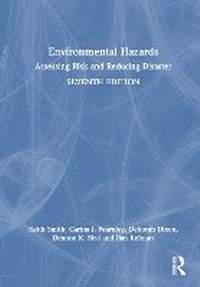
Environmental Hazards
Assessing Risk and Reducing Disaster
7th Edition
Published on 29. November 2023
Book
Hardback
660 pages
978-0-8153-6540-2 (ISBN)
Description
The seventh edition of Environmental Hazards provides a much expanded and fully up-to-date overview of all the extreme environmental events that threaten people and what they value in the 21st century globally. It integrates cutting-edge materials to provide an interdisciplinary approach to environmental hazards and their management, illustrating how natural and human systems interact to place communities of all sizes, and at all stages of economic development, at risk. Part 1 defines basic concepts of hazard, risk, vulnerability and disaster and explores the evolution of hazards theory. Part 2 employs a consistent chapter structure to demonstrate how individual hazards occur, their impacts and how the risks can be assessed and managed.
This extensively revised edition includes:
Fresh perspectives on the reliability of disaster data, disaster risk reduction, risk and disaster perception and communication, and new technologies available to assist with environmental hazard management
The addition of several new environmental hazards including landslide and avalanches, cryospheric hazards, karst and subsidence hazards, and hazards of the Anthropocene
More boxed sections with a focus on both generic issues and the lessons to be learned from a carefully selected range of up-to-date extreme events
An annotated list of key resources, including further reading and relevant websites, for all chapters
More colour diagrams and photographs, and more than 1,000 references to some of the most significant and recent published material
New exercises to assist teaching in the classroom, or self-learning
This carefully structured and balanced textbook captures the complexity and dynamism of environmental hazards and is essential reading for students across many disciplines including geography, environmental science, environmental studies and natural resources.
This extensively revised edition includes:
Fresh perspectives on the reliability of disaster data, disaster risk reduction, risk and disaster perception and communication, and new technologies available to assist with environmental hazard management
The addition of several new environmental hazards including landslide and avalanches, cryospheric hazards, karst and subsidence hazards, and hazards of the Anthropocene
More boxed sections with a focus on both generic issues and the lessons to be learned from a carefully selected range of up-to-date extreme events
An annotated list of key resources, including further reading and relevant websites, for all chapters
More colour diagrams and photographs, and more than 1,000 references to some of the most significant and recent published material
New exercises to assist teaching in the classroom, or self-learning
This carefully structured and balanced textbook captures the complexity and dynamism of environmental hazards and is essential reading for students across many disciplines including geography, environmental science, environmental studies and natural resources.
Reviews / Votes
"The 7th edition of Environmental Hazards is like having coffee with an old friend - the coffee is just better. This timely update of this classic text brings to the fold the latest in hazard, risk, and disaster risk reduction. I believe this is, and remains, an essential text for students, academics, and policy makers alike."Dewald van Niekerk, African Centre for Disaster Studies, North-West University, South Africa.
"This book provides a clear explanation of hazard and resilience typology in environmental science so that readers can completely understand the terminology and its usage. The updates of the current pandemic and "new" types of disasters are also covered, providing insights and connecting the events with the existing theory on disaster management and environmental issues. Highly recommended for undergraduates and graduates alike to have an excellent understanding on the subject on hazard, resiliency and environmental issues."
Elisabeth Rianawati, Director, Resilience Development Initiative (RDI).
"This book provides one of the most comprehensive compilations on the important topic of Environmental Hazards with cross cutting relations with disaster risk reduction. The book eloquently describes hazards, risks and its assessment and management. I find this book a great reference for the students, researchers and practitioners in the related field."
Professor Rajib Shaw, Graduate School of Media and Governance, Keio University, Japan.
"This timely new edition of a now classic text forefronts the latest perspectives on hazards and disasters without losing sight of the salient history of ideas and interventions. It is a tremendous learning resource, and an invaluable reference for anyone interested in, or involved with, disaster risk reduction."
Clive Oppenheimer, Cambridge University, UK.
More details
Edition
7th edition
Language
English
Place of publication
New York
United States
Publishing group
Taylor & Francis Inc
Target group
College/higher education
Professional and scholarly
Professional Practice & Development and Undergraduate
Illustrations
52 s/w Tabellen, 1 farbige Tabelle, 59 farbige Zeichnungen, 290 farbige Abbildungen, 231 Farbfotos bzw. farbige Rasterbilder
1 Tables, color; 52 Tables, black and white; 59 Line drawings, color; 231 Halftones, color; 290 Illustrations, color
Dimensions
Height: 246 mm
Width: 174 mm
Weight
1401 gr
ISBN-13
978-0-8153-6540-2 (9780815365402)
Copyright in bibliographic data and cover images is held by Nielsen Book Services Limited or by the publishers or by their respective licensors: all rights reserved.
Schweitzer Classification
Other editions
Additional editions
Keith Smith | Carina J. Fearnley | Deborah Dixon
Environmental Hazards
Assessing Risk and Reducing Disaster
Book
11/2023
7th Edition
Routledge
€57.50
Shipment within 15-20 days
Keith Smith | Carina J. Fearnley | Deborah Dixon
Environmental Hazards
Assessing Risk and Reducing Disaster
E-Book
11/2023
7th Edition
Routledge
€60.99
Available for download
Keith Smith | Carina J. Fearnley | Deborah Dixon
Environmental Hazards
Assessing Risk and Reducing Disaster
E-Book
11/2023
7th Edition
Routledge
€60.99
Available for download
Previous edition
Book
01/2013
6th Edition
Routledge
€267.85
Article exhausted; check for reprint
Persons
Keith Smith was Emeritus Professor at the University of Stirling, UK.
Carina J. Fearnley is Professor in Science Communication and Warning Research at University College London in the Department of Science and Technology Studies.
Deborah Dixon is Professor of Geography in the School of Geographical & Earth Sciences at the University of Glasgow, UK.
Deanne K. Bird is Adjunct Research Fellow at the Monash University Disaster Resilience Initiative, Australia, and a Research Specialist with the Nordic Centre of Excellence on Resilience and Societal Security (NORDRESS), University of Iceland.
Ilan Kelman is Professor of Disasters and Health in the Institute for Risk and Disaster Reduction and Institute for Global Health at the University College London, UK and Professor II at the University of Agder, Norway.
Carina J. Fearnley is Professor in Science Communication and Warning Research at University College London in the Department of Science and Technology Studies.
Deborah Dixon is Professor of Geography in the School of Geographical & Earth Sciences at the University of Glasgow, UK.
Deanne K. Bird is Adjunct Research Fellow at the Monash University Disaster Resilience Initiative, Australia, and a Research Specialist with the Nordic Centre of Excellence on Resilience and Societal Security (NORDRESS), University of Iceland.
Ilan Kelman is Professor of Disasters and Health in the Institute for Risk and Disaster Reduction and Institute for Global Health at the University College London, UK and Professor II at the University of Agder, Norway.
Content
Foreword by Mami Mizutori Part One: The Nature of Hazard Chapter 1 - Hazard in the Environment Chapter 2 - Dimensions of Disaster Chapter 3 - Vulnerability, Resilience, and Sustainability Chapter 4 - Risk Assessment and Management Chapter 5 - Disaster Risk Reduction Part Two: The Experience and Reduction of Hazard Chapter 6 - Earthquake hazards Chapter 7 - Volcanic hazards Chapter 8 - Tsunami hazards Chapter 9 - Mass Movements Chapter 10 - Storms Chapter 11 - Floods Chapter 12 - Drought Chapter 13 - Extreme Temperatures Chapter 14 - Wildfires Chapter 15 - Epidemic Diseases Part Three: Environmental Hazard and Risk in an Anthropocene Chapter 16 - Anthropocene Changes Chapter 17 - Industrial and Waste Hazards Chapter 18 - Climate and Beyond Chapter 19 - Using Environmental Hazards Knowledge for Action